Lively, entertaining reviews of, and essays on, old and newer films and everything relating to them, written by professional author William Schoell.
Showing posts with label Karl Malden. Show all posts

Thursday, October 1, 2020

HOTEL

Catherine Spaak and Rod Taylor
HOTEL (1967). Director: Richard Quine. Based on the novel by Arthur Hailey.

The beautiful and stately St. Gregory's hotel in New Orleans is in danger of shutting its doors forever. The owner, Warren Trent (Melvyn Douglas), is fielding two offers, the most aggressive of which comes from Curtis O'Keefe (Kevin McCarthy) who isn't above playing a few dirty tricks, such as using his girlfriend, Jeanne (Catherine Spaak), to get information from the hotel manager, Peter McDermott (Rod Taylor of The Liquidator). While this is going on there is a thief (Karl Malden) loose in the hotel, and a Count (Michael Rennie) and Countess (Merle Oberon) are being blackmailed by the house dick (Richard Conte) because they ran over a child in their expensive car. 

Kevin McCarthy and Taylor
Hotel is basically sixties schlock, devoid of deep characterization or any meaning whatsoever. At one point, when a dignified black couple is turned away at the desk of the St. Gregory according to the hotel's long-standing racist policy and their unproven fear that it will cost them clientele, it looks as if there might be something of substance to say. But everyone seems much more upset at what bad publicity will do to their coffers than their unfair and dated policy toward "Negroes." It's a case of "this is bad for the hotel" as opposed to "this is just plain bad." Peter may not be a racist but his employer definitely is.

Michael Rennie and Merle Oberon
In spite of all this, the film is smooth and mildly entertaining, with good performances. Taylor is commanding and pleasant, McCarthy and Douglas are solid pros, and Rennie and Oberon, especially the latter, nearly walk off with the movie. We never learn anything about the boy who was killed, nor do either of these privileged people ever express the slightest feeling about the child's death! Although we're supposed to believe that McDermott is a great manager, he doesn't shut down an elevator that is acting funny (resulting in the liveliest scene in the movie and undoubtedly a major lawsuit for the hotel) and seems to spend more of his time imbibing cocktails in the bar than anything else. Spaak and Malden both appeared in Cat O' Nine Tails.

Verdict: Watch Grand Hotel instead. **1/2.                                                                                                 

Thursday, January 24, 2019

GYPSY

Ann Jillian, Rosalind Russell, Karl Malden
GYPSY (1962). Director: Mervyn LeRoy.

Rose Hovick (Rosalind Russell of Auntie Mame) is the stage mother to end all stage mothers, and she pushes her daughters Louise and June into the theater whether they want to go or not. Baby June* (Morgan Brittany and Ann Jillian) fears that her mother will never let her grow up, and Louise (Diane Pace and Natalie Wood), forced to dress like a boy, fears that she has no talent and will never please her mother. Acting as their manager is Herbie Sommers (Karl Malden of Time Limit), who wants to marry Rose and tries to keep her wilder aspects in check. When circumstances remove June from the act, Rose sets her sights on Louise, who will wind up attaining stardom in a way no one would ever have anticipated.

Paul Wallace as "Tulsa" with Natalie Wood
Gypsy is one of the most successful adaptations of a hit Broadway musical. The basic material, based on the memoirs of stripper Gypsy Rose Lee, was already there, along with a fine score by composer Jule Styne and lyricist Stephen Sondheim, but the movie is bolstered by several excellent performances, especially from Russell, Malden and Wood. True, the characters are all etched in very, very broad strokes, but it doesn't detract from the enjoyability of the piece.

"You Gotta Get a Gimmick." Bruce, Dane and Arlen
Along with songs that have become standards, such as "Small World," "Everything's Coming Up Roses," "Some People," and "Let Me Entertain You," there are gems like "You'll Never Get Away From Me," and "If Mama Was Married," among others ("Together" was filmed but cut from the final release). Although he doesn't have a great voice as such, Paul Wallace makes a positive impression as Tulsa, who dances in June's act and who inspires romantic feelings in Louise. "You Gotta Get a Gimmick" is one of the zestiest numbers in the movie, sung by a spirited trio of strippers (Betty Bruce, Roxanne Arlen, and particularly Faith Dane who "bumps it with a trumpet.")

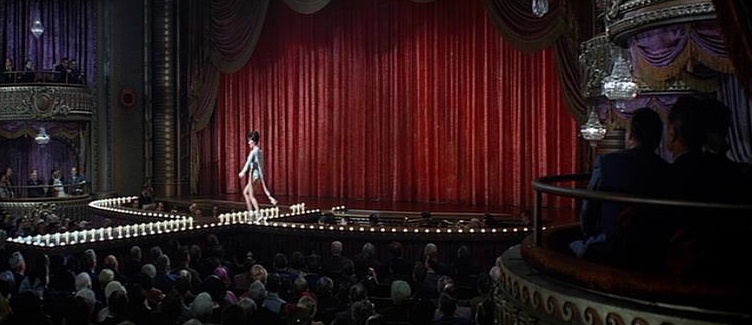
Gypsy Rose Lee struts her stuff
Although Rosalind Russell does do a little singing in this (such as the opening of "Rose's Turn"), most of her vocals were performed by Lisa Kirk (Broadway's Allegro), whose husky voice was probably chosen because it was more of a match to Russell's gravelly speaking voice. Unfortunately Kirk's singing is not especially euphonious in this, so they might just as well have let Russell handle all of it. Wood seems to do her own singing, but her off-key warbling perfectly fits her character. (The real Gypsy Rose Lee did not have much of a voice, and she was never as attractive as Natalie Wood!) Harry Stradling Sr.'s [Parrish] widescreen cinematography is a plus. Watch out for an amusing cameo by Jack Benny!

* "Baby June" grew up to become the successful actress June Havoc (not to be confused with June Haver, who married Fred MacMurray). She and her sister were estranged for many years, mostly over Gypsy, even though her depiction was not that negative. Her latter-day achievements after the events of Gypsy were completely eliminated of course. Her last theatrical film appearance was in Can't Stop the Music.

Verdict: Delightful! ***1/2. 

Thursday, April 2, 2015

PARRISH

Claudette Colbert looks at Troy Donahue with misgivings
PARRISH (1961). Writer/Producer/Director: Delmer Daves.

"If there's a death warrant for happiness, you've described it."

Ellen McLean (Claudette Colbert) gets a job as a sort of companion to Alison Post (Diane McBain), whose father, Sala (Dean Jagger), refuses to let Ellen's son, Parrish (Troy Donahue), live with them. Parrish nevertheless gets a job working Post's tobacco fields, and becomes friends with the vivacious if unsophisticated Lucy (Connie Stevens). Meanwhile Ellen finds herself drawn to the charismatic tobacco magnate, Jud Raike (Karl Malden), and Parrish soon finds himself with opportunities he may not desire, besides being in the middle of a love triangle with Lucy and Alison -- not to mention Jud's daughter, Paige (Sharon Hugueny). Parrish is a highly enjoyable light drama with some excellent performances. Although Troy Donahue is hardly in the league of the other actors, his brooding, intense quality works for the part and he even manages to do some genuine acting in certain scenes; he certainly doesn't ruin the movie as he did My Blood Runs Cold and may well have upped his game due to the influence of director Daves as well as Colbert and Malden; he proves a good listener if nothing else. Colbert gives a wonderful performance as the free-spirited mother who still has her standards; Connie Stevens and Diane McBain, one earthy, the other patrician, play with conviction; and Karl Malden, in a ferociously powerful performance, positively walks off with the picture. There is also fine work from Jagger [My Son John]; Hampton Fancher [Rome Adventure] as the slimy Edgar Raike; and Huguney as his love-happy sister, Paige. Director of Photography Harry Stradling [Suspicion] gives the picture a fairly glamorous sheen, and all of the aforementioned ladies -- and Donahue -- look stunning throughout. While nowadays the tobacco industry would be more deserving of an expose than a romance, Parrish is still a very entertaining picture. Max Steiner's insinuating musical score adds to the picture's class.

Verdict: Fine acting, interesting script, class production put this over. ***.

Thursday, July 3, 2014

WHERE THE SIDEWALK ENDS

Dana Andrews confronts Gary Merrill
WHERE THE SIDEWALK ENDS (1950). Producer/director: Otto Preminger.

Detective Mark Dixon (Dana Andrews) is a tough cop who has been warned once too often to use less force when "interviewing" suspects, but he goes too far and inadvertently kills a war hero with a plate in his head (Craig Stevens of Peter Gunn), then covers it up. As part of his investigation he meets the dead man's estranged wife, Morgan (Gene Tierney), whose father (Tom Tully) is arrested for the crime. Mark's guilt increases as he and the lovely Morgan are drawn to one another, and she worries terribly about a man whom Mark knows is innocent. Will he do the right thing? Where the Sidewalk Ends reunites the director and leads of Laura and is good enough that you don't even miss Clifton Webb. Andrews, Tierney, Gary Merrill (as a crook Mark has been trying to ensnare), and even Craig Stevens all give adept performances, and there is good support from Tully, Karl Malden and Bert Freed as cops, Eda Reiss Merin as Freed's wife, and Ruth Donnelly as a restaurant owner and friend of Mark's. More proof that Dana Andrews was an under-rated actor.

Verdict: Smooth romance-suspenser with some fine performances. ***.

Thursday, April 10, 2014

THEY KNEW WHAT THEY WANTED

Charles Laughton as Tony Patucci
THEY KNEW WHAT THEY WANTED (1940). Director: Garson Kanin.

This is the third film version of Sidney Howard's 1924 Pulitzer prize-winning play, and the only one to use his title. The story line -- later used by Frank Loesser in his brilliant musical theater piece The Most Happy Fella -- concerns a middle-aged vintner named Tony (Charles Laughton) who becomes infatuated with a pretty waitress named Amy (Carol Lombard), and asks for her hand in marriage -- but sends a photo of his younger, better-looking hired hand, Joe (William Gargan), instead of his own. When Amy arrives she's horrified to discover that the man she's been dreaming about is years older, uneducated, and rather homely, but her attraction to Joe is still there -- and vice versa ... Although you wouldn't first think of Laughton for the role of the Italian-American Tony Patucci, he's as superb as ever. Similarly, Lombard might not be considered the best casting but she is also excellent, as is Gargan [Strange Impersonation.] The biggest problem with the movie is that the production code was in effect, and there's an awful lot of moralizing and hand-wringing, and the ending is changed from happy to bittersweet [which kind of works anyway]. There's also an annoying priest, Father McKee (played by Frank Fay, who was Barbara Stanwyck's first husband), hovering over the whole movie like the literal embodiment of a censor. Tony is also a bit of an idiot, drunkenly falling off of a roof as he shows off for Amy [in the original version he is in an accident instead]. Despite its many flaws They Knew What They Wanted works because of the superior performances, good direction from Kanin, and a fine score by Alfred Newman. Karl Malden has a small role as Red. Playwright Howard did the screenplay for Dodsworth. Kanin also directed Next Time I Marry with Lucille Ball.

Verdict: Not all it could have been, but noteworthy for the acting. ***.

Thursday, September 12, 2013

FATAL VISION

Gary Cole as Jeffrey MacDonald
FATAL VISION (1984 telefilm/mini-series). Director: David Greene. Screenplay by John Gay from Joe McGinniss' book.

"They'll never come to know the beauty and wonder of the world." -- Mildred speaking of her late grandchildren.

In 1970 the Green Beret doctor, Captain Jeffrey MacDonald, made a frantic call to police claiming that four people invaded his home and slaughtered his family -- his wife and two little girls -- and left him with minor injuries. At first his wife's parents, Freddy (Karl Malden) and Mildred (Eva Marie Saint), are supportive of Jeffrey and furious that the Army suspects him of the murders, but later they learn that his story of intruders just doesn't hold up and is indeed contradicted by forensics. Leads about the alleged intruders go nowhere. Freddy sees Jeffrey on television saying things that he knows are not true, such as how he required surgery due to his injuries that night. Eventually Freddy becomes his former son-in-law's greatest nemesis, refusing to let the matter drop and dogging prosecutors until they put MacDonald on trial. Cole is a little too boyish at times, but he gives a fine performance as MacDonald, matched by an excellent Malden and Saint. Also notable are Barry Newman as MacDonald's lawyer, Andy Griffith as a prosecutor, and Mitch Ryan as a forensic pathologist. Gripping throughout its three hour running time. There are still those who insist MacDonald is innocent.

Verdict: Memorable television on a horrific true case. ***1/2.

Thursday, April 4, 2013

FEAR STRIKES OUT

FEAR STRIKES OUT (1957). Director: Robert Mulligan.

In Fear Strikes Out Anthony Perkins acts more "psycho" than in Psycho at times, but it's understandable, as he's playing a very troubled man in this drama based on a true story. Baseball player Jim Piersall (Perkins), who goes from the minors to the Boston Red Sox,  is saddled with a "sports dad" instead of a stage mother --  for his well-meaning father, John (Karl Malden), almost seems to act as if everything is happening to him. All of the stress and tension leads to neurotic episodes and a trip to a sympathetic psychiatrist (Adam Williams), although one senses Piersall's mental problems can't all be blamed on his father. Fear Strikes Out is absorbing, and Perkins gives one of his all-time best performances. Malden is also notable, as is Norma Moore as Jim's wife, Mary. Elmer Bernstein contributed a good score, although the music is somewhat overdone at times.

Verdict: Proof positive that there was more to Perkins than Psycho. ***.

Thursday, April 1, 2010

DEAD RINGER

DEAD RINGER (1964). Director: Paul Henreid. 

Edith Phillips (Bette Davis), a middle-aged bar owner in Los Angeles, attends the funeral of her sister Margaret DeLorca's (also Bette Davis) husband, the man that both women loved but whom Margaret managed to snatch away from her sister. When Edith learns that Margaret had completely made up that she was pregnant, she hatches a plot to take her place in the DeLorca mansion. But boy are there complications. It's great fun watching Davis, with her great flaring eyes, battling with herself (see photo), although in the early sequences it's obvious that it's not Davis under Margaret's black veil. Dead Ringer is entertaining and has lots of good twists. Karl Malden is a cop who loves Edith and Peter Lawford is Margaret's lover. Jean Hagen, Estelle Winwood, George Macready and Cyril Delevanti are also in the cast, and all are fine; Davis is in pretty good form as well. Andre Previn's theme music and romantic scoring are excellent. Not badly directed by Paul Henreid, Davis' leading man in Now,Voyager and Deception. The maid, Janet, is played by Monika Henreid, Paul's daughter. She was also in her father's Girls on the Loose and had about a dozen credits. Wonderfully ironic conclusion. 

Verdict: One of Davis' better latter-day movies. ***.

Wednesday, September 10, 2008

TIME LIMIT


TIME LIMIT (1957). Director: Karl Malden.

Colonel Bill Edwards (Richard Widmark, pictured, who also co-produced) leads an investigation into the charges that Major Cargill (Richard Basehart) collaborated with the enemy while a POW during the Korean War. Edwards wants to give the man a fair hearing, but he isn't helped by the fact that Cargill not only won't defend himself but seems to be hiding something. This is an excellent adaptation of a very strong play that is both intelligent, uncompromising, and compassionate, and poses a poignant moral dilemma to boot. Widmark has never been better, Basehart is wonderful, and the entire cast is top-notch: Martin Balsam as Edwards' assistant, Sgt. Baker; Dolores Michaels as his secretary, Corporal Evans; Rip Torn as Lt. Miller, one of the men who served under Cargill; June Lockhart as Cargill's wife; and especially Carl Benton Reid as General Connors, whose son died in the same POW camp where Cargill was imprisoned. This was the only film Karl Malden, who does not appear in the film, ever directed, and he does a fine job. Powerful, moving material with a peerless cast.

Verdict: Strong stuff. ***1/2.

Tuesday, March 25, 2008

DIPLOMATIC COURIER


DIPLOMATIC COURIER (1952). Director: Henry Hathaway.

With his customary assurance and suaveness, Tyrone Power plays a diplomatic courier who winds up mired in intrigue in Trieste and caught between two fascinating women, Joan (a very sexy Patricia Neal) and Janine (Hildegard Knef/Neff), both of whom have their secrets. A friend and associate of Power's is killed on a train, and various Cold War factions are after a list of secret info that, if acquired by the Americans, might save thousands of lives. Stephen McNally and Karl Malden are, respectively, a Colonel and Captain who seem ready and willing to throw Power and everyone else to the wolves. The finale has Power going against orders and attempting to save the life of one of the aforementioned ladies. This is an interesting, well-acted, fairly suspenseful spy story with great settings and a fast pace. Neal is sassy; Knef proves a fine actress and she deserved a bigger career.

Verdict: Entertaining, well-acted and unpredictable. ***.

Wednesday, March 19, 2008

ON THE WATERFRONT


ON THE WATERFRONT (1954). Director: Elia Kazan.

Terry Malloy (Marlon Brando), a once-promising boxer, is (somewhat) innocently involved in the death of a young man who dared to speak out against mob control of the waterfront union. Confused and guilty, he begins a relationship with the man's grieving sister, Edie (Eva Marie Saint). Wanting to do the right thing but not wanting to go up against the brother he loves (Rod Steiger), Terry struggles to decide whether or not to testify against crooked boss Johnny Friendly (Lee J. Cobb), knowing it may destroy his brother (who in a sense destroyed Terry's life) and himself in the process. This is a trenchant study of good versus evil -- with shades of gray -- and features many excellent performances. Brando may not be to everyone's taste, but he gives an undeniably expert performance in this. Eve Marie Saint, who was introduced in this film, is lovely and affecting and totally believable as Edie. The other cast members are also very effective, especially Pat Henning as "Kayo" Dugan. Strong, unsentimental script by Budd Schulberg (one possible flaw -- we never get to know much about the man whose death precipitates the story. Also Karl Malden's priest character, while well-played, is perhaps too stereotypically saintly to be believed.) Strikingly photographed by Boris Kaufman and expertly directed by Kazan. Interesting score by Leonard Bernstein. Brando's "I coulda been a contender" speech to his brother remains one of the best sequences in the movie. Highly influential on many subsequent movies, including Raging Bull, which is nowhere near as good.

Verdict: A masterpiece. ***1/2.

Tuesday, January 15, 2008

ALL FALL DOWN


ALL FALL DOWN (1962). Director: John Frankenheimer.

Young Clinton Willart (Brandon De Wilde) idolizes his older brother, the oddly-named Berry-Berry (Warren Beatty), until it finally comes home to him how much the older man mistreats women after a tragedy occurs. This is an interesting picture, the kind of movie that passed for “adult drama” back in the sixties, but it hasn't worn well with time. The characters aren't developed enough and we never really learn the reason for Berry-Berry's torment (although it's fairly easy to guess at, given the film is based on a novel by James Leo Herlihy and the screenplay is by William Inge); the whole business has a rather suspect psychology behind it. Angela Lansbury and Karl Malden play the parents, Annabelle and Ralph, and while both actors are good, neither of them could chalk this up as one of their more memorable performances. Beatty offers an effective performance, however, if hardly a brilliant one, and Brandon De Wilde comes off the best and most sensitive out of the major players. But the acting honors have to go to Barbara Baxley as the unnamed teacher who gives Beatty a ride and gets taken for one herself; she's just terrific. Otherwise, this just doesn't make much of an impression today.

Verdict: Only if you're curious or a real big Beatty fan. **.