Lively, entertaining reviews of, and essays on, old and newer films and everything relating to them, written by professional author William Schoell.
Showing posts with label 1942. Show all posts

Thursday, May 7, 2026

MEET THE STEWARTS

Frances Dee and William Holden
MEET THE STEWARTS (1942). Director: Alfred E. Green. 

Candy (Frances Dee of Mr. Scoutmaster) practically blackmails Michael (William Holden of Picnic) into proposing, an idea he resists because he wants to be able to support her on his own. This works out fine, because Candy's wealthy father, Mr. Goodwin (Grant Mitchell of It Happened on Fifth Avenue) has no intention of supporting his daughter once she's married. The newlyweds struggle to make ends meet, live in a house they can't quite afford, wind up in debt to a country club to which Candy thought she still belonged, and argue endlessly about finances. Will these two be able to settle their differences, or are they headed for divorce court?

Money, money, money
Meet the Stewarts is a perfectly pleasant if forgettable trifle that examines the usual problems young couples face such as finances, jealousy, meddling in-laws and the like. The film is mildly amusing, but it could have been very funny with different leads. While Dee and Holden are more-than-competent players they are not skilled comic actors -- Jack Lemmon, Cary Grant and others could have gotten more out of the frequently funny lines. A better impression is made by Grant Mitchell as the father and Anne Revere as Michael's blunt, no-nonsense sister, Geraldine. Margaret Hamilton has a few amusing moments as the maid, Willametta (as if struggling couples could afford a maid!). The film shows its age when one fellow proudly says "all wives have to be smacked around now and then." Alfred E. Green was a busy director who helmed a wide variety of pictures, including several Bette Davis films such as Dangerous

Verdict: Just nothing special in this mild comedy which at least boasts one rousing fist-fight that would not have been out of place in a cliffhanger serial. **1/2. 

Thursday, February 12, 2026

WHEN JOHNNY COMES MARCHING HOME

WHEN JOHNNY COMES MARCHING HOME (1942). Director: Charles Lamont.

War hero Johnny Kovacs (Allan Jones) is feted when he comes home on leave, but most of his musician buddies only know him as Johnny O'Rourke. Therefore when police come searching for him so he can fulfill some obligations, his pals assume he's a deserter from the army. Two women fall instantly in love with Johnny -- Joyce (Jane Frazee) and Marilyn (Gloria Jean) -- while Dusty (Peggy Ryan) can't even score with Frankie (Donald O'Connor). This has virtually no plot to speak of, but there are some well-delivered songs, such as the duets "This is It," "Romance," and "You and the Night and the Music." Jones has a very nice voice, but even in his day his style was a little too precious, and nowadays he seems just a bit hokey. Olin Howlin has a larger role than usual as a liaison, and a black dance group called the Four Step Brothers are full of verve. O'Connor is as good and as likable as ever, although his numbers with the frankly unfunny Ryan are nothing to sing about. Ryan made a better impression in Chip Off the Old Block, which starred O'Connor. Frazee was in Buck Privates and Gloria Jean in Copacabana.

Verdict: By the numbers -- but at least the numbers are good. **1/2.

Thursday, May 9, 2024

THE MAD MONSTER

George Zucco

THE MAD MONSTER (1942). Director: Sam Newfield.

"I'm not interested in your imbecilic mouthings."

Dr. Cameron (George Zucco) wants revenge on the scientific colleagues who mocked him, so he uses a formula created from wolf's blood to turn his handy man Petro (Glenn Strange) into a voracious monster complete with two fangs, a shaggy beard, and lipstick! Petro goes out to take care of Cameron's alleged enemies. Anne Nagel of The Secret Code is the doctor's daughter, Lenora, and Johnny Downs [Adventures of the Flying Cadets] plays a reporter named Tom Gregory. The film has its share of foggy atmosphere, but there's an awful lot of talking about things we already know. But the performances are good: Nagel [Black Friday] is always a pleasure, and Zucco is fun to watch no matter what the vehicle.

Verdict: Low-grade wolf man film with some limited appeal -- and Zucco! **.

Thursday, April 25, 2024

MYSTERY OF MARIE ROGET

Maria Montez as Marie Roget
MYSTERY OF MARIE ROGET (1942). Director: Phil Rosen.

Notorious actress Marie Roget (Maria Montez of Arabian Knights) goes missing in Paris, and Inspector Gobelin (Lloyd Corrigan) and the famous Dr. Dupin (Patric Knowles of Five Came Back), who solved the case of the Murders in the Rue Morgue, are called in to investigate. After a few days Marie turns up alive, and her grandmother, Cecile (Maria Ouspenkaya of Frankenstein Meets the Wolfman) suspects that Marie's stepsister, Camille (Nell O'Day) may be the subject of a devious murder plot. There is also a faceless corpse of a woman in the river. Dupin accompanies Camille to a party, but when another dead body turns up in the river it may be a surprise to everyone whose it is. Dupin, with the help/interference of the Inspector, uncovers the murderer and his motive. 

Knowles and Corrigan
Mystery of Marie Roget
 is very loosely based on the famous short story by Edgar Allan Poe, which in turn was inspired by a real murder case -- the first mystery story to do this -- although the murder occurred in New York and not in Paris. One problem with this film adaptation is that there aren't enough suspects, which include John Litel as the family lawyer, and Edward Norris as Camille's shady fiance, and even the old grandmother herself. Although the film still has some suspense in spite of this, the solution doesn't come as much of a surprise. As for the cast, Corrigan is as fun as ever, Knowles makes a credible Dupin, Ouspenkaya is suitably peppery (and borderline bitchy with the Inspector), Montez looks classy and actually gives a perfectly good performance, and Litel and Norris are on-target throughout the proceedings. The film is well-paced under Phil Rosen's direction and well-produced. Rosen directed several Charlie Chan movies and many others. 

Verdict: Not Poe perhaps, but entertaining, atmospheric, and well-made. ***.  

Thursday, March 14, 2024

MAN FROM CHEYENNE

Roy Rogers
MAN FROM CHEYENNE (1942). Director: Joseph Kane. 

Roy Rogers (Roy Rogers) has been traveling far from home in Cheyenne, Wyoming when he returns after ten years to renew old acquaintances with the likes of surrogate father Gabby Whittaker (Gabby Hayes). his daughter Sally (Sally Payne), and old crush Judy Evans (Gale Storm). He learns that some mysterious rustlers have been causing problems, and he is asked by a Cattlemen's Association to investigate as he won't be seen as a suspicious stranger. Meanwhile Roy meets up with fellow rancher Marian Hardy (Lynne Carver of Everybody Sing), who is keeping secrets, and Gabby's foreman Bob (Bob Nolan), who seems to have a hankering for Judy. 

Polite dislike: Gale Storm; Lynne Carver
Frankly, there's not much to this semi-musical modern-day cowboy film set in 1941 when it was made. However, it's pleasant enough, as are the actors and the songs. It probably won't be much of a surprise as to who's behind the gang of rustlers. Sally Payne is a homely Una Merkel lookalike, Lynne Carver needs a lot more meat on her bones, and Storm is as proficient and likable as ever. She and Carver have a catfight at one point, with Storm delivering a knock-out kayo to Carver's chin. James Seay plays Sheriff Jim, William Haade is the sinister Ed, and Jack Ingram is the rustler, Chuck. The Sons of the Pioneers play the ranch hands and do some singin'. Gabby Hayes is more bearable than usual in this. Rogers and Payne also appeared in Romance on the Range.  

Verdict: Okay time-passer with good-looking' Roy. **1/4. 

Thursday, July 20, 2023

BROOKLYN ORCHID

BROOKLYN ORCHID (1942). Director: Kurt Neumann.

Tim McGuerin (William Bendix) and Eddie Corbett (Joe Sawyer) are partners in a cab company. McGuerin is married to Sadie (Grace Bradley of The Invisible Killer), a former burlesque queen who now acts like she's To the Manor Born. Sadie can't stand Eddie's fiancee, Mabel (Florine McKinney of Beauty for Sale), who always needles her about her past. Ducking out from a party honoring the rather obnoxious pianist, Ignatz Rachkowsky (Leonid Kinskey), the two fellows try out Tim's anniversary gift of a fishing pole, and they net themselves a gal who has just tried to commit suicide. This gal, Lucy (Marjorie Woodworth), is angry that they saved her and insists that they take care of her, going so far as to try to move into the McGuerins' high-tone apartment. Tim and Eddie do their best to keep their respective ladies from finding out about Lucy, but she follows them on vacation, where she is pursued by an amorous wealthy man named Goodweek (Skeets Gallagher of The Meanest Gal in Town). Then Lucy runs into Sadie and Mabel and they all compare notes ... 

Brooklyn Orchid -- the title refers to a flower girl contest won by Lucy -- is the second of three comedies featuring Bendix and Sawyer as McGuerin and Corbett. (Brooklyn Orchid is wrongly listed as the first in some sources). The players are all game and adept at this kind of farce -- Kinskey is a riot and Jack Norton (of Fashion Model)  nearly steals the show as an inebriated music critic -- and there are a few laugh-out-loud moments, but the ultimate result is like a TV sitcom that treads overly familiar territory. As good as they are, Bendix and Sawyer are no Laurel and Hardy. 

Verdict: Some limited fun in this amiable comedy. **1/2. 

Thursday, May 25, 2023

THAT OTHER WOMAN

Virginia Gilmore and James Ellison
THAT OTHER WOMAN (1942). Director: Ray McCarey. 

Emily Borden (Virginia Gilmore of The Brotherhood of the Bell) is secretary to handsome Henry Summers (James Ellison of The Ghost Goes Wild), who seems to spend more of his time chasing women than getting work done. Knowing how she feels about her boss, Emily's grandmother (Alma Kruger of Saboteur) suggests she create an air of mystery about herself by sending Henry some mysterious letters. This all leads to busy but not terribly funny complications wherein Henry thinks this lady's gangster boyfriend wants to kill him even as Emily's sort-of fiance, Ralph (Dan Duryea) goes after him as well. Henry masquerades as the caretaker of his cabin in the woods even as he finally begins noticing Emily. But what will happen when he learns she is the architect of all of his problems? 

Henry Roquemore, Gilmore, Urecal, Ellison
That Other Woman
 is yet another mediocre James Ellison comedy. Ellison is always reasonably adept in these vehicles but the greatest comedian in the world can't triumph over an insufficient screenplay. As for the ladies, neither Gilmore nor Kruger are especially adapt at comedy. The movie does have one moment of fun, and that is when Emily and Henry check into a hotel that seems to cater strictly to the elderly and encounter the termagant manager Mrs. MacReady, with Minerva Urecal looking throughout as if she wants to kill anyone who dares to even look at her! Typical of these kind of movies, Duryea's character is treated horribly.
Gilmore did a few movies but had more credits on TV. She was married to Yul Brynner for 16 years. 

Verdict: Much running around to little effect. **. 

Thursday, February 2, 2023

THE GLASS KEY

Alan Ladd
THE GLASS KEY (1942). Director: Stuart Heisler. 

Politician Paul Madvig (Brian Donlevy), essentially a crook, is trying to clean up his reputation for re-election by going after hood Nick Varna (Joseph Calleia). Paul has formed an alliance with wealthy Ralph Henry (Moroni Olsen), and also fallen in love with Henry's daughter, Janet (Veronica Lake). Meanwhile Paul's sister, Opal (Bonita Granville), is head over heels for Janet's brother, Taylor (Richard Denning), a gambling addict with serious debts. Paul's associate and best friend, Ed Beaumont (Alan Ladd), stumbles across Taylor's dead body, and wonders if Paul, who hated Taylor and his influence over his sister, could possibly be responsible. Apparently both Opal and Janet think that he is. The truth may be a little more complicated.

Ladd and Lake
Based on the novel by Dashiell Hammett, The Glass Key is a reasonably absorbing but rather unpleasant bit of film noir. For one thing, there isn't a single really likable major character; even the hero played by Ladd is a creep. Ladd is as swell at the hardboiled routine as anyone, but he never quite comes off as a real person. He's handsome, but almost as bland and artificial as a Ken doll. Brian Donlevy is as good and forceful as ever, but it's a typically brusque and bristling Donlevy performance like he gives in virtually every movie, including The Creeping Unknown. Similarly Joseph Calleia is excellent in his very familiar gangster role. Veronica Lake has been seen to better advantage in other movies (such as I Married a Witch). 

"Let's have a drink." William Bendix with Ladd
Part of the problem is that the characters in this are mostly one-dimensional and the actors can't do enough to flesh them out. One exception is William Bendix, who honestly steals the movie as the sadistic gunsel who nearly beats Ed to death. Bendix also has a splendid scene, again with Ladd, when they sort of share a drink together as a semi-drunken Bendix tells Ladd what horrible things he's going to do to him. It's not in the script, but Bendix makes this miserable character come alive and almost makes your flesh crawl. (Why Ed would want to be anywhere near the psychopath who put him in the hospital is another question.) Before he became the lovable hero of TV's Life of Riley, Bendix frequently played distinctly malevolent characters and played them superbly.

Tramp and Dickhead: Margaret Hayes and Ladd
A tip of the hat also must go to Margaret Hayes, who briefly plays Eloise Matthews, the trampy wife of a newspaper publisher who makes a play for Ladd right in front of the man after she learns her hubby is flat broke. A true gentleman -- not -- Ladd fervently responds to her sexual entreaties. Again, even with this character being played by the pleasant and inoffensive- looking Ladd it can't disguise what an utter dickhead Ed is! Others in the cast include Frances Gifford as a friendly nurse; Donald MacBride as the easily-influenced district attorney; and Billy Benedict as an office boy. Bonita Granville does a nice job as the grieving girlfriend of the dead Denning.

Verdict: If ever a "hero" didn't deserve a happy ending! **1/4. 

Thursday, August 4, 2022

ARABIAN NIGHTS

Jon Hall and Maria Montez
ARABIAN NIGHTS (1942). Director: John Rawlins. 
 

Sentenced to a slow death for trying to usurp the throne from his brother, Kamar (Leif Erickson) escapes and holds court in the palace while the true king, Haroun (Jon Hall of The Invisible Man's Revenge), goes on the run until he can regain his rightful position. Kamar is in love with the dancer Sherazade (Maria Montez) -- a different version of the Sheherazade of legend -- but before he can find her she is sold into slavery. As Sherazade and Haroun fall in love, they escape from slave traders and other nefarious characters until Kamar at last reclaims his chosen bride. But will true love win out in the end or is Haroun doomed to die? Young Ali (Sabu) will certainly do all he can to unite the lovers. 

Hall gets some wise counsel from Sabu
Universal may not have been in the same league as MGM when it came to gloss and pageantry, but they certainly gave it the old college try with Arabian Nights. The film is often beautifully photographed (Milton R. Krasner) in positively gorgeous -- and very expensive -- technicolor with striking desert vistas and impressive matte paintings. Frank Skinner's exciting score is flavored with the occasional "Arabian" touch. Jon Hall and Leif Erickson make a fine pair of literally dueling brothers, Sabu is as appealing as ever as the young Ali, and Edgar Barrier [Phantom of the Opera] is properly loathsome as Kamar's plotting associate, Nadan. 

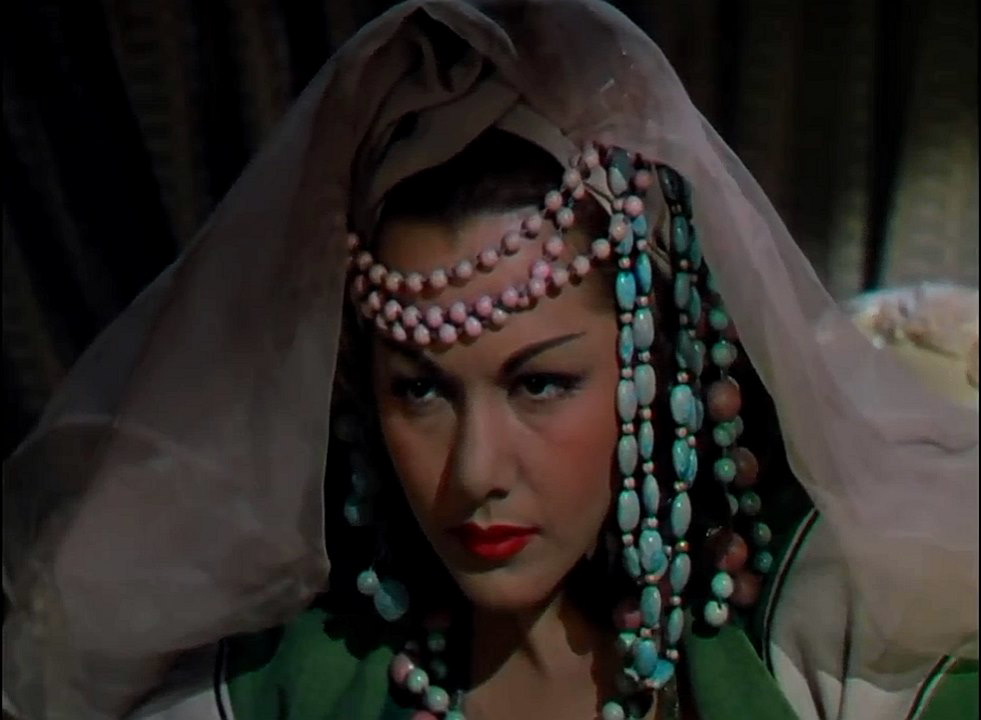
The Montez gives a smoldering look
As for Maria Montez? The movie is populated by starlets just as attractive if not more so than Montez, although she is certainly very decorative, as they say. One thing you must say about the woman is that she has a haughty, imperious authority -- possibly the way she was off-screen as well -- that works very well for her in parts like these. Her arrogance and self-confidence come through with her every line reading, which are generally on target. No, she's no Kate Hepburn, but one could hardly see Hepburn in this role (although she might have been better than one might imagine)! In other words, while no Oscar would have been in the offing for Ms. Montez, she is more than acceptable as Sherazade. 

A striking sequence from Arabian Nights
There are other characters, some from the Arabian Nights, sprinkled throughout the movie. Sinbad, presented as a lazy lout instead of as a hero, is played by Shemp Howard, one of the Three Stooges! Aladdin (John Qualen) spends the movie trying to find his famous lamp and failing. Turhan Bey is cast as a captain in the King's army who comes to a bitter fate. As Ahmed, who runs a shop, Billy Gilbert overacts atrociously. Gilbert's scenes sometimes resemble something out of Abbott and Costello. Sherazade does a very expressive and sensual dance late in the movie, but apparently that was not Montez, who could neither sing nor dance. 

Verdict: A Maria Montez movie that is actually good! ***. 

Thursday, April 28, 2022

TALES OF MANHATTAN

TALES OF MANHATTAN (1942). Director: Julien Duvuvier. 

This very entertaining film is a series of tales connected by a tailcoat that proves lucky or disastrous for whoever wears it, including an actor (Charles Boyer) who is in love with a married woman (Rita Hayworth); a man (Cesar Romero) who is about to get married and who has a jealous fiancee (Ginger Rogers) and a friend (Henry Fonda) who tries to help him; a musician (Charles Laughton) whose wife (Elsa Lanchester) gets him the tailcoat to wear on the night he conducts his symphony, to disastrous (and somewhat unlikely) results; and a down-on-his luck lawyer (Edward G. Robinson) who wears the coat to a reunion of his ivy league college buddies who have no idea of how far he's fallen. The final sequence stars Paul Robeson, Ethel Waters, and Eddie Anderson in a charming tale of poor folk (who are not exactly in Manhattan) who have to decide how to spend the money that falls out of the tailcoat. A brief but amusing sequence with W. C. Fields (appearing with Margaret Dumont!) lecturing society folk was cut out for the initial theatrical release, but has been wisely reinstated. The entire cast is good, with special honors going to Boyer, Robinson, and Fields. 

Verdict: Who knew a movie about a coat could be such fun? ***.

Thursday, March 18, 2021

WOMAN OF THE YEAR

Hepburn and Tracy
WOMAN OF THE YEAR
(1942). Director: George Stevens. 

Tess Harding (Katharine Hepburn) and Sam Craig (Spencer Tracy) are columnists for the same newspaper but don't know or care very much for each other. That changes when they actually meet and fall in love -- but can Sam deal with the fact that Tess, eventually named "Woman of the Year," is always on the go and is more celebrated than he is? Frankly, Woman of the Year, while a good and entertaining movie, sort of ducks the question of Sam's ego, making it more about Tess' lack of domesticity and maternal feelings, and despite some attempt at the end to arrive at a compromise, the movie comes off now as rather dated. For a moment it even turns into one of those "woman with amazing career will give it all up to become a devoted wifey" kind of movies. Still both of the stars, in their first pairing, are excellent, as are Fay Bainter as Tess' Aunt Ellen; Minor Watson as her father; and Edith Evanson as her maid, Alma. (Although she was frequently uncredited, Evanson had a long career, and appeared in such films as Journey to the Center of the Earth, Rope and Marnie.) Little George Kezas has a nice turn as Chris, the boy refugee, as does Sara Haden as the head of the home where he resides. Funniest scene has Kate trying to make coffee! 

Verdict: On its own 1940's terms, not bad at all, but boy what it could have been! ***.

Thursday, February 4, 2021

THE GAY SISTERS


THE GAY SISTERS
(1942). Director: Irving Rapper.

The Gaylord Sisters have been waiting 27 years for their father's will to be probated, but a stubborn businessman named Charles Barclay (George Brent) refuses to accept their settlement offer. Seems the man has a personal grudge against one of the sisters, Fiona (Barbara Stanwyck), the reason for which comes out as this highly entertaining movie progresses. The other sisters, Evelyn (Geraldine Fitzgerald) and Susie (Nancy Coleman), don't like each other very much, with a true-to-form Evelyn doing her best to steal Susie's beau, "Gig Young" (played by Gig Young, who took his screen name from this picture). Then there's that little charmer Austin, who's sort of been adopted by Fiona. But whose little boy is he really? There are very interesting twists to this very well-acted and directed drama that transcends soap opera due to Lenore Coffee's excellent script and its sheer quality. Stanwyck is excellent, as are Fitzgerald and Coleman, and a large supporting cast including Donald Woods, Donald Crisp, Anne Revere, and Grant Mitchell. Young and Brent aren't slouches, either. Certain to stimulate debate is a scene between Stanwyck and Brent that could be taken as consensual (if cynical) sex or as rape! Irving Rapper, who is in full command of the picture, also directed Deception, The Corn is Green, Now, Voyager, and many others.

Verdict: Really the kind of movie they don't make anymore. ***1/2.

Thursday, July 25, 2019

MY SISTER EILEEN (1942)

Rosalind Russell and Janet Blair
MY SISTER EILEEN (1942). Director: Alexander Hall.

Ruth Sherwood (Rosalind Russell) and her younger and prettier sister, Eileen (Janet Blair), feel that they'll get nowhere fast if they stay in small town Ohio, so the gals head for New York City with the encouragement of their grandmother (Elizabeth Patterson) and to the dismay of their father (Grant Mitchell). They manage to find an apartment in Greenwich Village, but soon discover that they're blasting for a new subway tunnel right underneath their feet. Ruth tries to sell her writing to a magazine edited by Bob Baker (Brian Aherne) while Eileen hopes to become an actress. As their money runs out they meet an assortment of characters who live in the building on Barrow Street. These include "Wreck" Loomis (Gordon Jones) and his jealous wife, Helen (Miss Jeff Donnell); the fortune teller Effie (June Havoc), who used to live in the apartment; drug store owner Frank Lippincott (Richard Quine); and slimy reporter Chic Clark (Allyn Joslyn).

Richard Quine with Blair and Russell
My Sister Eileen is based on a play by Joseph Fields and Jerome Chodorov, who also did the screenplay. The movie boasts some very adept performances and is consistently amusing and amiable. Although she was never quite the comic genius that Lucille Ball was, Rosalind Russell is still a fine actress who can not only do comedy well but can reveal the dramatic nuances under the laughs; she's wonderful. Blair is very effective as the not-so-naive Eileen, and once you get used to his blustering over-acting early on, Aherne makes a good foil for Russell. In addition to the others named above, there is also good work from Donald MacBride as a blithering cop; Chick Chandler as a friend of Effie's and an air raid warden; George Tobias as the landlord and wannabee painter, Apoppolous;.and Arnold Stang as the annoying copy boy, Jimmy. There are also the group of handsome Portuguese merchant marines who form a conga line in the village, a delightful sequence. And you must not miss the hilarious cameo by the Three Stooges!

The Fleet's In 
My Sister Eileen was turned into the Broadway musical Wonderful Town -- with a score by no less than Leonard Bernstein -- in 1953. Russell, who had already been a little old for the part in the film, and who couldn't really sing, was cast as Ruth yet again, and the show was a big hit, eventually being televised. In 1955 Columbia did a color and widescreen remake of My Sister Eileen with Janet Leigh and Batty Garrett. This was directed and co-written by Richard Quine [Sunny Side of the Street] , who plays Lippincott. To date there has been no theatrical film version of Wonderful Town, which is rarely revived.


Verdict: Fun movie with a terrific and talented cast. ***. 

Thursday, June 27, 2019

RANDOM HARVEST

When will he remember? Greer Garson and Ronald Colman
RANDOM HARVEST (1942). Director: Mervyn LeRoy.

Towards the end of WWI, an amnesiac and shell-shocked soldier named "John Smith" (Ronald Colman) is institutionalized in a small British town, but he escapes during the melee when the end of the war is announced. He meets up with a sympathetic music hall entertainer named Paula (Greer Garson), and the two eventually fall in love, get married, and have a child. But when "Smithy" goes to Liverpool for a job interview, he is struck by a taxi and his memory comes back -- he is really a wealthy man named Charles Rainier. Unfortunately, he goes back to his old life with absolutely no recollection of his wife and baby. Will Paula ever be reunited with the man she loves?

Greer Garson 
Random Harvest is based on a novel by James Hilton, and in some ways its story is just as absurd as anything in Lost Horizon. (It's not surprising the movie was spoofed on The Carol Burnett Show. For one thing, the notion that a blow to the head can both cause and cure amnesia is utterly ludicrous.) I haven't read the novel, so I'm not going to blame Hilton for any deficiencies in the screenplay, which he didn't write, but the structure of the film had to be changed from the book. In the novel the true identity of the woman Rainier marries when his memory is restored comes as a surprise.  But before I get to that, I'll examine the film itself and what it offers the viewer.

Susan Peters and Ronald Colman
Random Harvest is essentially a well-produced (MGM) soap opera with fine photography by Joseph Rutternberg, an effective score by Herbert Stothart,  and an excellent cast. Garson is splendid throughout, and Colman, although basically too old for the part, is also first-class. They are matched by Susan Peters [The Sign of the Ram] as Kitty, a young woman who falls for Charles and nearly gets him to the altar. Peters is especially great in a sequence when she looks at Charles, realizes his mind is elsewhere, and that marrying him would be a mistake for both of them. Una O'Connor, Arthur Shields, Arthur Space. Elisabeth Risdon, Reginald Owen, Alan Napier, and Philip Dorn, among others, enrich the supporting cast.

Ronald Colman
SPOILER ALERT: Stop reading if you haven't seen the picture. Random House must be taken with a grain of salt. It works beautifully on an emotional level, and has a moving conclusion, but the fact is that it is so contrived as to be nearly comical. After "Smithy" disappears, Paula tracks him down and begins to work for him under an assumed name. Years go by. Not only does he not recognize her, but he never develops any particular feelings for her. He eventually marries Paula, more as a "merger," as he puts it, than a romantic gesture, because he needs a "good wife." Three years go by during which Paula becomes the perfect hostess and loving wife, yet Charles still doesn't recognize her and still never develops any special feelings for her. Now this begs the question: since Paula is the same person she always was and has the same qualities that drew Charles to her in the first place, why on earth doesn't he fall in love with her all over again? One can argue that it was circumstances that made the difference, but come on! It isn't until he finally remembers her that he realizes he's in love with her. Or does he? (Thank goodness they avoided the cliche of him being hit on the head again.)

Verdict: Well, if you can just suspend disbelief Random Harvest has its rewards. For romantic souls only! ***. 

Thursday, April 11, 2019

PANAMA HATTIE

Ann Sothern
PANAMA HATTIE (1942). Director: Norman Z. McLeod.

Down in Panama a singing dancer named Hattie (Ann Sothern of Fast and Furious) has fallen for a wealthy Army man named Dick (Dan Dailey of It's Always Fair Weather), This is bad news for three sailors -- Red (Red Skelton), Rags (Rags Ragland) and Rowdy (Ben Blue) -- who are smitten with the gal and whom she relies on for emotional support. Hattie has some problems with her man when she meets his eight-year-old daughter and a woman named Leila Tree (Marsha Hunt of Smash Up), who is convinced she is more suitable for Dick. Reluctantly, Hattie agrees, at least for awhile ...

Virginia O'Brien with Skelton, Ragland and Blue
Based on an old Broadway show, Panama Hattie is as insubstantial as lint. The only real thing is has going for it, aside from some spirited performers, is the music, which consists of such Cole Porter tunes as "Just One of Those Things: (sung by Lena Horne) and other songs by Edens and Harburg ("Let's Be Buddies"). Sothern at least appears to be dubbed (although she could sing), but we hear the real voice of snappy Virginia O'Brien, who employs her deadpan style in some numbers ("Boy, Did I Get Stinkin' at the Club Savoy") and actually smiles during others ("I'm in Love"). Another highlight is a great dance number by a trio of talented black guys

Virginia O'Brien and Alan Mowbray
In the "slob vs snob" sub-plot, Leila is made as affected and unpleasant as possible, but Hattie really doesn't have much class. When Dick's little girl laughs, not unkindly, at Hattie's over- elaborate outfit, the adult practically calls the child a bitch! More fun is provided by O'Brien, whose character unaccountably develops a hankering for Dick's disdainful butler, amusingly played by Alan Mowbray. There is some tiresome, mildly comical business at the end when the three sailors make like lesser case Stooges, go into a haunted house, and uncover a nest of dangerous spies. Skelton delivers a tasteless gag about having his legs shot off. Ragland was in the Broadway show, wherein Ethel Merman played Hattie. Ben Blue was a comic who started in silent pictures.

Verdict: Easy to forget but with likable players and some good numbers. **1/2. 

ROMANCE ON THE RANGE

Roy Rogers
ROMANCE ON THE RANGE (1942). Director: Joseph Kane.

Roy Rogers (Roy Rogers of Arkansas Judge) is the foreman of the Arrowhead ranch. One of his buddies is murdered by poachers who are out for furs. The owner of the ranch, Joan Stuart (Linda Hayes), at first wants to hire a private detective to investigate, but instead goes out west, incognito, with her maid, Sally (Sally Payne), who has been corresponding with Roy's pal, Pat (Pat Brady), through a lonely hearts club. Pat and Sally are happy to finally meet, but Roy, not realizing that Joan is his boss, makes some tactless remarks about spoiled city women with too much money and no common sense. But meanwhile, he and his buddies have to capture the bad guys.

Linda Hayes with Roy
The trouble with Romance on the Range, a Republic Roy Rogers programmer if ever there were one,  is that there isn't much romance and most of the picture consists of fairly dull horse chases and shoot-outs that are not done nearly as well as in the classic Republic serials. Rogers gets by, as usual, on his looks and charm, and he doesn't have a bad voice when he warbles some unmemorable country ditties with the Sons of the Pioneers.  Linda Hayes appeared in a couple of "Mexican Spitfire" movies and did a number of westerns; this was her penultimate feature. Sally Payne amassed 57 mostly minor credits.

Gabby Hayes 
Pat Brady basically played himself in 73 movies and TV shows, most if not all with Roy Rogers. Ditto for Bob Nolan. Edward Pawley [Thirteen Women] plays the head bad guy, Jerome Banning, in this, and serial specialist Roy Barcroft is also in the cast. And we mustn't forget -- although we should certainly try to -- Gabby Hayes [From Broadway to Cheyenne], Rogers' grizzled, old and somewhat misogynous sidekick whose antics have not worn well with time. He did manage to get one -- only one -- laugh out of me, however. Romance on the Range is a "modern-day" western -- it does not take place during the days of the Wild West.

Verdict: Not much to this cheap oater but Rogers is always pleasant. *1/2. 

Thursday, November 8, 2018

JOHNNY DOUGHBOY

Jane Withers
JOHNNY DOUGHBOY (1942). Director: John H. Auer.

16-year-old Ann Winters (Jane Withers) is sick and tired of playing 12-year-olds in her movies, and runs off to be a woman. She winds up staying at the home of playwright Oliver Lawrence (Henry Wilcoxon of Cleopatra), and gets the wrong idea about his feelings for her. Meanwhile Penelope Ryan (also Jane Withers), the winner of an Ann Winters lookalike contest, comes to visit Ann and is importuned to temporarily replace her by Ann's manager, Harry (Willam Demarest). A group of has-been child actors, played mostly by, well, has-been child actors, want the real Ann to take part in a show they want to do for soldiers; they've been told that they can only go on if a "real" star also participates. Penelope tries to appeal to the spoiled Ann's better nature to get her to do the show, but it may be a losing battle.

Alfalfa, Jack Boyle Jr, and Spanky McFarland
Johnny Doughboy was one of several pictures Jane Withers did for Republic studios as a teen lead when her long run as a child star was over. Nowadays most baby boomers remember Withers, who is still alive, as Josephine the Plumber in many commercials for Comet cleanser (which is also still around), while she may be completely unknown to younger people (aside from film buffs), especially Millennials. Johnny Doughboy is a pleasant minor musical with some snappy tunes in it, including "Baby's a Big Girl Now;" "You Better Not (With Somebody Else);" and "A Guy Like I." An amusing but also strangely sobering number, "All Through," has several former child stars, including Bobby Breen, Baby Sandy, Spanky and Alfalfa, essentially singing about how they're washed up in Hollywood, a song with built-in pathos when you consider the fate of some of these young actors. (Actually Carl "Alfalfa" Switzer was not washed up, appearing in a few Gas House Kids comedies as well as other movies and shows for several years afterward.)

Carl "Alfalfa" Switzer does his singing routine
Three other cast members of Johnny Doughboy are of note. Jack Boyle Jr. (billed as "Patrick Brook") makes an impression as the handsome singing actor Johnny Kelley and does a great dance routine with Withers, but he had very few credits. Ruth Donnelly [The Family Next Door] is as adroitly acerbic as ever as Miss Biggsworth, who looks after Ann; and Etta McDaniel, sister of the more famous Hattie, is amiable as Oliver Lawrence's housekeeper, Mammy.  "Alfalfa" reprises his funny tone-deaf singing routines from Little Rascals.

Verdict: Another amiable Republic musical. **1/2. 

Thursday, June 7, 2018

FRECKLES COMES HOME

Mantan Moreland and Laurence Criner
FRECKLES COMES HOME (1942). Director: Jean Yarbrough.

Summoned by his old pal Danny (Marvin Stephens of Borrowing Trouble), "Freckles" Winslow (Johnny Downs) comes back to Fairfield, Indiana, accompanied on the bus by a stranger named Muggsy Dolan (Water Sande of Blonde Ice). Muggsy pulled off a bank robbery in which a guard was killed, and has taken it on the lam, figuring quiet, isolated Fairfield is as good a place to hide out as any. He gets it into his head to rob the bank and brings in an associate, Quigley (Bradley Page). Danny lost money that he needed to pay bills for his hotel by buying an alleged gold-finding machine, and wants Freckles' help in using old girlfriend Jane Potter (Gale Storm) to convince her banker father, Hiram Potter (John Ince), to build a new highway into town, increasing business. Freckles is irritated because Jane seems to go for Quigley's oily charm. Meanwhile hotel porter Jeff (Mantan Moreland) has fun trying to convince Quigley's chauffeur, Roxbury (Lawrence Criner), to buy his phony machine. Freckles Comes Home has an amiable cast, including Betty Blythe [The Spanish Cape Mystery] as Hiram's wife and Irving Bacon as the ditsy town constable, but the picture is completely stolen by Moreland and Criner, especially in a very funny sequence when the two argue over which of them is to get the more comfortable bed in their hotel room. These are two great comic actors in their prime. Otherwise this is a typical Monogram quickie. Apparently this has nothing to do with the old Freckles newspaper comic strip.

Verdict: Short Monogram flick is fairly easy to take. **3/4.

Thursday, May 10, 2018

HATTER'S CASTLE

James Mason
HATTER'S CASTLE (aka A, J. Cronin's Hatter's Castle/1942). Director: Lance Comfort.

James Brodie (Robert Newton of Obsession) owns a hat shop in a small British township and not only has pretensions but an alleged connection to the peerage. The huge house he has built and can hardly afford to keep is called "Hatter's Castle" by the townspeople. Brodie takes out his anger on his dying wife (Beatrice Varley) and pretty daughter, Mary (Deborah Kerr of The Night of the Iguana), but reserves his only affection for his young son, Angus (Tony Bateman), on whom he pins his hopes. The hypocritical Brodie turns his daughter out when she becomes pregnant by his slimy clerk, Dennis (Emlyn Williams), but keeps a mistress, Nancy (Enid Stamp-Taylor), in town, whom he later hires as his housekeeper! This is Newton's picture -- James Mason [Caught] has a relatively small role as a doctor who ministers to Mrs. Brodie and falls in love with Mary despite everything that happens. Mason is excellent, as is everyone else in the cast, with Newton giving an especially strong and flavorful performance (although one could argue that at times Newton threatens to turn into a caricature of a palm-rubbing silent movie villain  -- and the movie certainly has elements of silent melodrama). Based on a novel by A. J. Cronin, Hatter's Castle is an absorbing film full of dramatic and moving incident; it moves fast and plays very well.

Verdict: Superior British melodrama with a gripping Newton, lovely Kerr and stalwart Mason. ***.

Thursday, March 1, 2018

PRIVATE BUCKEROO

Maxene, Patti and LaVerne Andrews
PRIVATE BUCKEROO (1942). Director: Edward F. Cline.

When band leader Harry James, playing himself, is drafted, his singer Lon Prentice (Dick Foran), decides to enlist. His sergeant is "Muggsy" Shavel (Shemp Howard of the Three Stooges), who is engaged to Bonnie (Mary Wickes), who finds herself drawn to another singer and comic, Biff (Joe E. Lewis). Lon finds himself on the outs with his fellow soldiers because he requests and (inexplicably) receives special privileges, which doesn't help when he tries to romance Joyce (Jennifer Holt). Meanwhile the top-billed Andrews Sisters perform both in James' nightclub and on the base, wouldn't you know? Private Buckeroo, which is the name of a song warbled by Foran, is modestly entertaining, without much of a plot, but it has its charms, chief among them the Andrews Sisters performing "Tell It to the Marines" and "Don't Sit Under the Apple Tree." There is also a nifty dance number done by a bunch of talented teenagers, and Dick Foran delivers a fine rendition of "Nobody Knows the Troubles I've Seen." Shemp Howard and Mary Wickes make a winning combo; Dick Foran [Violent Road], who started out as a band singer and eventually became an excellent dramatic actor, has a very nice baritone; and Susan Levine makes an adorable "Tagalong," Joyce's little sister. Donald O'Connor, Peggy Ryan, and Huntz Hall have smaller roles. Harry James plays a mean trumpet, but he proves not to be much of an actor. This is a rare opportunity to see the real singer-comedian Joe E. Lewis, who was played by Frank Sinatra (who looked nothing like Lewis) in The Joker is Wild. Lewis is rather amusing in this as he squares off with rival Shemp Howard.

Verdict: More than passable patriotic Universal musical. **1/2.