Lively, entertaining reviews of, and essays on, old and newer films and everything relating to them, written by professional author William Schoell.
Showing posts with label comedy-mystery. Show all posts

Thursday, March 2, 2023

SLEUTH (1972)

Lawrence Olivier and Michael Caine
SLEUTH (1972). Director: Joseph L. Mankiewicz. Screenplay by Anthony Shaffer from his play.

"Sex is the game; marriage the penalty." -- Andrew

"You are the complete clown." -- ditto

Mystery writer Andrew Wyke (Lawrence Olivier) receives a visitor at his country estate: Milo Tindle (Michael Caine), who owns his own hairdressing salon and happens to be the lover of Wyke's wife. Milo is hoping that Andrew will agree to give his wife a divorce, but Andrew has other plans. He wants Milo to steal some of his wife's jewelry -- Milo can sell the jewels and have enough money to keep his lover in style, and Andrew will get a huge insurance pay-out. But Andrew may have a more sinister scheme in mind than insurance fraud. It isn't too long before Inspector Doppler comes a calling ... 

Inspector Doppler deals with Andrew
Based on Anthony Shaffer's stage play, this is a twisty mystery-thriller that provides two good actors with some juicy roles and real opportunities for scene-stealing. While Caine is marvelous, Olivier is outstanding, putting on a thespian show of grand proportions. That's what makes the film entertaining even if you've seen it before and remember the plot twists (although it's a bit more fun when you're seeing it for the first time). The film is overlong at over two hours, and I confess this business at the very end with police showing up out of nowhere makes little sense, but the movie is certainly worth one look. The play is intelligently opened up by Shaffer, and Mankiewicz's direction is inobtrusive and keeps things moving. The picture is quite amusing until things get serious -- and even afterward. 

Verdict: Perhaps not nearly as wonderful as people remember -- even back then one of the twists seemed obvious -- but memorable in spite of it. ***. 

Thursday, August 16, 2018

FAST AND FURIOUS

Ann Sothern and Franchot Tone
FAST AND FURIOUS (1939). Director: Busby Berkeley.

When Gerda Sloane (Ann Sothern), the wife of bookseller and amateur sleuth Joel Sloane (Franchot Tone), is told by him that the two are taking a vacation, she doesn't know that he's put money in a bathing beauty contest occurring in the resort town of Seaside City (read: Atlantic City). As Gerda runs interference for the occasionally amorous beauties, Joel investigates the murder of the contest's promoter, Eric Bartell (John Miljan). The suspects include his girlfriend, Lily (Ruth Hussey of The Uninvited); his other girlfriend, Jerry (Mary Beth Hughes of Men On Her Mind); Sloane's old friend, Mike Stevens (Lee Bowman of Up in Mabel's Room); and others. Fast and Furious was the debut and apparently the one and only entry in this bid for an aborted mystery series a la The Thin Man, but it's mediocre enough that there were never any sequels. Sothern and Tone make good leads -- Tone is somewhat better and has more aplomb at this than his co-star does -- but even Tone, good as he is, can't compete with William Powell. The business about a wife getting all hot and bothered because her husband is judging a beauty contest was to be repeated ad nauseum in various movies and TV shows, and had probably been done even before 1939. Harry Kurnitz' script has few laughs aside from a very funny bit involving some lions, and there is at least one very suspenseful scene when our couple are caught underneath a descending stage elevator, nearly crushing them. Otherwise, this is forgettable.

Verdict: Not one of the classics of 1939. **.

Thursday, December 7, 2017

THE HAT BOX MYSTERY

Allen Jenkins, Virginia Sale, Pamela Blake, Tom Neal
THE HAT BOX MYSTERY (1947). Director: Lambert Hillyer.

Russ Ashton (Tom Neal of Detour) isn't doing too well as a private investigator, but he has an assistant-fiancee named Susan (Pamela Blake of Highway 13) and another associate named 'Harvard" (Allen Jenkins). The three of them are kept in hamburgers by Harvard's restaurant-owning girlfriend, Veronica (Virginia Sale of Those We Love), who also loans Russ money to go to Washington on a case. Meanwhile Susan takes an assignment herself, to photograph a straying wife as she exits a building for her husband (Leonard Penn) to use in a divorce case. The husband supposedly conceals a camera in a hat box for Susan to use, but she winds up shooting the woman for real -- as it's actually a gun that is hidden in the hat box! Susan finds herself in pretty hot water with the police, while the "husband" disappears ... The Hat Box Mystery is mediocre filler with a mystery that poses no threat to Agatha Christie but it does benefit from the enthusiastic playing of the main quartet of actors -- Sale is especially appealing in this.

Verdict: At least it's only 44 minutes long! **.

Thursday, November 2, 2017

FINGERS AT THE WINDOW

Laraine Day and Lew Ayres
FINGERS AT THE WINDOW (1942). Director: Charles Lederer.

In Chicago a series of seemingly unrelated individuals are slaughtered by an ax, and each time the killer is a different person. Actor Oliver Duffy (Lew Ayres) sees Edwina Brown (Laraine Day) being followed one night and comes to her rescue, determining that someone is definitely out to get her. Edwina, who doesn't seem very bright, scarcely seems to understand that someone wants to behead her. As the police focus in on Oliver himself as the killer, he tries to pin down the true architect behind the gruesome murders. If there is one major problem with Fingers at the Window, which has a splendid premise, it's the dopey character of Edwina, who seems half-demented throughout most of the movie. We are also clued in as to the identity of the mastermind very early on, although it must be said that for once he is given a motive that makes absolutely perfect sense. The conclusion is also suspenseful. Ayres [Johnny Belinda] and Day [And One Was Beautiful] are too "cutesy" by far, and the picture is stolen by an excellent Basil Rathbone [The Black Sleep] as Dr. Santelle.

Verdict: Creepy idea sort of frittered away but it has its good points and a great Rathbone. **1/2.

BURY ME DEAD

June Lockhart and Hugh Beaumont
BURY ME DEAD (1947), Director: Bernard Vorhaus.

"I'm sorry you're alive -- I wish you were dead."

Barbara Carlin (June Lockhart) is supposedly burned to death in a barn fire, but she shows up alive and well at her own funeral. Now she and her husband, Rod (Mark Daniels), have to figure out which woman's body is actually buried in Barbara's grave, and whether it was Barbara or this unknown woman who was the killer's target. Suspects include Barbara's neurotic and hateful sister, Rusty (Cathy O'Donnell); Barbara's boxing paramour George (Greg McClure); Rod's girlfriend, Helen (Sonia Darrin); Barbara's lawyer, Michael (Hugh Beaumont); or even the butler (Milton Parsons). Bury Me Dead is one of PRC's better movies, with a neat premise, plenty of plot twists, and interesting characters and performances. The main problem with the movie is that it mixes far too much foolish domestic comedy in with the suspense. Lockhart makes a good heroine, and Mark Daniels [The Invisible Avenger], a handsome and pleasant leading man with charm to spare, deserved a much bigger career. Cathy O'Donnell [Ben-Hur] certainly makes her mark as the nearly-demented Rusty, and Hugh Beaumont's work is on the money as well. McClure [Sky Liner] is fine as the boxer who seems at least one bulb short of a chandelier. The picture consists mostly of flashbacks, and there's a brief if fairly exciting "cat fight" between Lockhart and Darrin. Vorhaus also directed So Young, So Bad with Paul Henreid.

Verdict: PRC nearly presents a real winner. ***.

THE BLACK RAVEN

Old pros: Charles Middleton; George Zucco
THE BLACK RAVEN (1943). Director: Sam Newfield.

"He's suffering from rabid delusions aggravated by a moronic mentality." -- Amos.

Amos Bradford (George Zucco), once known as the criminal the Raven, now runs an inn called The Black Raven. On a dark and stormy night he gets a variety of guests, many of whom have some ulterior purpose. Mousy Horace (Byron Foulger) is running away with $50,000 in embezzled money. Winfield (Robert Middlemass) is a crooked political boss whose daughter, Lee (Wanda McKay), wants to run off with the man she loves, Alan (Robert Livingstone of Borrowed Wives). Mike Bardoni (Noel Madison) is another crook, and Whitey Cole (I. Stanford Jolley) is an escaped con who's out to get vengeance on Amos. When someone gets murdered -- the first death of several -- the Sheriff ("Charlie" Middleton) is called in and matches wits with the acerbic Amos. While it's fun watching Zucco and Middleton working together, The Black Raven is a forgettable picture. Glenn Strange, who played Frankenstein, is cast as the half-wit handyman Andy, and is fine. Zucco [Fog Island], Middleton [Charlie Chan's Murder Cruise] and Foulger are also excellent.

Verdict: Another cheap PRC timepasser. **.

Thursday, October 19, 2017

ELLERY QUEEN AND THE MURDER RING

Blanche Yurka and Ralph Bellamy
ELLERY QUEEN AND THE MURDER RING (1941). Director: James P. Hogan.

Augusta Stack (Blanche Yurka) is a nasty old lady who runs a hospital, senses chicanery everywhere, and treats her own children like crap. We learn early on that son John (Leon Ames) is plotting murder with the help of two bumbling confederates. But when the termagant kicks off, are the conspirators actually responsible for her death? Then there are more murders. Writer/amateur sleuth Ellery Queen (Ralph Bellamy) investigates with the help of his cop father, Inspector Queen (Charlie Grapewin), and Ellery's secretary, Nikki (Margaret Lindsay). Ellery has a very condescending attitude toward Nikki, who also seems to be his girlfriend, but she also seems a lot smarter than he is. Notable cast members include George Zucco [The Mad Monster] as a doctor suspected of assorted bad things; James Burke as a cop; Olin Howland (Howlin) as another, rather merry doctor; and especially Mona Barrie [King of Burlesque] in a vivid turn as nurse Marian Tracy, who is involved with John. Dennis Moore has a small role as another doctor, and wouldn't you know Pierre Watkin shows up as lawyer Crothers and is as bland and minor as ever. The basic plot is workable, but there is too much unfunny "comedy" relief surrounding the hit men, and the movie becomes fairly tedious before too long. Characterization is minimal; there's no attempt to explain why Mrs. Stack has such a bad relationship with her children, for instance. The Spanish Cape Mystery, with Donald Cook playing Ellery Queen, was better than this. This was Bellamy's last appearance as Queen.

Verdict: Some people like this picture; they're welcome to it. *1/2.

Thursday, July 20, 2017

MANHATTAN MURDER MYSTERY

Woody Allen
MANHATTAN MURDER MYSTERY (1993). Director: Woody Allen. Screenplay by Allen and Marshall Brickman.

Carol Lipton (Diane Keaton) is convinced that an older neighbor, Paul House (Jerry Adler), murdered his wife, who supposedly died of a heart attack. Carol's husband, Larry (Woody Allen), thinks she's nuts, but their divorced friend, Ted (Alan Alda of Same Time, Next Year), thinks she may be on to something. When Carol and Ted team up to track down House's possible girlfriend, Larry is afraid something may be developing between the two. A book editor, Larry convinces one of his authors, Marcia Fox (Anjelica Huston), to go on a date with Ted, but then Carol gets jealous when Marcia gets involved in solving the mystery ... Manhattan Murder Mystery is obviously a homage to those comedy-mystery films of the forties with the plucky heroine determined to get to the bottom of a case, and it's an entertaining, well-acted picture, even if Allen and Keaton aren't exactly William Powell and Myrna Loy. Leisurely-paced, and longer than some of his dramas, the movie keeps introducing enough perplexing elements to keep the viewer in suspense. I do wish the picture didn't ape the final sequence of the far superior The Lady from Shanghai, which is playing in a theater where the climax takes place. Carol and Larry make a likable couple with a basically warm relationship. Melanie Norris, Lynn Cohen, Marge Redmond, Joy Behar, and Ron Rifkin have smaller roles and are fine. The credit music is Cole Porter's marvelous "I Happen to Like New York," sung by Bobby Short.

Verdict: I liked this a lot more than the more "serious" Manhattan. ***.

Thursday, June 15, 2017

HAUNTED HOUSE

Jackie Moran
HAUNTED HOUSE (1940). Director: Robert F. McGowan.

In a small town a handyman named Olaf (Christian Rub) is on trial for murder. A young aspiring reporter named Jimmy (Jackie Moran) believes in Olaf's innocence but has absolutely no evidence to back this up. Into town comes Mildred Henshaw (Marcia Mae Jones), who is the daughter of Albert Henshaw (George Cleveland of Pillow of Death), the editor of the paper. Jimmy and Millie are immediately attracted to one another, and set out to find out who actually murdered Olaf's elderly employer. The two young people prove to be very lousy detectives, but they sort of stumble into a solution. There is no actual Haunted House in Haunted House, only the now-deserted domicile of the murdered woman. Moran [Let's Go Collegiate] is charming, full of that breathless boyishness so typical of the period, and Jones is fine, with some good supporting actors helping things along. Clarence Wilson and Mary Carr [The Sea Fiend] are notable as, respectively, the gas station owner named Eph, and the old lady everyone calls "Grandma."

Verdict: Minor if smooth Monogram filler. **1/2.

Thursday, May 18, 2017

MR. MOTO'S GAMBLE

Mr. Moto meets Lee Chan, Charlie Chan's son
MR. MOTO'S GAMBLE (1938). Director: James Tinling.

Mr. Moto (Peter Lorre) is teaching a course in criminology and his students include the punch-drunk "Knock-Out" Wellington (Maxie Rosenbloom of Mr. Universe) and Charlie Chan's son, Lee (Keye Luke) -- temporarily moving from one mystery series to another -- who wants to follow in his father's footsteps. These last two serve as comedy relief -- Rosenbloom instead of Mantan Moreland -- in a tiresome tale of a boxer, Frankie Stanton (Russ Clark), who is murdered in the ring during a battle. The surviving boxer, Bill Steele (Dick Baldwin), has two women fighting over him: the plucky sports reporter Penny (Lynn Bari of City in Darkness); and spoiled society gal, Linda Benton (Jayne Regan), who is sort of a groupie for boxers, dumping them whenever they lose. Suspects include not only those already mentioned, but also Clipper McCoy (Bernard Nedell); Nick Crowder (Douglas Fowley); Connors (George E. Stone, on vacation from playing the Runt in the Boston Blackie movies); nasty boxer Biff Moran (Ward Bond of Blowing Wild); and Linda's father (John Hamilton), whose racket is the fight game. Lon Chaney Jr. has a small role; Pierre Watkin plays another of his seemingly endless bland authority figures; Harold Huber is Lt. Riggs; and Irving Bacon almost runs off with the movie in his funny portrayal of Sheriff Tuttle. The comedy relief in this is quite stupid for the most part, and the script is mediocre, but at least it has a fast pace and a slightly surprising ending. With this third entry the Mr. Moto series took a real dip in quality, adding Lee Chan and the moronic Rosenbloom to make it more resemble the Chan series, but even the weakest Chan entry had a more interesting screenplay. Lorre is as terrific as ever. Mr. Moto apparently knows Charlie Chan, at least by reputation, but the two characters, I believe, never appeared together -- too bad.

Verdict: A vehicle unworthy of both Peter Lorre and Mr. Moto. *1/2.

THE LONE WOLF MEETS A LADY

Warren William as Michael Lanyard, the Lone Wolf
THE LONE WOLF MEETS A LADY (1940). Director: Sidney Salkow.

"Jamison! Open the window -- and air the room!"

Joan Bradley (Jean Muir) is all set to marry wealthy Bob Penyon (Warren Hull), when her future mother-in-law (Georgia Caine) lends her an expensive diamond necklace. At her apartment Joan is confronted by an old acquaintance who demands the necklace before being promptly shot by an unseen figure; the necklace disappears. Before long Michael Lanyard, aka the Lone Wolf (Warren William), is involved in the case even as Inspector Crane (Thurston Hall), who loves rare plants, is on the trail of both Lanyard and Joan. The Lone Wolf Meets a Lady is distinguished primarily by the acting, with William, as usual, doing splendidly as the title character. Jean Muir [And One Was Beautiful] is on the money as Joan; Hall makes a terrific inspector; Fred Kelsey is funny as the bumbling cop, Dickens; Victor Jory [Manfish] scores as a sleazy "associate" of Lanyard's; and Eric Blore [Swiss Miss] nearly steals the picture as Jamison, Lanyard's butler and aide. The screenplay isn't terrible, with good dialogue, but The Lone Wolf Meets a Lady is no great shakes as a mystery. Not to be confused with The Lone Wolf and His Lady.

Verdict: Modestly entertaining with some very good performances. **1/2.

PHILO VANCE RETURNS

cop vs private eye: Eddie Dunn and William Wright
PHILO VANCE RETURNS (1947). Director: William Beaudine. 

"Mrs. Simns is a neurotic -- an advanced case."

Larry Blendon (Damian O'Flynn) has already had four wives and a girlfriend, but he is smitten again when he meets singer Virginia Berneaux (Ramsay Ames). Unfortunately, Virginia is shot to death not long after being introduced to Larry's grandmother, Stella (Clara Blandick), then Larry himself is found dead. Larry's friend, detective Philo Vance (William Wright) teams up with Virginia's former manager, Alexis Karnoff (Leon Belasco), to look up these former wives -- and the fan dancer Choo Choo (Iris Adrian) -- all of whom were unaccountably mentioned in Larry's will (what, no divorce settlements?). There are more murders, usually involving women who put on a lipstick that's been poisoned. Frank Wilcox [The Devils Mask] is lawyer George Hullman, and Eddie Dunn [A Fig Leaf for Eve] is police lieutenant Mullard, who often finds Vance underfoot and doesn't like it. This one had possibilities in its characters and plot, but it's a minor PRC (Producer's Releasing Corporation) production, which puts it on an even lower level than Monogram. Still, Wright [Reveille with Beverly] is okay as Vance, and most of the performances are at least competent. Albert Glasser did the score.   

Verdict: Standard series mystery with some interesting elements. **

PHILO VANCE'S SECRET MISSION

Alan Curtis and Sheila Ryan
PHILO VANCE'S SECRET MISSION (1947). Director: Reginald Le Borg.

Martin Jamison (Paul Maxey of The Sky Dragon), a publisher of lurid horror and mystery pulp magazines, wants to hire Philo Vance (Alan Curtis) to write a story based on a real-life murder case. The victim was the husband of widowed Elizabeth Phillips (Tala Birell), who is working for Jamison and faints when she discovers Vance will be investigating her late spouse's still-unsolved murder. Jamison announces that he already knows who did it -- and is later found dead in the trunk of a car. Aided by Jamison's cover model, Mona Bannister (Sheila Ryan), Vance attempts to discover who killed the late Mr. Phillips as well as Jamison. Other suspects include Paul Morgan (Frank Fenton of Hell Bound), Louise Roberts (Toni Todd of Philo Vance's Gamble), and others who worked for their deceased boss. Philo Vance's Secret Mission is an acceptable lower case mystery with a not-bad plot, even if the solution is somewhat obvious. Curtis makes a handsome and reasonably adept Philo and the others are all okay. Frank Jenks plays Philo's buddy and sort of-partner, Ernie, and James Bell is the sheriff. This is another PRC release.

Verdict: Passable time-passer. **1/2.

Thursday, December 29, 2016

SONG OF THE THIN MAN

William Bishop, Myrna Loy, William Powell
SONG OF THE THIN MAN (1947). Director: Edward Buzzell.

The gambling ship, S. S. Fortune, is the sight of the murder of band leader Tommy Drake (Phillip Reed). Suspects include songstress Fran (Gloria Grahame); her ex-boyfriend Buddy (Don Taylor of The Girls of Pleasure Island); gangster Al Amboy (William Bishop); Mr. and Mrs. Talbin (Leon Ames; Patricia Morison); and Phil Brant (Bruce Cowling), whom the police are after for the crime. His fiancee, Janet (Jayne Meadows of Enchantment), comes to Nick Charles (William Powell) for help, and he digs into the case with his usual jaunty style. Nora (Myrna Loy) tags along to no great purpose, while their cute little boy Nick Jr. (Dean Stockwell of The Werewolf of Washington) is left in the charge of Asta and the housekeeper, Bertha (Connie Gilchrist). Song of the Thin Man is not one of the better entries in the series -- in fact it was the last --  although it does have a lively and quite amusing finale. Gloria Grahame is completely wasted in her very small role as Fran, as is Marie Windsor, playing the gangster's wife in just one sequence. This has one of the dumbest murderers ever. The catchy song "You're not so easy to forget" is pleasantly warbled by whoever is dubbing Grahame. Ralph Morgan is Janet's grumpy father, and Morris Ankrum is the police inspector.

Verdict: Talky and dull with few bright spots. **.

Thursday, September 15, 2016

SHADOW OF THE THIN MAN

William Powell and Stella Adler
SHADOW OF THE THIN MAN (1941). Director: W. S. Van Dyke.

Nick and Nora Charles (William Powell; Myrna Loy) are enjoying a relatively quiet life with Asta and little Nicky (Richard Hall) when murder comes a'calling again. This time the victim is a virtually anonymous jockey who's dead practically before the film begins, but soon other bodies begin to pile up. Suspects and victims alike include reporter Paul Clarke (Barry Nelson); his girlfriend, Molly (Donna Reed); her boss, "Link" Stephens (Loring Smith); his mistress, Claire Porter (Stella Adler); and assorted underworld or otherwise shady characters such as Fred Macy (Joseph Anthony); "Rainbow" Benny (Lou Lubin); and "Whitey" Barrow (Alan Baxter). Then there's Major Sculley (Henry O'Neill of Scandal Sheet) and the excitable Lt. Abrahms (Sam Levene of Dial 1119). Gathering the suspects at the climax where everyone has a serious hate on, Nora is afraid that Nick is going to name her as the murderer. This is a typically convoluted, but amusing "Thin Man" movie with very good performances from all. Stella Adler, who is very saucy in this picture, did a lot of theater work, but her film and TV credits were limited to five; she later became best-known as an acting coach. Joseph Anthony later became a director for the stage and of such films as Career.

Verdict: Smooth and entertaining. ***.

Thursday, August 18, 2016

ANOTHER THIN MAN

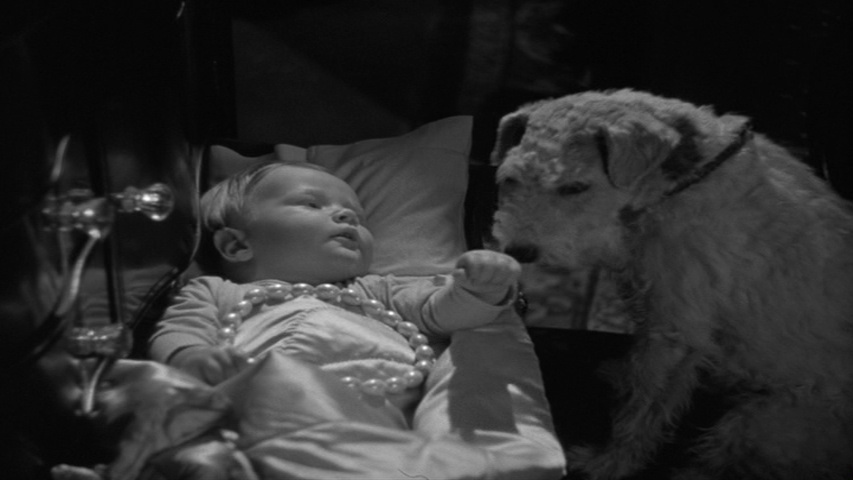
Baby Nicky and li'l Asta
ANOTHER THIN MAN (1939). Director: W. S. Van Dyke II.

Back in New York with their new son, Nicky, and little Asta in tow, Nick and Nora (William Powell and Myrna Loy) are summoned to the Long Island estate of Colonel MacFay (C. Aubrey Smith). MacFay has been receiving weird death threats from an old employee named Church (Sheldon Leonard) and hopes to have Nick's protection. Naturally, as in most of these detective movies, the threatened man is murdered under the disinterested hero's nose, and the rest of the movie is concerned with finding out who done it. Another Thin Man is quite talky, but entertaining, with an intricate script and a denouement that is truly a surprise. Members of the supporting cast (as well as suspects in certain cases) include Virginia Grey [Jeanne Eagels] as MacFay's adopted daughter; Patric Knowles as her secret fiance; Tom Neal [Bruce Gentry] as a man carrying a torch for Grey; Otto Kruger as the detective on the case; Ruth Hussey as a kind of nanny; Muriel Hutchison as Church's paramour, among others, all giving adroit performances. The business with ex-cons being delighted to see Nick even though he sent them up the river gets tiresome, and leads into a party for little Nicky with the hoods each bringing their own baby! (Don't blink or you'll miss Shemp Howard.) Some of the subsequent victims certainly don't deserve to be murdered, but there's never any sympathy for them. However, there's a swell scene with Powell interacting with Marjorie Main [The Law and the Lady] as a landlady, and the ending is a pip! The killer in this is especially conniving and heartless.

Verdict: Things look up for the series with this entry. ***.

Thursday, August 11, 2016

AFTER THE THIN MAN

Myrna Loy and William Powell
AFTER THE THIN MAN (1936). Director: W. S. Van Dyke.

Nick Charles (William Powell) and wife, Nora (Myrna Loy) have returned from New York to California in this first sequel to The Thin Man, but discover that wherever they go murder follows. Nick learns that when it comes to intrigue and craziness, Nora's relatives are not much different from the thugs and ex-cons Nick hangs out with. This time Nora's cousin, Selma (Elissa Landi of The Sign of the Cross), is accused of murdering her philandering husband, Robert (Alan Marshal). The suspects include a nightclub owner named Dancer (Joseph Calleia); a dancer named Polly (Penny Singleton); her "brother," Phil (Paul Fix of The Bad Seed); Dr. Kammer (George Zucco), who thinks everyone is nutty: and David Graham (James Stewart), who has long carried a torch for Selma. Somewhat better than The Thin Man, this is arguably not a whole lot better than a typical mystery from a minor studio, but it is served up with relish, some very good acting, and has an effectively comic-dramatic ending. Singleton, who was billed as "Dorothy McNulty" back then, is vivid as Polly, and Jessie Ralph [David Copperfield] simply walks off with the movie as Nora's formidable Aunt Katherine, a harridan force of nature if ever there were one. Sam Levene is fine as Lt. Abrahms, the detective on the case. Asta has a bit more to do then he did in the first film.

Verdict: Nick Charles is no Perry Mason, but this is fun enough. ***.

Thursday, August 4, 2016

AND THEN THERE WERE NONE (1945)

Walter Huston and Barry Fitzgerald
AND THEN THERE WERE NONE (1945). Director: Rene Clair.

Several people receive invitations to the very isolated Indian island, and find themselves accused of murder and of escaping justice. One by one, in accordance with a nursery rhyme on "Ten Little Indians," the members of the party are killed as the diminishing survivors become increasingly paranoid. This somewhat light-hearted version of Agatha Christie's classic novel has perhaps too much humor, and changes the grim and uncompromising ending of the book, but it manages to work up considerable suspense along with atmosphere and a certain tension. The actors are generally good, with Barry Fitzgerald as a judge, Walter Huston as a doctor, Louis Hayward as an adventurer, June Duprez [The Brighton Strangler] as a secretary, and Judith Anderson [Rebecca] as a prim and proper if rather heartless middle-aged woman. Richard Haydn [Dear Wife], C. Aubrey Smith, and Roland Young also have important roles. Most of the actors have been directed to play it rather "cute," but for the large part Clair's direction is quite adroit. Christie created her own little sub-genre with this very influential book, which was filmed several times both as "And Then There Were None" and "Ten Little Indians." Most of these were pretty bad. There was a creditable British mini-series in 2015.

Verdict: The fascinating and macabre situation carries this along. ***.

THE THIN MAN

William Powell prepares to question the suspects
THE THIN MAN (1934). Director: W. S. Van Dyke.

Nick Charles (William Powell) retired as a detective when his wife, Nora (Myrna Loy), inherited a fortune from her father. On a trip back to New York, Nick discovers he can't stay away from sleuthing when several people he knows are embroiled in murder. Dorothy Wynant (Maureen O'Sullivan) is worried when her father, Clyde (Edward Ellis), disappears, and things get more complicated when Clyde's mistress, Julia (Natalie Moorhead of The Curtain Falls) is found murdered. More deaths follow as the suspects pile up: Wynant's ex-wife Mimi (Minna Gombell of Babbitt); his weird son, Gilbert (William Henry of Nearly Eighteen); his lawyer, MacCauley (Porter Hall); Mimi's gigolo and second husband, Chris (Cesar Romero); and several other nefarious types. Nick gathers all of the suspects (he pronounces the word with the accent on the second syllable, which is kind of charming in an old-fashioned way) at a dinner party he hosts with an utterly baffled Nora. The Thin Man has good performances from all -- Gertrude Short is snappy in a small role as the shrewish girlfriend of a dead hood -- but one could argue that there's more silliness than humor and it often gets in the way of the not-very-memorable story, although it does manage to build up minor interest and suspense as it goes along. Nobody who watches this will especially care who the killer is. Powell does his usual suave shtick with aplomb; Loy is fine if typically arch; and the little dog Asta almost runs off with the show. There were five sequels to this popular film, most of which, if memory serves me, were superior to this first entry. The title refers to the vanished Wynant, described by police and papers as a "thin man with white hair." Nick, rarely without a drink in his hand, seems half-inebriated throughout the movie. Nat Pendleton is the detective on the case, and Henry Wadsworth is Dorothy's fiance, Tommy.

Verdict: Too self-consciously "cute" by half but not without its moments. **1/2.

Thursday, January 21, 2016

DETECTIVE KITTY O'DAY

Jean Parker and Peter Cookson
DETECTIVE KITTY O'DAY (1944). Director: William Beaudine.

Kitty O' Day (Jean Parker) works for Oliver Wentworth (Oliver Earle), who has also hired her boyfriend, Johnny Jones (Peter Cookson), to deliver some important papers. Wentworth is murdered and the papers are missing, and Kitty determines to find out what's what and clear both her and Johnny's names. Suspects include Veda Ann Borg as Wentworth's much-younger widow; Douglas Fowley as her possible love interest; Herbert Heyes as another attorney; and Olaf Hytten [Shanghai Chest] as the butler, Charles. Blowsy Kitty keeps tripping over bodies as she investigates, and winds up balancing on a ledge with Johnny in a scary-funny sequence set in an apartment building. Parker [Flying Deuces] isn't bad, Cookson is as good (and wasted) as ever, Tim Ryan (who co-wrote the screenplay) is fine as typically harried Inspector Clancy, and Edward Gargan scores as Clancy's befuddled and put-upon assistant, Mike. Followed by a sequel.

Verdict: A monogram picture that actually has a few real laughs in it to go with some good acting. **1/2.