Lively, entertaining reviews of, and essays on, old and newer films and everything relating to them, written by professional author William Schoell.
Showing posts with label Terry-Thomas. Show all posts

Thursday, December 22, 2022

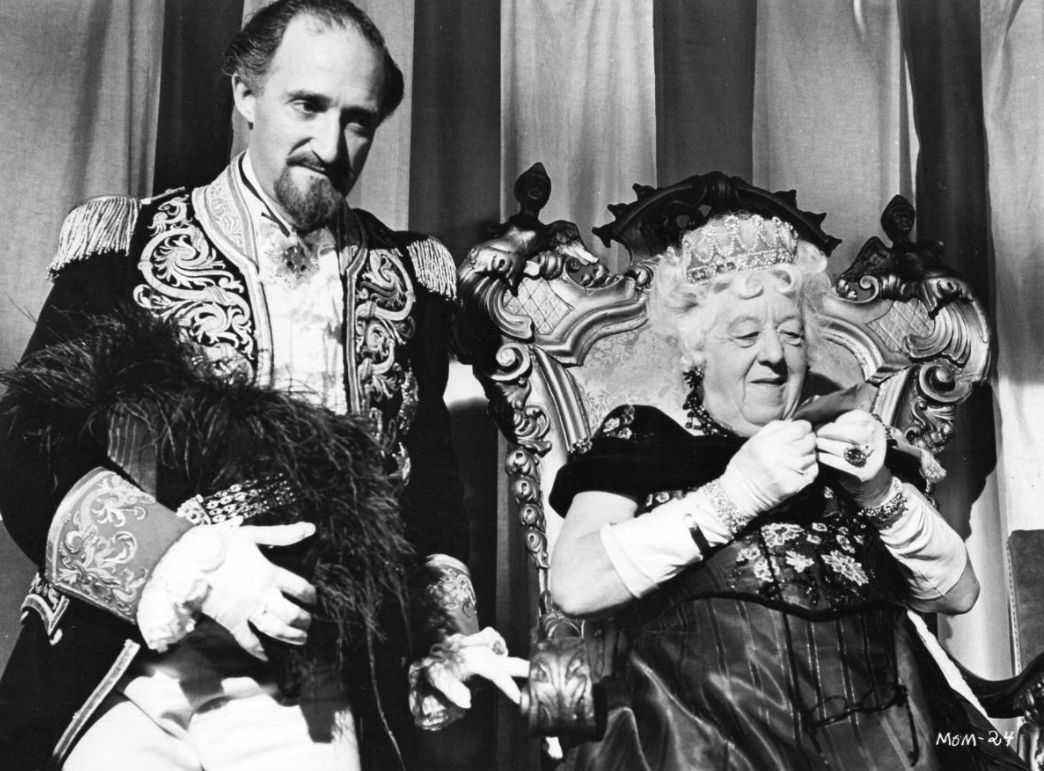
THE MOUSE ON THE MOON

Ron Moody and Margaret Rutherford
THE MOUSE ON THE MOON (1963). Director: Richard Lester.

A crisis develops in the little duchy of Grand Fenwick, the smallest nation in the world, when their chief and only export, wine, inexplicably develops explosive properties. The Prime Minister, Count Mountjoy (Ron Moody) hopes to borrow half a million from the United States to install modern-day plumbing throughout the duchy, but tells the government that they need the money for their space program so as not to sound silly. The U.S. gives Grand Fenwick a million dollars -- a ploy by the Secretary of State. Not to be outdone, the Russians send a rocket to the country, which Mountjoy hopes to transform into indoor plumbing. However, scientist Kokintz (David Kossoff) decides to use the wine as fuel so as to send the rocket on a trip to the moon. Delegates from the US and USSR arrive to see if the professor can actually pull it off. Going with him on the trip is Mountjoy's son, Vincent (Bernard Cribbins of Frenzy).

The Mouse on the Moon
, a sequel to The Mouse That Roared, has a cute idea, and there are quite a few laughs, especially in the first half, but it still comes off as second-rate. Margaret Rutherford as the dotty Grand Duchess is as fun and appealing as ever, but she isn't given nearly enough to do. Ron Moody gets the lion's share of the action, and he's fine, but not quite as amusing as you might hope. Once the rocket heads for the moon, the picture turns into a poor imitation of First Men in the Moon with its equally unscientific voyage into space. Terry-Thomas is cast as a spy, and June Ritchie is Mountjoy's niece, who gets involved with Vincent. Twenty years later Richard Lester directed Superman III. In The Mouse That Roared Peter Sellers played both the Grand Duchess and Count Mountjoy! 

Verdict: Very pleasant -- and pleasantly satirical -- in spots, but overall a disappointment. **1/2. 

Thursday, January 10, 2019

HOW TO MURDER YOUR WIFE

Jack Lemmon and Terry Thomas
HOW TO MURDER YOUR WIFE (1965). Director: Richard Quine.

Confirmed bachelor Stanley Ford (Jack Lemmon), the very successful writer-artist of a popular newspaper strip, Brash Brannigan -- Secret Agent, lives in a fabulous Manhattan townhouse with his devoted butler/houseman Charles (Terry-Thomas of The Vault of Horror). One night at a bachelor party for a friend, Stanley gets drunk and wakes up in the morning married to a stranger (Virna Lisi) who speaks only Italian and turns out to be the gal who jumped out of the cake. With the help of his lawyer Harold (Eddie Mayehoff of Off-Limits) and his wife, Edna (Claire Trevor of The Velvet Touch), Mrs. Ford begins taking over the house, the kitchen, and threatens to fly her mother in from Italy. When Charles quits in disgust, Stanley decides it's time to take action. But when he kills off Brash's wife in the comic strip and the real Mrs. Ford disappears, he finds himself in very hot water ...

Jack Lemmon and Eddie Mayehoff
The first thing that must be said about How to Murder Your Wife is that in the style of many films of the sixties it is outrageously misogynistic. Sure there are men who resent their wives' interference in their lives and miss their bachelor days, but the thesis of George Axlerod's incredibly sexist screenplay is that all men hate married life, every wife is a battle axe (despite the fact that Mrs. Ford seems like an ideal spouse in many ways) and if men could only push a button to get rid of them they would all do so with glee. The film not only ignores all the men who are perfectly happy with their spouses, but all the women who have had to put up with horrible husbands, not to mention the sexism many women have had to endure even before the days of #metoo.  True, How to Murder Your Wife is not supposed to be taken seriously, but even so! A courtroom scene is staggeringly -- even shockingly -- chauvinistic.

Mary Wickes, Lemmon, Claire Trevor
On the other hand, despite this major problem, the movie is often very funny, bolstered by fine performances from the entire cast. Mary Wickes even manages to practically steal a scene when she's playing Harold's secretary and gets drunk on champagne. Sidney Blackmer is also notable as the drunken Judge Blackstone, as is Jack Albertson as Stanley's doctor. One might wonder why Stanley almost seems to cringe whenever his sexy wife gets affectionate, even if the ending suggests that it is sex -- certainly not love -- that makes him decide that he may prefer to stay married. In other words, the only way to enjoy this movie -- and it is enjoyable -- is to recognize its dated qualities and take it on its own terms. The funny thing about misogynous males is that they want women for sex and nothing else, but develop the screaming mimis if anyone dares suggest they might prefer the more-than-company of other guys, but then there's always been a link between sexism and homophobia.

Verdict: Women-hatred at its worst, but with a few chuckles and adept performances. **3/4. 

Thursday, June 8, 2017

DANGER: DIABOLIK

Dead or only resting? John Phillip Law as Diabolik
DANGER: DIABOLIK (aka Diabolik/1968). Director: Mario Bava.

Diabolik (John Phillip Law) is a ruthless master criminal who dresses in a black leather outfit that only exposes his eyes. He lives in an elaborate HQ with pools, caverns, equipment, and a humongous revolving bed, and shares his life and crimes with his girlfriend, Eva (Marisa Mell). His chief opponent is Inspector Ginko (Michel Piccoli), who is determined to bring him to justice. To that end Ginko forces hoodlum Ralph Valmont (Adolfo Celi of Thunderball) to arrange to kidnap Eve and ensnare Diabolik in a trap. "It takes a thief to catch a thief," intones Ginko. Danger: Diabolik is based on an Italian comic book which in turn was inspired by the adventures of French criminal Fantomas. The movie is very sixties in its pop-style sensibility, and at least one scene reminds one of the Batman TV series, but for the most part the pic is played more or less straight. Diabolik's schemes, especially as they pertain to some stolen emeralds and faking his own death, are extremely clever, and there's a neat sequence when Valmont and Diabolik are fighting each other even after they've fallen out of an airplane. The movie boasts some interesting settings and scenic design but Ennio Morricone's score is just horrible. Law [The Sergeant] makes a splendid Diabolik; Mell [One On Top of the Other] is effective as Eve; Celi and Piccoli are each fine as crook and inspector; and Terry-Thomas is wonderful as a dignitary trying to hold on to his dignity. This is much better than the sixties Fantomas movie, and much, much better than horror-specialist Bava's other "spy" pic, Dr. Goldfoot and the Girl Bombs.

Verdict: Highly entertaining comic book flick with a completely amoral "hero." ***.

Thursday, October 29, 2015

DR. PHIBES RISES AGAIN

"Hackett isn't saying anything!"
DR. PHIBES RISES AGAIN (1972). Director: Robert Fuest.

In this sequel to The Abominable Dr. Phibes, the not-so-good doctor (Vincent Price) is after certain Egyptian scrolls that he hopes will bring his beloved Victoria (Caroline Munro) back to life, but first he has to get rid of anyone who might get to the scrolls first. Phibes' chief adversary is archaeologist Darrus Biederbeck (Robert Quarry of A Kiss Before Dying and Count Yorga, Vampire), but Phibes has absolutely no problem ridding himself of everyone in Biederbeck's party by various inventive, diabolical -- and often quite funny-- means. There's a fog that melts away flesh; a phone device that snaps a spike through the caller's ear; a body- crushing device; an attack by falcon; crawling scorpions; and the like, all served up with ghoulish and amusing relish. Peter Cushing, Beryl Reid, Fiona Lewis, Hugh Griffith, and Terry-Thomas have smaller roles, while Price himself seems to be having a ball.

Verdict: Gruesome and funny in equal measure, this is a sequel that's as good as the original. ***.

Thursday, October 1, 2015

THE ABOMINABLE DR. PHIBES

Vincent Price
THE ABOMINABLE DR. PHIBES (1971). Director: Robert Fuest.

Many years ago the wife of Dr. Anton Phibes died on the operating table,and he himself was incinerated in an auto crash. Or was he? Now the members of the medical staff who attended Mrs. Phibes are being murdered one by one, in manners that relate to the ten biblical curses of the Pharaohs. One poor man is attacked by blood-thirsty bats, while another is given a toad mask to wear that eventually crushes his head. Terry-Thomas has all of the blood removed from his body, quart by quart. The head surgeon, Dr. Vesalius (Joseph Cotten) is warned by Inspector Trout (Peter Jeffrey) that his first-born son (Sean Bury) may be in deadly danger... The Abominable Dr. Phibes is a zesty, well-acted black comedy that is as gruesome as it as comical. Price [Tower of London], Cotten [Half Angel] and Jeffrey are all excellent. Phibes' lovely assistant Vulnavia (Virginia North) has no dialogue, and neither does Caroline Munro, who stands in for the late Victoria Phibes. Followed by Dr. Phibes Rises Again. Fuest also directed the terrible Devil's Rain.

Verdict: As delightful as it is appalling, and definitely not abominable. ***.

Thursday, December 19, 2013

MUNSTER, GO HOME!

Al Lewis camps it up with John Carradine
MUNSTER, GO HOME! (1966). Director: Earl Bellamy.

"See what sandpaper skin and a touch of malnutrition can do for the complexion?"

The Munsters TV series, NBC's answer to ABC's The Addams Family, but more watchable, aired for two seasons from 1964 - 66. Its swan song was this theatrical feature which was released in 1966. In the movie, Herman Munster (Fred Gwynnne) learns that an uncle has died, making him the new Lord Munster, and heir to a British estate. Herman's English relatives, who reside in the estate, aren't too thrilled with this development. In fact, Freddie Munster (Terry-Thomas) tries to kill them off while they're still sailing across the ocean. Freddie's fellow conspirators include his mother, Lady Effigie (Hermione Gingold), and sister, Grace (Jeanne Arnold), the butler, Cruikshank (John Carradine), and a mysterious figure known only as the Griffin. Gwynne, Yvonne De Carlo as his wife, and Al Lewis as Grandpa are excellent in their roles, and they get good support from classy veterans Gingold, Terry-Thomas, Arnold, and Carradine. Butch Patrick and Debbie Watson are also notable as the Munster children, Eddie and Marilyn, with Robert Pine effective as an affected fellow who falls for Marilyn but whose family strenuously objects to the Munsters from any coast. It all leads to Herman becoming a contestant in a race that is frenetic but not especially funny. There are a few amusing moments throughout the movie, and kids may find more chuckles than the rest of us, but this basically proves that when it comes to TV sitcoms, no matter how cute and charming, less is definitely more.

Verdict: For Munster fanatics. **1/2.

Thursday, August 2, 2012

STRANGE BEDFELLOWS

STRANGE BEDFELLOWS (1965). Director: Melvin Frank.

"No more gay, married bachelor!"

Inter-Allied Petroleum executive Carter Harrison (Rock Hudson) literally bumps into artist Antonia "Toni" Vincente (Gina Lollobrigida) in London, and the two get married practically the same day, only to discover that Toni is a free spirit and Carter much more conservative. After seven years of separation Toni finally files for divorce so she can marry old boyfriend and boss, Harry (Edward Judd of First Men in the Moon), only a willing Carter discovers that he's up for a huge promotion, and his boss prefers happily-married employees. Can Carter win Toni over once again; can he put up with her "antics" and she with his stuffiness; and is he really in love or just play-acting for his job? In the climax, Toni (un)dresses up as Lady Godiva to protest the moral outrage over a piece of artwork. Strange Bedfellows is not a classic comedy, but it does have some solid laughs and an enthusiastic cast. The two leads are effective, and they get fine support from, Judd, Terry-Thomas (in a small, funny role of an undertaker), Gig Young (as Carter's co-worker, a thankless part he makes the most of), and Nancy Kulp as a friend of Toni's who winds up in bed with Carter (who also winds up in bed with Harry!) A highlight is a cab ride with some funny exchanges between the principles and the driver, and the low light is this business of dragging in civil unrest and massacre in Africa as part of Carter's plot to foil Toni's Godiva plans. The film has less to do with Toni's cause of Freedom of Artistic Expression as it does with titillating double entendres.

Verdict: Fair-to-middling mid-sixties sex comedy. **1/2.

Thursday, June 7, 2012

THE VAULT OF HORROR

Glynis Johns and Terry-Thomas
THE VAULT OF HORROR (1973). Director: Roy Ward Baker.

After the success of their Tales from the Crypt, Amicus decided to release this follow-up featuring more adaptations of 1950's E.C. horror comic stories. The framing device has five men entering an elevator and winding up down in a sub-basement lounge, where they tell each other of horrible dreams -- or prophecies -- that they've had. Rogers (Daniel Massey), who is looking for his sister (played by real-life sister Anna Massey) for nefarious purposes, uncovers a nest of vampires in a small town in "Midnight Mess." Glynis Johns [Personal Affair] has had more than she can stand of her neat freak, belittling husband (Terry-Thomas) and takes action in "A Neat Job," from the gruesomely amusing story from the first issue of ShockSuspense Stories. "This Trick'll Kill You" features Curt Jurgens [The Mephisto Waltz] and Dawn Addams [The Two Faces of Dr. Jekyll] as a team of magicians who even resort to murder to steal tricks away from Indian fakirs, with back-firing results. Michael Craig [Doctor in Love] and Edward Judd [First Men in the Moon] make a "Bargain in Death," an insurance scam in which one of them pretends to be dead -- but of course there are horrible complications. "Drawn and Quartered" features an artist (Tom Baker) who uses voodoo and paintings depicting scenes that come true to get even with several people who cheated him out of his rightful acclaim and fortune. Superior to Tales from the Crypt, Vault of Horror is very entertaining, creepy and, at times, delightfully ghoulish.

Verdict: Good anthology horror film. ***.

Thursday, June 9, 2011

KISS THE GIRLS AND MAKE THEM DIE

KISS THE GIRLS AND MAKE THEM DIE (1966). Director: Henry Levin.

A CIA operative known only as Kelly (Mike Connors) is in Rio tracking down the activities of a man named Ardonian (Raf Vallone), who has many girlfriends -- and kills any of them who dare to take on other lovers. But this ultimate Male Chauvinist Pig has another nefarious plan in mind. Working with the Red Chinese, Ardonian has developed a formula which will remove the sex drive from all human beings, eventually wiping out the U.S. population in a generation or so without bloodshed. [Ardonian doesn't seem to reckon with the ingenuity of human beings.] With the help of Susan, a British spy (Dorothy Provine), and her gifted chauffeur (Terry-Thomas), Kelly sets out to stop Ardonian and his allies. With attractive Brazil locations and some exciting scenes, and good performances from the leads (especially Vallone, who strikes just the right note), Kiss the Girls is basically good-natured but a little bit too silly for its own good. Poor Provine is clothed in one hideous fashion "creation" after another. But the movie is fun for the most part.

Verdict: One of the better James Bond imitations if not without its flaws. **1/2.

Thursday, March 19, 2009

YOUR PAST IS SHOWING / THE NAKED TRUTH


YOUR PAST IS SHOWING aka THE NAKED TRUTH (1957). Director: Mario Zampi.

A man named Mr. Dennis (Dennis Price) pays a call on several individuals and tells them that they either pay him ten thousand in two weeks or he'll publish an embarrassing expose of their exploits in his new paper The Naked Truth. Some of his victims individually decide that the only way to take care of Mr. Price is to kill him -- with varying but always comical results. Terry-Thomas (pictured) and Peter Sellers are two of the victims, and a very funny team-up they are. Peggy Mount is a scream as writer Flora Ransom (who was "indiscreet" in her youth) and Joan Sims as her daughter Ethel is even funnier. Miles Malleson (Ransom's future husband), Georgina Cookson (Terry-Thomas' wife), and Shirley Eaton (another blackmail victim) add much to the fun. The movie goes in a lot of amusing directions which won't be revealed here. Suffice it to say, it's a lot of macabre fun with some really memorable sequences. And it provides more proof that Sellers was a comic genius.

Verdict: A darkly comic romp indeed. ***.

Tuesday, January 15, 2008

WONDERFUL WORLD OF THE BROTHERS GRIMM

WONDERFUL WORLD OF THE BROTHERS GRIMM (1962). Directed by Henry Levin. Fairy tale sequences directed by George Pal. 

Over-length and the occasional cloying moment are the only deficits to this otherwise excellent fantasy film inspired by the lives of the Brothers Grimm. The biographical sections – which probably have to be taken with a grain of salt – are interrupted by the telling of three classic fairy tales. In the first, Russ Tamblyn is a woodsman who tries to find out why a princess (Yvette Mimieux) wears out her shoes every night, and discovers that she runs out a secret door to dance all night long with a bunch of gypsies. A cloak of invisibility helps him in this task. In the second a weary cobbler's figurines come to life to help him finish up his work in time for Christmas [he spent too much time making toys for the poor children of the neighborhood]. The last story has to do with a knight (Terry-Thomas) and his put-upon servant (Buddy Hackett) who set out to destroy a dragon that has been terrorizing Otto Kruger's kingdom. When Hackett manages to slay the dragon, his master kills him and takes the credit, but the servant manages to have the last laugh. As Wilhelm Grimm attempts to collect fairy tales to preserve for future generations, he and his brother Jacob struggle to finish a family history that they have been hired to write.

You wouldn't think Laurence Harvey would be the right actor for this kind of stuff but he's excellent as Wilhelm Grimm, and also scores as the elderly cobbler in the second tale. Karl (Peeping Tom) Boehm also strikes the right note as Jacob. The many actors in the assorted supporting roles – everyone from Beulah Bondi as an old gypsy woman to Jim Backus as the father of the dancing princess – are all in top form. The settings and cinematography are of a very high order [the film was originally released in Cinerama and MUST be seen in letterbox format.]. The “puppetoon” animation in the second story is charming, expressive and fluid. The dragon with the bejeweled body in the third story is deliberately dopey-looking for comedic effect and the stop-motion animation used to bring it to life isn't bad at all, if not quite on the Ray Harryhausen level. [At one point Hackett interacts with a full-size mock-up of the monster's feet and stomach as the creature tries to crush him.] The dream sequence near the end when Wilhelm is ill and sees visions of Cinderella, the Frog Prince etc. may have been required to remind viewers of all the tales the Grimms made famous, but it becomes tiresome very quickly. Still, this is a very worthwhile picture with many memorable sequences. 

Verdict: Lots of fun. ***. NOTE: This is about a thousand times better than the recent godawful Brothers Grimm with Matt Damon and Heath Ledger, which actually has little to do with the brothers or their stories and is a big, tedious, mess with rubbery special effects and little coherency. Skip it!