Lively, entertaining reviews of, and essays on, old and newer films and everything relating to them, written by professional author William Schoell.
Showing posts with label Carroll Baker. Show all posts

Thursday, March 19, 2020

SOMETHING WILD (1961)

Carroll Baker and Ralph Meeker
SOMETHING WILD (1961). Director/co-screenplay: Jack Garfein.

Mary Ann Robinson (Carroll Baker of Bridge to the Sun) walks home from work one evening, and is pulled into the bushes and raped. This traumatic experience leads into a series of strange actions, such as her leaving home without telling her mother (Mildred Dunnock) or stepfather (Charles Watts), taking a job in a five and dime store in another neighborhood, and moving into a cramped "apartment" about the size of a closet. One afternoon on the Brooklyn Bridge she tries to throw herself into the river, but she is stopped by the intervention of a worker named Mike (Ralph Meeker). But this apparently kind stranger may have even more problems than Mary Ann does and she finds herself locked in his apartment ...

Carroll Baker
Something Wild was based on a novel named Mary Ann and directed (and co-written) by theater man Jack Garfein, who was married to Carroll Baker at the time. Baker is deglamourized in this and generally gives a good performance, as does Meeker, although both are given rather impossible characters to play. I believe the film is trying to say that two damaged individuals can find love with each other, but there's a big difference in being a (rape) victim and being (in essence) someone who commits criminal actions like holding someone against their will, so turning this into a "love" story -- and yes the film does try to make us believe this has a happy and romantic ending -- would be almost as ludicrous as having Mary Ann fall in love with her rapist (who never shows up after the opening sequence). Apologists for the film -- and there are many -- try to suggest that Mike only locked Mary Ann in because he didn't want her killing herself, but she could just have easily killed herself in the apartment and his motives for keeping her a prisoner aren't nearly so noble.

Cinematography by Eugene Shufftan
The shame of it is that this hopelessly muddled, even offensive film has a lot going for it. In addition to the leads we have notable work by Mildred Dunnock as the concerned if ineffectual mother; Jean Stapleton as a slatternly neighbor of Mary Ann's; Doris Roberts as a co-worker at the five and dime who is put off by what she perceives as Mary Ann's stuck-up attitude; Martin Kosleck [The Flesh Eaters] as the somewhat sleazy landlord; and others. The film has a highly interesting score by no less than Aaron Copland [The Heiress], and is strikingly photographed in black and white by Eugen Shufftan, who makes the most of some very familiar New York City locations. Shufftan gives the film a very grim and intense atmosphere throughout. Garfield's direction is good if imperfect. He only directed one other movie, The Strange One. 

Despite all the notable aspects, Something Wild is done in by its contrivances. One suspects the plot was concocted before the characters were conceived, and -- in the film, at least -- they are never developed all that well.

Verdict: Should these two sick individuals get married? Where is Dr. Phil when you need him? **. 

Thursday, September 14, 2017

EASY TO LOVE

EASY TO LOVE (1953). Director: Charles Walters.

In Cypress Gardens, Julie Hallerton (Esther Williams of Raw Wind in Eden) works for Ray Lloyd (Van Johnson) as a highly successful swimming spokes model for various products and he's not about to let her go. Julie keeps hoping that Ray, a slave driver who rarely lets her have any time off, will propose to her, but just in case she has a handsome boyfriend, also a model, named Hank (John Bromfield of Crime Against Joe). "I bet you've never even seen him with his clothes on," Ray tells Julie. If that weren't enough, Julie meets crooner Barry Gordon (Tony Martin of Casbah) while on assignment in New York and dares to stay up late the night before a gig to have a wonderful romantic date with him. Back in Florida, Julie finds herself pursued by Hank and Barry even as she keeps pursuing Ray in her own way. The question is why? Most sensible women would quickly throw off the unpleasant, recalcitrant Ray (whose unlikable character isn't even redeemed by his being played by the likable Johnson) and take up with one of the two hunks who are dying for her hand in marriage. But Johnson was the bigger star so he gets the girl. Easy to Love is easy to take and just as easy to forget, although the performances are fine (Bromfield in particular makes a nice impression) and there are some pleasant song numbers, a smashing ballet on water skis, a romantic swim between Williams and Bromfield, a charming number with Tony Martin and some elderly ladies, and for good measure a brief appearance by pre-stardom Carroll Baker as one of Ray's jealous girlfriends. Production numbers designed and directed by Busby Berkeley. 

Verdict: Can't stop that Esther when she's wet! **1/2.

Thursday, March 10, 2016

HARLOW (1965) vs. HARLOW (1965)

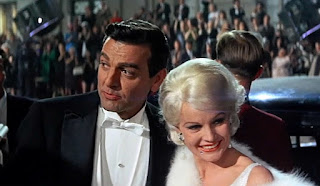
Mike Connors and Carroll Baker
HARLOW (1965). Director: Gordon Douglas.
HARLOW (1965). Director: Alex Segal.

"All the best things in life have to be done alone" -- "Marie Dressler" in Harlow II

In 1965 there were two "dueling" biopics about the star Jean Harlow, who died tragically young at 26, but neither of these films give the actress her due. Right off the bat, it seems like unfair competition, as Harlow I is a technicolor, widescreen epic with the highly publicized Carroll Baker [The Carpetbaggers] in the lead. Harlow II stars the perhaps lesser light Carol Lynley [The Shuttered Room], and was essentially a black and white television production (shot in Electrovision) and blown up to theatrical proportions. The chief difference, among many, is that Baker plays the role so that Harlow comes off as fresh and appealing, while Lynley is in "big bitch" mode throughout most of the movie, making one wonder why anyone would want to work with her. Harlow's mother is played in the first film by a marvelous Angela Lansbury, and Ginger Rogers is also quite good as the mother in Harlow II. In both films Harlow has a shiftless Italian stepfather, Marino. Raf Vallone [A View from the Bridge] is excellent as the character in the first film, while Barry Sullivan, despite not being Italian, manages to score in the second film as well. Both movies are rather slanderous (by 1960's standards as well as 1930's) in the character of first/second husband Paul Bern, who appears at least to be impotent and, it is suggested, homosexual. In the first film Peter Lawford barely registers, while a superb Hurd Hatfield [The Picture of Dorian Gray] gives the best performance in either picture as the same character. Bern had a common law wife who is never seen in the first film, and is played quite well by Audrey Totter in the second; she tells Harlow's mother that although she is Bern's mistress, they have never had physical contact. In both pictures Harlow is so dejected/depressed by the Paul Bern business that she turns herself into a "slut." Harlow I is based on a bio by Irving Shulman that was found by subsequent biographers to be heavily fictionalized. Unfortunately, Shulman's version of Harlow and her circle seems to be the unofficial basis for the second film as well.

Carol Lynley as Jean Harlow
In Harlow I Leslie Nielsen as "Richard Manley" is cast in the Howard Hughes role, while Efrem Zimbalist Jr. [A Fever in the Blood]  plays the counterpart to William Powell in the second; Zimbalist actually gives one of his best performances while Nielsen is acceptable. His near-rape of Harlow in his over-opulent bedroom is one of the best scenes in Harlow I, while Harlow II boasts a funny sequence which depicts her screen test with each take ruined because she can't stand to have the dour, disapproving Zimbalist watching her. There is also a very good scene between Rogers and Totter arguing over Paul Bern. The second version has some famous old actors being impersonated, such as Hermione Baddeley doing a not-bad Marie Dressler, and Celia Lovsky much less successful as a supposed Maria Ouspenskaya. There are interesting performances by Red Buttons and Hanna Landy in the first film, and Michael Dante, Lloyd Bochner, and especially John Williams in the second. Martin Balsam plays a studio head in Harlow I and gives one of his rare unconvincing performances.

As for the leading ladies, both give competent if second-rate performances (especially in the case of Baker), with both failing to capture the essence of Harlow -- her voice, her attitude, that surly, sexy, lovable demeanor that made her so famous. The ladies do the best they can, but as both versions say over and over again, there's only one Jean Harlow. [Both movies fail to get across that Harlow was a good actress.] An unintentionally comical scene occurs at the end of Harlow I when the doctor administering to a very ill Harlow exhibits as much compassion to her mother as a sociopathic iceberg. Oddly, the doctor in the second film is similarly cold, if not quite so stone-faced. In Harlow I Baker/Harlow disgustedly smears cold cream all over her image in her mirror, a scene that also occurs in the earlier Queen Bee with Crawford.

Verdict: Two smutty movies that don't have that much to do with the real Harlow. Both versions: **1/2 out of 4.

Thursday, February 4, 2016

SYLVIA

SYLVIA (1965). Director: Gordon Douglas.

"Before you can save the soul, you gotta feed the body."

Frederic Summers (Peter Lawford) hires private eye Alan "Mack" Macklin (George Maharis) to investigate the background of his fiancee, Sylvia (Carroll Baker). As Mack tracks down the woman's past, he learns about how she was raped by her stepfather, became a prostitute, then a poet, and has favorably impressed many of the people she met along her journey. This includes the librarian, Irma (Viveca Lindfors) and a former "hostess" named Jane (Joanne Dru), whose hospital bills were paid by Sylvia. Mack finally catches up with Sylvia herself, and is drawn to her -- but what will happen when she discovers the truth about him? At first Sylvia seems that it might have serious possibilities, and doesn't just seem like a tawdry exercise despite the subject matter, but as the film proceeds it's clear that it's pretty much junk that isn't lurid enough. The two leads are okay, but small-scale, and hardly give great performances. There is better acting from Lindfors (whose character has often been considered a lesbian although there's nothing in this to indicate it); Dru; and especially Ann Sothern [A Letter to Three Wives] as a slatternly former co-worker of Sylvia's. There are also nice turns by Nancy Kovack as a stripper, Jay Novello as a priest, Edmond O'Brian [Backfire] as a former client of Sylvia's, Connie Gilchrist as a madame, and especially Paul Gilbert [So This is Paris] as a drag queen entertainer/club owner known as "Lola." Lawford is actually quite good and there are appearances by Aldo Ray, Lloyd Bochner, and Majel Barrett, among other familiar faces, as well. Although the story bounces around from Mexico to New York and other places, there is never any sense of time or location, as if everything exists in that certain soap opera void that only Hollywood could produce.

Verdict: There's a reason why certain movies are completely forgotten. **.

Thursday, June 12, 2014

THE BIG COUNTRY

That's a mighty bigggg country, all right!
THE BIG COUNTRY (1958). Director: William Wyler. Produced by Wyler and Gregory Peck.

Easterner James McKay (Gregory Peck) goes west to meet the family of his fiancee, Patricia (Carroll Baker). There he discovers that her father, Henry Terrill (Charles Bickford), has been embroiled for years in a feud with the Hannassey family, which is led by grizzled but proud Rufus (Burl Ives). James also finds he has a rival in foreman Steve (Charlton Heston), who doesn't believe he makes a fit mate for Patricia. While Steve needs to impress Pat and flaunt his machismo on a regular basis, the more secure James wants to be loved for other reasons than his ability to fight (at which he happens to be quite good). As the feud that James wants no part of heats up, he is drawn to a lovely friend of Pat's named Julie (Jean Simmons), who owns the land where both families send their cattle for water, and who has the unwanted eye of Rufus' crude son, Buck (Chuck Connors). Eventually all the intense rivalries boil over ... Franz Planer's widescreen photography gets across the vastness and beauty of the countryside in panoramic style, and even the comparatively "petty" quarrels are set against the hugeness of the "big" country. A major fight scene between James and Steve is photographed mostly in long and medium shot, where their struggle is contrasted with the epic majesty of their impressive surroundings. Other memorable scenes include James trying to tame a spirited horse that pulls the blanket off its back with its teeth [although you sort of wish he would just let the horse retain its independent spirit]; James and Julie trying to outdo one another with gross and grisly stories of sharks and red ants; a pistol duel between two characters late in the movie; and a  moving climactic scene between Rufus and his son, Buck. Gregory Peck, although a little too cool at times, gives an excellent performance in a role that was made for him. Heston also gives one of his best performances and Baker [The Carpetbaggers] and Simmons [Angel Face] are similarly perfect. As the blustering patriarchs who hate each other Bickford and Ives nearly walk off with the movie; the latter is especially effective in his entrance scene when he comes to a party at the Terrill estate to tell off Henry in no uncertain terms. Although he's saddled with a stereotypical role, Mexican actor Alfonso Bedoya scores as the Terrill servant, Ramon. And Chuck Connors offers an outstanding turn as the nasty but somehow likable Buck, who seems as lonely as he is horny. The Big Country has a fairly predictable plot but somehow it doesn't matter, as you are anxious to see the confrontations and developments that you know are coming, and Wyler's expert direction not only adds an artistic sheen to the production but insures that you're never bored for the nearly three hour running time. [It might have been more interesting if James weren't quite so adept at fighting and everything else.] Jerome Moross' theme music is wonderful and I believe was later re-used for a western TV show. It's very strange that this movie -- considering its major stars and director -- seems to have been almost completely forgotten. It's arguably more successful than Peck's other big western, Duel in the Sun.

Verdict: Rousing, absorbing, Grand Old Western with superior direction and some fine performances. ***1/2.

Thursday, July 19, 2012

GIANT

Elizabeth Taylor and James Dean
GIANT (1956). Director: George Stevens.

Texas rancher Jordan "Bick" Benedict (Rock Hudson) marries the feisty, independent-minded Leslie (Elizabeth Taylor) and comes to realize that meek compliance is not in her nature. Meanwhile, the arrogant, slouching ranch hand Jett Rink (James Dean) discovers oil on the property left to him by Benedict's sister, Luz (Mercedes McCambridge) and is soon even wealthier than Jordan, leading to various complications and a couple of fight scenes. This long, sprawling saga is entertaining for the most part, and features one of Taylor's best performances. Hudson isn't the best casting, but he isn't bad, and the odd Dean makes a minor impression as well. Giant is not really a masterpiece, but it does have some good scenes: the Benedict children discovering that their Thanksgiving dinner is their pet turkey; Leslie telling off the men who think women have no place in politics; Angel (Sal Mineo) "coming home" from WW2. The other cast members include Carolyn Craig (House on Haunted Hill) as Leslie's younger sister; Rod[ney] Taylor as her cast-off suitor, who later on marries said sister; Carroll Baker as Leslie's daughter [in her second film and first big role]; Chill Wills as Uncle Bawley; Dennis Hopper as the Benedict son, Jordy, who, like his mother, has a mind of his own; Elsa Cardenas as Jordy's Mexican wife; and Earl Holliman as Bob, the husband of the youngest Benedict daughter, Judy (Fran Bennett). Of the supporting players, Hopper and McCambridge provide the most vivid performances. Giant has an admirable sub-text on the evils of racism -- both Benedict and Rink are prejudiced against the "wetbacks" -- but this might have had more impact if the Mexican characters, such as Angel, were developed a lot more.

Verdict: Long, but generally sustains interest, and -- surprisingly -- Taylor is the glue holding it all together. ***.

Monday, June 23, 2008

BRIDGE TO THE SUN


BRIDGE TO THE SUN (1961). Director: Etienne Perier.

A pretty young woman named Gwen (Carroll Baker) falls in love with a handsome Japanese diplomat named Hidenari Terasaki (James Shigeta), marries him, and moves to Japan, where she's expected to conform to the docile, subservient role of a typical Japanese housewife, causing friction, to say the least. The couple and their young daughter are back in the U.S. when the Japanese bomb Pearl Harbor; when Hidenari is deported, Gwen -- to her mother's horror -- decides to go with him. Hidenari is distrusted by his colleagues not only because of his American wife but because he is secretly working for peace (exactly what he's doing is never really specified). Based on a true story, Bridge to the Sun is interesting and well-acted, but despite some good scenes, its examination of some serious and provocative situations is on the superficial side. (The whole business of atomic bombs being dropped on Japan is completely glossed over so we never learn the reactions of either Gwen or Hidenari.) However, the ending is very moving.

Verdict: An A for effort. **1/2.

Saturday, January 12, 2008

THE CARPETBAGGERS


THE CARPETBAGGERS (1964). Director: Edward Dmytryk. Screenplay by John Michael Hayes.

George Peppard gives a surprisingly dynamic performance – his best, ever – as Jonas Cord, a Howard Hughes-type rich boy's son who weds and beds many a wench, starts an international airline, and takes over a movie production company and creates a star out of his own, very sexy former stepmother (Carroll Baker). Based on Harold Robbins' novel, this could easily be dismissed as trash were it not for the fact that it's quite well-acted, well-scripted (for what it is), and moves at a pace that leaves little time to ponder events but much time to be extremely entertained – there isn't a boring moment and much of the film is even striking in its way. Peppard and Baker are both better than you'd expect them to be, although they may not capture whatever nuances other actors might have found in their characters. Alan Ladd scores as Peppard's old companion and surrogate father, who becomes a cowboy hero of the movies and marries Baker. Ladd's climactic fight scene with Peppard is a highlight of the picture. Elizabeth Ashley, who later married Peppard in real life, is excellent as the wife he terribly mistreats, and even Martha Hyer is sexy fun as another blond hooker Peppard decides to turn into a star. Ralph Teager is fine as Peppard's pilot buddy and Bob Cummings is right on the money as a rather slimy Hollywood agent positively dripping with charm. Lew Ayres has one of his best latter-day roles as Peppard's business advisor, who is eventually disgusted by his antics (their parting scene is very well played).
Verdict: Overall, this long, lusty, often amusing and exciting picture isn't bad at all. ***.