Lively, entertaining reviews of, and essays on, old and newer films and everything relating to them, written by professional author William Schoell.
Showing posts with label Germany. Show all posts

Thursday, January 15, 2026

DIE HALBSTARKEN

Horst Buchholz
DIE HALBSTARKEN (aka Teenage Wolfpack/1956). Director: Georg Tressler. Colorized

A youth gang (of sorts) in post-war Germany is led by Freddy (Horst Buchholz), the most attractive and charismatic of the bunch. He has acquired some of his nasty attitude from his father (Paul Wagner), who has been in a foul mood since his brother-in-law borrowed a significant amount of money and can't repay it. Freddy's younger brother, John (Christian Doermer), is dismayed that his father takes it all out on his mother (Viktoria von Ballasko) and hopes to raise the money to repay his father. Meanwhile Freddy has moved or been thrown out of the house, and has his own place, with his 15-going-on-16 girlfriend, Sissy (Karin Baal), just next door. Freddy concocts a robbery scheme that goes horribly wrong, and discovers that the female of the species may just be deadlier than the male. 

Doermer and Baal
If one is hoping for a serious and thoughtful look at life in post-WW2 Germany, Die Halbstarken is not it. Clearly inspired by Hollywood juvenile delinquency films (which were dubbed and shown in Germany), this picture resembles one of them even down to the jazz score. We've got the restless teenage boys, the sluttish females, the attitude and feeling of wasted lives going nowhere, and all the usual tropes. The acting is quite good, however, with Buchholz (billed as "Henry Bookholt" in the dubbed American version of the film, Teenage Wolfpack, which even played drive-ins in the states) taking top honors but getting competition from Doermer as his nicer and more sensitive brother and Baal as the girlfriend, a blonde Lolita who tries to play both ends against the middle. The supporting cast is also on top of things. Buchholz struts around in tight black leather pants through the whole movie, which is somewhat entertaining if minor. NOTE: After I wrote this review I discovered that I'd already seen and reviewed the darn thing some years ago. I hate when that happens! 

Verdict: Buchholz went on to better things. **3/4. 

Thursday, December 8, 2022

M (1931)

Peter Lorre pleads his case
M (1931), Director: Fritz Lang.

In Germany a series of young girls have been abducted and presumably murdered. The police. headed by Inspector Lohmann (Otto Wernicke), are using all of their resources to track down this fiend, but can't zero in on him. Members of the underworld, represented by Schranker (Gustaf Grundgens), himself a murderer, gather together to try to deal with the fact that the search for the child-killer is drastically and negatively interfering with their own operations. The crooks determine to find the maniac themselves, and employ the beggars of the city to help them do so. A blind balloon seller who recalls a man whistling when one child goes missing is able to direct the thieves and cutthroats to one Hans Beckert (Peter Lorre), and he is put on trial by the city's underworld. 

Determined to catch the killer: Otto Wernicke
Frankly, M, long considered a classic and a masterpiece (I never held with the latter opinion), does not hold up well. The movie is rather slow, often primitive -- with long stretches of silence (sometimes strikingly interrupted by noise) -- although there are certainly touches of mild cinematic virtuosity. The final section of the film, the underground trial, presents Beckert as mentally ill and unable to control himself, an attitude that would not be that well-received today. (Some people would rather shoot themselves than hurt a child, and why couldn't Beckert have sought help when he realized he had these impulses?) The sequence can also be taken as a plea against capital punishment, with three mothers at the very end saying "it won't bring our children back." Having the killer judged by criminals also enables the film to supposedly take a moral high road it doesn't deserve. At times M has a light touch that is at odds with the proceedings. Peter Lorre gives a very good performance, however. Lohmann apparently played the same role two years later in Lang's Testament of Dr. Mabuse. The prolific Fritz Lang directed everything from genuine masterpieces like Clash By Night and Scarlet Street to stinkers like Secret Beyond the Door ... There was an American remake of M twenty years later. 

Verdict: I don't care what some so-called film scholars say -- this is a bit dull all told. **, 

Thursday, November 11, 2021

THE VIOLIN CASE MURDERS

Sylvia Pascal and George Nader
THE VIOLIN CASE MURDERS (aka Schüsse aus dem Geigenkasten/1965). Director: Fritz Umgelter. 

FBI agent Jerry Cotton (George Nader) is called in, along with his partner, Phil Decker (Heinz Weiss), by their boss, Mr. High (Richard Munch) to investigate what becomes known as the "Bowling Gang,' due to the location of their hide-out. The gang seems to be run by Christallo (Hands E. Schons) but he takes his orders from the nasty Dr. Kilborne (Franz Rudnick). These fellows, including a man named Percy (Helmut Fornbacher), carry weapons in violin cases (like something out of the forties) and think nothing of murdering without mercy anyone who gets in their way. Pretending to be a drunk who witnessed the group's activities and wants to join up, Jerry infiltrates the gang and discovers that they plan to blow up a school to create a distraction for their latest caper. 

Jerry and Percy (Helmut Fornbacher) after a fight
"Jerry Cotton" was a character as popular in Germany and Finland as James Bond was in the US or UK. He appeared in a huge series of novels over many decades, written by a variety of authors. When it was decided to make a film of his exploits, an American actor was chosen to play the U.S. agent, and many sequences were filmed on American locations, such as New York City, where that bowling alley HQ is located. George Nader, who had previously played the insurance investigator on the TV show Shannon, is fine as Jerry, and there are a host of excellent German supporting actors. Sylvia Pascal is cast as Christallo's girlfriend, and Heidi Luplot is her ill-fated sister, Mary. Nader uses his real voice in this English version while the other actors are dubbed.

Nader with Heinz Weiss
The Violin Case Murders
 is a treat, a fast-paced, very well-directed, and skillfully edited action-suspense film with some taut and beautifully choreographed fight scenes. There's also a clever bit with the bad guys using rolling oil cans, set on fire, to try and trap Phil Decker. One problem with the movie, however, is the music with its martial Jerry Cotton theme (which Jerry even whistles at one point) and jazzy carnival-like rifts that threaten to dissipate the exciting atmosphere at any moment. One can imagine how good this might have been with a different, more suspenseful score. Nader appeared in several more Jerry Cotton movies. 

Verdict: Despite the music, this plays. ***.  

Thursday, September 27, 2018

DER VERLORENE

Peter Lorre
DER VERLORENE/ aka The Lost One/1951. Director: Peter Lorre. 

NOTE: This is a report on the movie as opposed to a review. The only print I could find of this film was in German with no sub-titles, but I had a detailed synopsis of the film which told me what was going on. However, as there was no way I could judge the effectiveness of the dialogue, I will withhold a verdict until I see the film with an English soundtrack or sub-titles.

In the only film ever directed  by Lorre, he plays Dr. Karl Rothe, who was the former director of bacteriological research under the Nazi regime. Now he has changed his name and works as a well-liked doctor at a post-war German refugee camp. Into the camp comes Hosch (Karl John), who had been his assistant before the war, and now -- also under an assumed name -- becomes his assistant once again. Meeting Hosch brings back unpleasant memories to Rothe, such as when he murdered his own fiancee when it was revealed that she was a traitor. Now he can't control his urges to kill other women. some of whom escape and some of whom do not. Finally Rothe can no longer live with himself.

Der verlorene got a mixed reaction, with some feeling that it was an uncomfortable mixture of politics and thrills; other contemporary critics felt it was one of the best films to come out of Germany in years. The picture is undeniably gloomy, well-photographed by Vaclav Viche, and there's a very powerful (if perhaps too often overwrought) musical score by Willi Schmidt-Gentner. For much of its length Der verlorene reminds one of nothing so much as a "B" noir thriller, and there is some suspense in certain sequences. Two of the best scenes involve trains, one concerning a murder, and the striking final shot of a train bearing down on Rothe that seems right behind the actor.  As far as I can judge, the performances in the film  seem to be quite good. 

Thursday, June 21, 2018

GAY PRIDE SPECIAL: GAY-THEMED MOTION PICTURES

Dirk Bogarde in Victim
SEVERAL GAY-THEMED MOVIES FOR GAY PRIDE WEEK.

New York City celebrates Gay/LGBT pride this coming weekend, and in honor of that, Great Old Movies looks at several gay-themed movies and documentaries from different time periods and countries. First we have Victim, the classic 1961 drama about a British lawyer victimized by a blackmail ring (back when it was a crime just to be gay); the more recent film, Jonathan, a German drama in which a young man deals with the fact that his dying father once had a loving relationship with another man; the Israeli short Summer Vacation, in which a closeted man with a wife and children is confronted with his gay past at the beach; the 1974 Butley, with Alan Bates as a teacher who learns that both his estranged wife and boyfriend are moving on to other men; and the documentaries A Bit of Scarlet (gay depictions in British film), Uncle Bob (about the gay activist who streaked the Oscars), and Do I Sound Gay?, which kind of deals with gay stereotyping.

For more gay-themed films just type "gay" or "LGBT" into the search bar on the upper left hand corner of the blog. Thanks for reading!


Thursday, March 23, 2017

PHOENIX

Nina Hoss and Ronald Zehrfeld
PHOENIX (2014). Director: Christian Petzold.

Nelly (Nina Hoss), a concentration camp survivor whose face has been reconstructed, returns to Germany and is helped by her dear friend Lene (Nina Kunzendorf). Nelly wants to find her husband, Johnny (Ronald Zehrfeld), but Lene warns her that he betrayed her to the Nazis. Nelly can't believe this, but when she re-encounters Johnny, he doesn't recognize her and in fact wants her to pretend to be herself so he can lay claim to her money. Loving not wisely but well, Nelly goes along with the "deception," but she may not be able to deal with the bitter truth. Phoenix may seem to borrow a plot point from Anastasia or Return from the Ashes, which is not surprising in the latter case since Phoenix and Return were both based on the novel Le Retour des cendres. The story is treated quite differently in each film, however. Return from the Ashes is basically a suspense film, whereas Phoenix, although it has some suspense in its understated way, is more of a drama. Phoenix also examines the feelings of Jews and other Germans in the post WW2 period, and is quite moody and low-key. This approach may not work for everyone, but it is quietly powerful nevertheless. Another change is that there are hints that the character of Lene may be a lesbian who is in love with Nelly, making certain late developments in the picture even more tragic. The film is very well acted by the entire cast. One might wish, however, that despite the numbness felt by the main character, there was a little more emotion in the picture and perhaps a more dramatic windup..

Verdict: Flawed but absorbing. ***


Thursday, December 22, 2016

THE TERROR OF DR. MABUSE

Wolfgang Preiss as Mabuse
THE TERROR OF DR. MABUSE (aka Das Testament des Dr. Mabuse1962). Director: Werner Klingler.

"Mabuse -- the criminal? No -- Mabuse the genius!"

"Dr. Mabuse will very much enjoy this -- watching you squirm, hearing you shriek."

This remake of The Testament of Dr. Mabuse follows the story pretty closely. A series of ingenious robberies -- of everything from armored cars to banks -- befuddle Inspector Lohmann (Gert Frobe of Goldfinger) and his assistant, Kruger (Harald Juhnke). Mortimer (Charles Regnier) leads the men on their assignments, but they all answer to "Dr. Mabuse," who has resided in an institution for many years. Mabuse's strong will and hypnotic powers have turned Professor Pohland (Walter Rilla ), the head of the institution, into a carbon copy of himself. In the meantime, Mortimer enlists a washed up boxer, Jonny (Helmut Schmid), into the gang, but he has a crisis of conscience, and winds up imprisoned with his girlfriend, Nellie (Senta Berger of The Spy with My Face). The chief differences between both films is that in the latter Mabuse is strictly a criminal mastermind while in the earlier film he is an out and out terrorist. There is no scene in the remake equivalent to the sequence involving the room with a bomb that fills with water in the original, although this version has a suspenseful bit in regards to a descending elevator car. Unlike the first film, Lohmann winds up tortured by electroshock by the professor. The main problem with this film is that it doesn't improve on Fritz Lang's version, which itself was not exactly a masterpiece. The acting in this isn't bad, and Anneli Sauli makes a brief impression as the prostitute, Heidi.

Verdict: So-so Mabuse. **1/2.

Thursday, March 10, 2016

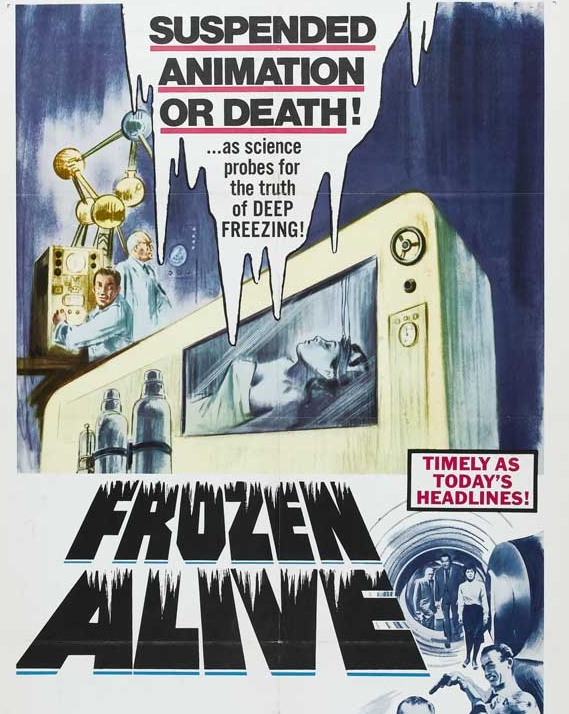
FROZEN ALIVE

FROZEN ALIVE (aka Der Fall X701/1964). Director: Bernard Knowles.

Dr. Frank Overton (Mark Stevens) is working on a project involving suspended animation via very low temperatures with another scientist named Helen (Marianne Koch). Overton's wife, Joan (Delphi Lawrence), is very jealous of Helen, and suspects her husband is having an affair with her, even as she carries on her own casual fling with her friend, Tony (Joachim Hansen). This leads to rather melodramatic but entertaining complications, including Overton being accused of murder. The highlight of the film is when one of the participants is frozen as an experiment, and there is some trouble bringing him out of the deep freeze -- a very suspenseful sequence. However, one problem with the climax is that Helen's actions, although her motivations are somewhat understandable, are enough to get her forever thrown out of the medical profession  -- she's a nut! The performances in this are very good, especially handsome Stevens [Fate is the Hunter], who gives a very sympathetic performance that makes it clear why the two ladies in his life are so crazy about him.  Knowles also directed Space Flight IC-1 and A Place of One's Own with James Mason. A West German production.

Verdict: Unusual romance/science-fiction melodrama with a very good cast. ***.


Thursday, July 30, 2015

KISS KISS KILL KILL

Brad Harris and Tony Kendall
KISS KISS KILL KILL aka Kommissar X -- Jagd auf Unbekann/1966). Director: Gianfranco Parolini (Frank Kramer).  

Not to be confused with Kiss Kiss Bang Bang, this movie is another dubbed Eurospy action flick. Despite the fact that the hero, Joe Walker (Tony Kendall), is a private eye and not a secret agent, the movie is still an imitation of Goldfinger with its megalomaniac villain, named Oberon [actor unknown], and his plan of hoarding all the world's gold on his private island. Oberon also has a force of cold-eyed blondes with the same hairdo whose minds have been made blank and only follow his specific orders. Like something out of Boston Blackie and innumerable films and TV shows afterward, our adventurer has a friendly but adversarial relationship with a cop, in this case Captain Rowland (Brad Harris). What's unusual in this situation is that the cop may be even better-looking than the private eye. Walker is hired by Joan (Maria Perschy), who works for the sinister Oberon, to find a missing nuclear scientist and uncovers a much more bizarre plot; both Walker and Rowland, with the help of Joan, team up to take down Oberon and save the world. This is the first of several "Kommissar X" films that Kendall, actually an Italian actor, appeared in. Harris was a handsome American actor who appeared in more of the Kommissar X films, as well as other Eurospy features, and was also on Falcon Crest and other US TV shows. Harris and Kendall [The Whip and the Body] make a good team. This is essentially a dubbed German film made with Italian and Yugoslavian co-financing.

Verdict: Not terrible, and a more elaborate production than usual, but Goldfinger it ain't. **1/2.

Thursday, December 11, 2014

FREE FALL

Hanno Koffler (top) and Max Riemelt
FREE FALL (aka Freier Fall/2013). Director: Stephant Lacant.

Marc Borgmann (Hanno Koffler), a German in the police academy, has a pregnant girlfriend (Katharine Schuttler) but finds himself attracted to the more open Kay (Max Riemelt), a very handsome fellow male cop. Marc tries to resist his attraction, but the affair has repercussions both on the job and within his family. Free Fall seems somewhat dated for the 21st century -- its story of a closeted, guilt-wracked man, although such men certainly still exist, smacks more of the 1970's. The characters are not developed enough, which is particularly true for Kay, who seems to exist only to be sexy and "torment" Marc. [You might also be left with the sense that Kay is a bit out of Marc's league.] In other words, it's all been done before and done better. Even That Certain Summer, made forty years (!) earlier for American television, was more progressive. The acting is quite good, however. This got much more enthusiastic reactions than it deserved. If taken as a parable that shows how old-fashioned shame screws up a gay person's life it might have some resonance, but that may be giving it too much credit.

Verdict: Downbeat, rather regressive (however unintended), and a little pointless. **.

Thursday, October 3, 2013

THE SINS OF MADAME BOVARY /PLAY THE GAME OR LEAVE THE BED

An Emma Bovary with Something Extra
THE SINS OF MADAME BOVARY (AKA Play the Game or Leave the Bed and Die Nackte Bovary/1969). Director: Hans Schott-Schobinger.

In this loose adaptation of Gustave Flaubert's "Madame Bovary," Emma (Edwige Fenech) is married to a country doctor (Gerhard Riedmann) but has affairs with Rudolf Boulanger (Peter Carsten) and young Leon Dupuis (Gianni Dei) while dodging the admiring creditor Adolphe Lheureus (Franco Ressel). Major changes to the story include Boulanger being willing to pay off Emma's debts (which he never does in any other version, pleading poverty), and Emma having sex with Lheureus in exchange for a batch of IOUs. Fenech seems to have been cast for her body, which is undraped as often as possible, while the male cast members seem not to have been cast for their looks; Fenech's acting seems adequate as does the others'. This is an adaptation of a French novel made by a combined German-Italian production company with a French-born star and dubbed into Italian. Fenech's eye make up is way overdone but her fans won't be looking at her eyes.

Verdict: Watch Jennifer Jones in Madame Bovary instead -- or even Beyond the Forest. **.

Thursday, November 15, 2012

MARK OF THE DEVIL

MARK OF THE DEVIL (aka Hexen bis aufs Blut gequäl/
1970). Director: Michael Armstrong.

"The most attractive things in the movie were my close-ups." -- actor Udo Kier.

Promoted as "the most horrifying movie ever made" -- patrons were given a "stomach distress" (vomit) bag along with their ticket -- Mark of the Devil certainly has its disgusting moments, but the fact is that once you get past the unpleasantness it's not a bad movie. Lord Cumberland (Herbert Lom), a famous witch hunter, arrives at a village with his young assistant, Christian (Udo Kier), and upsets the local witch hunter Albino (Reggie Nalder), who brands women who rebuff his slimy advances as witches. The latest victim is the busty tavern wench Vanessa (Olivera Vuco), who has caught the eye of Christian and vice versa. Cumberland proves little better than Albino, as he threatens a baron (Michael Maien) with torture unless he turns over his inheritance to the "Church," has thumbscrews and the rack applied to a young woman who insists she was raped by a bishop (in the movie's most notorious scene, this poor gal's tongue is extracted), and rapes the beautiful wife (Ingeborg Schoner) of a puppeteer. (The puppeteer is played by Adrian Hoven, who took over the direction of the film from Armstrong according to Kier.) Another hard-to-take scene has the bare-assed baron sat forcibly down on a bed of needles. Sadly, the torture sequences are probably accurate, and the movie makes it clear that there were often political, financial or sexual motives behind the witch hunters' accusations. The villains in this are utterly loathsome, and the ironic ending has the elements, oddly enough, of operatic or Greek tragedy. While the story holds the attention,  the actors are all good, and the pace is fast, Mark of the Devil hasn't got much style. It's too bad the film makers were more determined to make a horror film than a drama with horrifying sequences. Armstrong only directed one more movie 16 years later. This was a West German production, not very well dubbed, but at least we hear Herbert Lom's actual voice.

Verdict: Intense, gruesome, and absorbing. ***.