Lively, entertaining reviews of, and essays on, old and newer films and everything relating to them, written by professional author William Schoell.
Showing posts with label romantic comedy. Show all posts

Thursday, March 12, 2026

HER FIRST ROMANCE (1940)

Edith Fellows and Wilbur Evans
HER FIRST ROMANCE (1940). Director: Edward Dmytryck.  Colorized.

Linda (Edith Fellows of Girls' Town) is a supposedly plain 17-year-old college freshman with an older half-sister and guardian, Eileen (Julie Bishop of Why Men Leave Home), who is cruel and selfish. Katy (Marian Kerby), the peppery housekeeper, can see right through bitchy Eileen, and makes up her mind to help Linda go to the prom -- and get the right dress -- despite her sister's edict that she cannot attend. Linda's being asked to the prom is just a fraternity joke, but when the boys see how transformed -- and downright beautiful -- she is, they all want to be her date. But that honor goes to handsome baritone Philip Niles (Wilbur Evans), who runs into Linda when both are busy singing in the woods!

Alan Ladd and Julie Bishop
Her First Romance is pure romantic fantasy, but it has a degree of charm and some very nice singing. Edith Fellows makes an appealing heroine, but once she becomes officially "beautiful," she's far less interesting. At the halfway point the movie becomes sillier and more incredible, with people falling in and out of love at the drop of a hat. Fellows had been acting since she was six, and amassed over eighty credits. Wilbur Evans appeared mostly on the stage, as he only had four appearances in movies, but with his looks and talent he should have become more famous. (Appearing in a Monogram picture probably didn't help him.) In a supporting role is Alan Ladd (of The Glass Key), as Eileen's fiance, whom she stole away from another sister, Marion (Judith Linden). Ladd, of course, went on to major stardom. The music includes the love duet in the forest; another duet from Don Giovanni; "My Love for You;" and Evans singing a version of Tchaikovsky's "Piano Concerto No. One." You watch the film to the end to see Eileen get her comeuppance, although she deserves worse than she gets.

Verdict: Just buy a new dress and the boys will all pant for you! **1/4. 

Thursday, February 15, 2024

FOREVER DARLING

Desi Arnaz, James Mason, Lucille Ball
FOREVER DARLING (1956). Director: Alexander Hall. 

Lorenzo or Larry Vega (Desi Arnaz), a chemist working on a new bug killer, is married to Susan (Lucille Ball), who is much influenced by her snobbish cousin, Millie (Natalie Schafer of Female on the Beach), whom Larry can't stand. Larry also feels that he and his wife are drifting apart after several years of marriage. He is hoping to rekindle things by taking her with him on a work-related trip, an idea that doesn't sit well with Susan. Then who should appear in her bedroom one night but James Mason (James Mason), who is actually Susan's guardian angel wearing the face of someone she admires. "James" gives Susan some sage advice, and convinces her to go off on a short trip with Larry so he can test his new insecticide, but things may not go exactly as planned ...  

Arnaz and Lucy
Made at the height of the popularity of I Love Lucy, the main strength of Forever Darling is its cast. Not exactly playing the Ricardos, Arnaz and Ball are as wonderful as ever, James Mason -- who probably wondered how he ever wound up in this film -- is classy and excellent, and the ever-adept Louis Calhern [The Asphalt Jungle] nearly steals the movie -- no easy feat -- as Susan's highly amusing father. Then we've also got Natalie Schafer, Nancy Kulp as the maid, John Hoyt and Willis Bouchey as Larry's associates, Mabel Albertson in a brief turn as a reporter, and John Emery in a very funny bit as a psychiatrist who tries to explain to Susan why she's seeing strange men in her bedroom. 

Forever Darling, alas, is not as good as the other film the Desi-Lucy combo did, the very funny The Long, Long Trailer, but it has its moments. What starts out almost as a somewhat sophisticated drawing room comedy turns into an episode of I Love Lucy as the couple have misadventures while camping, with their plastic boat springing a leak and so forth. It was probably decided that that was what the couple's fans wanted, but it makes the flick a bit lopsided. Nothing much really happens with the whole "guardian angel" idea, making the movie -- but for the delightful performances and a few laughs -- almost seem pointless. Still, it's Lucy! The theme song by composer Bronislau Kaper is pleasant, sung by the Ames brothers over the credits and by Desi late in the picture. He also sang the tune on an episode of Lucy. Marilyn Maxwell appears in a move-within-a-movie sequence with Mason. 

Verdict: Has a certain degree of charm and amusing performances, but the script -- an old one dusted off for Lucy and Desi -- could have used some work. **3/4. 

Thursday, May 25, 2023

THAT OTHER WOMAN

Virginia Gilmore and James Ellison
THAT OTHER WOMAN (1942). Director: Ray McCarey. 

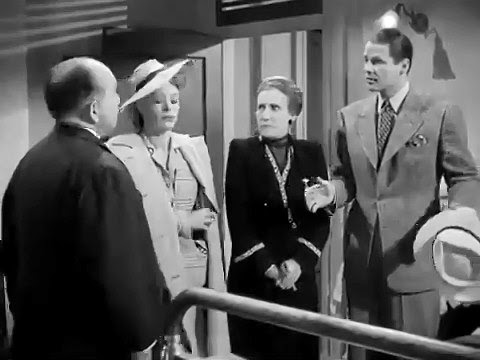
Emily Borden (Virginia Gilmore of The Brotherhood of the Bell) is secretary to handsome Henry Summers (James Ellison of The Ghost Goes Wild), who seems to spend more of his time chasing women than getting work done. Knowing how she feels about her boss, Emily's grandmother (Alma Kruger of Saboteur) suggests she create an air of mystery about herself by sending Henry some mysterious letters. This all leads to busy but not terribly funny complications wherein Henry thinks this lady's gangster boyfriend wants to kill him even as Emily's sort-of fiance, Ralph (Dan Duryea) goes after him as well. Henry masquerades as the caretaker of his cabin in the woods even as he finally begins noticing Emily. But what will happen when he learns she is the architect of all of his problems? 

Henry Roquemore, Gilmore, Urecal, Ellison
That Other Woman
 is yet another mediocre James Ellison comedy. Ellison is always reasonably adept in these vehicles but the greatest comedian in the world can't triumph over an insufficient screenplay. As for the ladies, neither Gilmore nor Kruger are especially adapt at comedy. The movie does have one moment of fun, and that is when Emily and Henry check into a hotel that seems to cater strictly to the elderly and encounter the termagant manager Mrs. MacReady, with Minerva Urecal looking throughout as if she wants to kill anyone who dares to even look at her! Typical of these kind of movies, Duryea's character is treated horribly.
Gilmore did a few movies but had more credits on TV. She was married to Yul Brynner for 16 years. 

Verdict: Much running around to little effect. **. 

Thursday, April 13, 2023

3 FOR BEDROOM C

Gloria Swanson and James Warren
3 FOR BEDROOM C (aka Three for Bedroom C/1952. Director: Milton H. Bren. 

Movie star Ann Haven (Gloria Swanson), who has just won an Oscar, discovers there are no compartments available for her and her daughter, Barbara (Janine Perreau), and she must take a train to Hollywood in a hurry. She simply takes over a compartment and is lucky enough to discover that the true occupant, chemist Dr. Oliver Thrumm (James Warren), finds the two ladies charming. As other arrangements are made with the help of steward Fred (Ernest Anderson), Ann and Oliver find themselves falling for one another. But there are complications when Oliver finds out who Ann is, as well as interference from her manager, Johnny (Fred Clark of White Heat), the press agent Jack Bleck (Hans Conreid of The Twonky) and a declasse theater person, Conde Marlowe (Steve Brodie of Desperate), who is heading for Hollywood. Will the romance between Ann and Ollie run smoothly?                

Conreid, Clark, Brodie
Despite her performance in Sunset Boulevard, Gloria Swanson found herself with few movie offers (or turned them down) after her triumph in that picture. Unfortunately, her choice of this light -- very light -- comedy was not a good one. Her choice of leading man was also odd, as you have to wonder why she didn't go after someone with more box office clout. A former star of low-budget westerns, James Warren was handsome and competent enough, but he was no Cary Grant (who would certainly have turned this script down). Swanson herself is quite good, as are the supporting cast members already mentioned, and there are slightly amusing cameos from Margaret Dumont (who certainly doesn't get enough to do) and Percy Helton. 

As for Ernest Anderson, he plays the role of the intelligent, wise and educated steward with dignity. Anderson also had a good part in In This Our Life. Swanson had only two more theatrical films in her future -- a foreign comedy about Nero and Airport 1975 -- along with a host of TV show guest spots. She did her best to constantly reinvent herself and stay in the public eye. Janine Perreau, another member of the Perreau acting family, is more annoying than cute. 

Verdict: Labored comedy that is easy enough to take but never really gets off the ground. **. 

Thursday, March 17, 2022

JUST A GIGOLO

William Haines and Irene Purcell
JUST A GIGOLO (1931). Director: Jack Conway. 

Lord Robert Brummel (William Haines) finds lots of female companionship with married women who have no problem cheating on their husbands. His Uncle George (C. Aubrey Smith) thinks his nephew is an overspending mountebank who doesn't know the value of a dollar. For some reason George thinks a match between Bob and equally upper-crust Roxana Hartley (Irene Purcell) would make the perfect union. But before he consents, Robert wants to make sure that Roxana isn't like (to his eye) most other women, and tests her by pretending to be a paid dancer and gigolo. 

C. Aubrey Smith and Haines
Just a Gigolo is a mildly amusing comedy that boasts a winning performance by the likable Haines, and an especially notable turn from the equally charming C. Aubrey Smith. Although a trifle off-putting at first, Irene Purcell proves an attractive and capable leading lady. This was her first full-length film and she only appeared in five more. (Ironically, Haines only had five more films to go before his movie career was over.) An interesting aspect of the film is the fury felt by Roxana when she learns of Bob's deception, his gall at testing her morals when he himself is hardly above reproach. The movie gets across the unjustness of the double standard without hitting you over the head with it. Although released in 1931, Just a Gigolo isn't creaky and moves at a fairly fast pace. Charlotte Granville is fun as Roxana's mother, and although Ray Milland is listed in the cast, if you blink you will certainly miss him. 

Verdict: A good chance to see Haines, once a top box office attraction, in a sound film. **1/2.

Thursday, June 13, 2019

SUSAN SLEPT HERE

Dick Powell
SUSAN SLEPT HERE (1954). Director: Frank Tashlin.

Screenwriter and bachelor Mark Christopher (Dick Powell of Pitfall) finds himself with an unusual Christmas "present." Two cops of his acquaintance want him to babysit a 17-year-old girl, Susan (Debbie Reynolds), over the holiday so they won't have to actually book her for some minor offense on Christmas Day. Mark reluctantly agrees but this causes problems for his sort of fiancee Isabella (Anne Francis), and upsets his household, which consists of secretary Maude (Glenda Farrell) and his old Navy buddy, Virgil (Alvy Moore). But is the middle-aged author more drawn to lovely, very young Susan than he would care to admit?

Farrell, Moore and Reynolds
One thing this comedy has going for it is some excellent performances. Debbie Reynolds, who was actually twenty-two at the time, is simply outstanding. Powell --fifty playing thirty-five but not getting away with it -- is no slouch, either. Farrell uses all she learned about acting since the thirties to make a distinct impression, and Moore manages to emerge an almost poignant figure, although his chief function is to get more laughs. Anne Francis also scores in the thankless role of the fiancee who is treated rather badly but whom Mark apparently never took seriously to begin with. Maidie Norman [What Ever Happened to Baby Jane?] and Les Tremayne [The Monolith Monsters] are also good as, respectively, Mark's maid and lawyer.

The characters at least seem a little more dimensional than in most comedies of this type, but that may be due to the performances. The picture goes on about twenty minutes too long, and there is a very tedious dream sequence in which Susan imagines Annabella literally snaring Mark in her web. (You would think that Powell and Reynolds would actually dance together, but they never really do.) Red Skelton has a funny cameo. This was Dick Powell's last theatrical film; he appeared strictly on television thereafter.

Verdict: Strangely appealing May-December romantic comedy that shouldn't work but does. ***. 

Thursday, January 14, 2016

LOVE IN THE AFTERNOON

Audrey Hepburn and Gary Cooper
LOVE IN THE AFTERNOON (1957). Director: Billy Wilder.

Ariane (Audrey Hepburn), the daughter of a private detective, Chavasse (Maurice Chevalier), saves a playboy, Frank Flannagan (Gary Cooper), that her father has been tracking, from a jealous husband (John McGiver). Ariane and Frank eventually begin seeing each other, and she tries to make him jealous by reciting all of the mythical men she has been with before (even though she's hardly old enough to have had so many affairs). Wanting to know the truth about Ariane, and not knowing her true identity, he hires her own father to find out more about her. Said to be Wilder's tribute to Ernst Lubitsch, this lacks the "Lubitsch Touch" and is rather slow at times. If it was meant to be a screwball comedy it doesn't work on that level, and the characters are too one-dimensional to make them really interesting. The whole bit with the aging playboy who finally finds the right girl is as old as "The Affairs of Anatol" and then some, and the whole movie has a distinctly old-fashioned quality even for the fifties. A big problem is that Hepburn [The Children's Hour] was 28 but looks ten years younger, and Cooper was 56 but (due to illness) looks ten years older -- Cooper is given only two closeups and they are not good --  so it looks as if Ariane is in love with a man old enough to be her grandfather. Exploring the sexuality of senior citizens is a perfectly worthwhile project, but Flannagan is not supposed to be as old as he looks, and he would come off much better with a more age-appropriate female on his arm. A bigger problem is not the age difference, but that Flannagan is a bit of a pig, even a vulgarian, making the allegedly "happy" ending more tragic than anything else. He is also an uncultured nincompoop (a la Donald Trump) who acts like an eight-year-old during the gorgeous overture of Tristan and Isolde in the opera house, another example of someone who has lots of money but absolutely no taste. The film never explores the reality that Flannagan's millions and ostentatious lifestyle would certainly influence Ariane's feelings toward the man. Hepburn may be bony, but she's wonderful in the movie, as are Chevalier and McGiver. Cooper does his familiar "cutesy" act but it's especially off-putting by this time; he basically just walks through the movie. Wilder directed some great movies, such as Double Indemnity and Witness for the Prosecution, but this picture hasn't aged at all well.

Verdict: Given the talent involved, this is a major disappointment. **.

Thursday, May 14, 2015

LIVING IN A BIG WAY

LIVING IN A BIG WAY (1947). Director: Gregory La Cava.

Leo Gogarty (Gene Kelly) got married to Margo (Maria McDonald) just before he shipped out, but the two never really got to know one another. Now Leo's back with her wealthy family, but she and everyone else feel the rushed marriage was a mistake, and Leo begins to agree. Things begin to change when Margo's peppery Granny (Jean Adair) takes her shuttered old manor house and turns it into apartments for homeless veterans and their families, with both Margo and Leo pitching in. Will these two kids finally realize they really are in love with each other?

It's funny, but for some reason I can't quite explain I've never cared for Gene Kelly. He's not bad-looking, has a fair to middling voice, is an okay actor, and an excellent dancer, but there's just something about him that I've never liked -- perhaps he lacks the genial amiability of a Fred Astaire, coming off more like a prick. This, admittedly, is just a reaction to something in his screen image, as he generally plays good guys. In one scene Kelly tells war widow Peggy (Phyllis Thaxter) that she ought to forget about staying where she met her late husband and go home to her family in the small town where she was born, but Kelly's matter-of-fact delivery of the lines only makes him seem like a rather tactless and unfeeling bastard; Thaxter is excellent, however. As for the rest of the players, Adair is wonderful (even if sometimes Granny's pithy comments are semi-moronic, consisting of badly dated epithets passing for wisdom); Charles Winninger and Spring Byington both score as Margo's parents; that cute little child actor Jimmy Hunt [Pitfall] is as delightful as ever as Thaxter's son; Paul Harvey [Henry Aldrich Plays Cupid] makes a memorably funny judge in a sequence in divorce court; and acerbic Clinton Sundberg makes his mark as the dyspeptic and opinionated butler, Everett, whom anyone but Winninger would have fired. Leading lady McDonald [Guest in the House] is attractive and competent but there's nothing special about her. Living in a Big Way boasts some excellent dancing from Kelly, and some good and amusing moments, but it never develops into anything all that terrific.

As for Kelly, according to imdb.com "he was voted the 42nd greatest movie star of all time by Entertainment Weekly [not that I take EW all that seriously] and named the fifteenth greatest actor on The 50 Greatest Screen Legends list by the American Film Institute." The question is why? Kelly was admittedly a great dancer, but a great actor, no! He must have been quite popular in his day, but number fifteen! To each his own.

Verdict: Pleasant if forgettable. **1/2.