Lively, entertaining reviews of, and essays on, old and newer films and everything relating to them, written by professional author William Schoell.
Showing posts with label comic books. Show all posts

Thursday, July 19, 2018

WALLY'S WORLD

WALLY'S WORLD: The Brilliant Life and Tragic Death of Wally Wood, the World's Second-Best Comic Book Artist. Steve Starger and J. David Spurlock. Vanguard; 2006.

This book examines the life, death, and career of Wally Wood, who was considered one of the best pencillers, and especially, inkers, in the comic book business, contributing to the classic E.C. horror line and doing exemplary work for Marvel's Daredevil (creating the sleek red costume in the sixties that was later worn by Ben Affleck in the film version) and other series; he also wrote, drew and edited T.H.U.N.D.E.R. Agents for Tower comics and did much other illustrative work. Wood had a problematic relationship with his father, as well as with his wives, with his alcoholism and other issues especially creating tension in the latter case. Wally's World is full of testimonials from people who greatly admired his work, as well as co-workers and other artists, looks at his influence on both comics and films, and offers illustrations of some of his most interesting and effective drawings in various genres. Beset by demons and serious health problems that affected his work, as well as bitter at certain aspects of the comic book industry, Wood took his own life at age 54.

Verdict: Interesting look at the life and work of a talented illustrator. ***. 

Thursday, March 1, 2018

A BRIEF HISTORY OF COMIC BOOK MOVIES

A BRIEF HISTORY OF COMIC BOOK MOVIES. Wheeler Winston Dixon and Richard Graham. Palgrave Macmillan; 2017.

This is indeed a very brief overview of comic book and comic strip adaptations that comes off more like a long article than a book. Chapters look at characters from the DC Comic universe, such as Superman and Batman; the characters of the Marvel Universe, such as Iron Man and the Fantastic Four; Japanese anime; and independent films such as Teenage Mutant Ninja Turtles. The book is breezily written for the most part, makes some good points about these movies, but in some ways comes off like a well-done term paper. There are no photographs. It's strange that the publisher didn't invest in some pictures and thicken the book's page count.

Verdict: Publish or perish? **1/2.

Thursday, January 11, 2018

THOSE COOL COMIC BOOK HEROES!

Superman vs Nuclear Man from Superman IV
THOSE COOL COMIC BOOK HEROES! 

This week Great Old Movies looks at films that star famous super-heroes such as Superman and Batman. We first look at comic book heroes whose exploits were adapted for cliffhanger serials (such as Blackhawk and Spy Smasher), then jump to films of the seventies and more recent flicks such as Wonder Woman. We've also got a section on animated features, most of which star Batman or Superman. In other words, we've got more super-powered and/or heroic (or villainous) characters than you can shake a stick at! Enjoy!

NOTE: All of the heroic characters covered this week originally appeared in comic books with the exception of Captain Midnight, whose exploits were first charted on the radio and in the serial before he got his own successful comic book series. 


Thursday, May 25, 2017

MOVIE COMICS: PAGE TO SCREEN; SCREEN TO PAGE

MOVIE COMICS: Page to Screen; Screen to Page. Blair Davis. Rutgers University Press; 2017.

This is one of a number of books on the subject of film adaptations of comic strips and comic books since the 1990 publication of my Comic Book Heroes of the ScreenMovie Comics is an intelligent and well-researched look at even older strips (my book concentrated on super-heroes) including Mickey Mouse and other Disney cartoon characters. Davis looks, in turn, into comic books that were inspired by individual films, or just by The Movies themselves. Davis examines such strip-into-films as Skippy, Li'l Abner, Dick Tracy, Joe Palooka, and Prince Valiant, and comic book-into-films (and TV shows)  such as the Superman TV series with George Reeves and The Adventures of Captain Marvel serial, among many others. Davis can occasionally be accused of being painfully obvious in his assertions -- typical of academic books -- but unlike many academic books Movie Comics is readable and accessible as well as informative.

Verdict: Engaging and pretty thorough look at its subject if not necessarily the last word. ***.

Thursday, March 24, 2016

SUPERHUMAN: THE BRONZE AGE OF COMICS

SUPERHUMAN: THE BRONZE AGE OF COMICS. Timbre Books; 2016.

Shameless promotion time again.

Here at last is my follow up to The Silver Age of Comics. In this tome you will learn:

* How feminist hero Ms. Marvel told off her teammates on the Avengers when they seemed to think all she needed was a good lay to settle  her down.
* How Marvel's first African-American super-hero, the Black Panther, went from being King of Wakanda to a strange Jack Kirby fantasy creation.
* How the X-Men's Jean Grey turned into the Phoenix, who wiped out an entire galaxy with nary a thought.
* Why Batman and Robin split up -- only to get back together again. Did it have something to do with Catwoman, or Ra's al Ghul's daughter, Talia?
* How black superhero Luke Cage, aka Power Man, teamed up with blond and blue-eyed martial arts master Iron Fist.
* Why Brainiac-5 of the futuristic Legion of Super-Heroes went nuts.
* How Spider-Man's frail Aunt May went into a nursing home, died, then came back again!
* Why Brother Blood, arch-enemy of the New Teen Titans, wound up in a war with the disembodied Brain and his Brotherhood of Evil.
* How the Justice League of America took on hungry mutated animals who slayed humans in a bloody arena, and helped bring the golden age's Justice Society back into prominence.
* How Wonder Woman finally lost her virginity -- and to whom.
* Why the Flash was put on trial for murdering the woman who killed his wife!
* The differences between Marvel and DC Comics competing undersea kings, Aquaman and Namor, the Sub-Mariner.
* Why Thor's father, Odin, tried to murder his son -- more than once!
* Why Black Goliath and Black Lightning used the word "black" in their names even though it was obvious they were African-American.
* What did Shang-Chi, the Master of Kung Fu, have to do with venerable villain Fu Manchu?

For the answers read SUPERHUMAN: The Bronze Age of Comics, available on Amazon in a spanking new Kindle edition. [Also downloadable on computers and mobile devices.] Naturally many of these comic book characters appeared in movies and TV shows decades after they were created for the comics.


Thursday, June 19, 2014

FANTASTIC FOUR

Invisible Woman, Mr. Fantastic, Human Torch and the Thing
FANTASTIC FOUR (aka Fantastic 4/2005). Director: Tim Story.

Reed Richards (Ioan Gruffudd of Sanctum), his ex-girlfriend Susan Storm (Jessica Alba), her brother Johnny (Chris Evans of Captain America: The First Avenger), and buddy Ben Grimm (Michael Chiklis) all participate in a space experiment with college acquaintance and scientist Victor Von Doom (Julian McMahon). Unfortunately things go a little awry and they all wind up with strange, super-human powers. Sue can become invisible and create force fields. Johnny becomes a flying, blazing Human Torch. Reed can stretch any part of his body like a latter day Plastic Man; and Ben turns into a lump of orange rocks with incredible super-strength. Together they become known as the Fantastic Four and save the city when Von Doom [aka "Dr. Doom"] mutates into a metallic maniac and goes on the rampage. Despite some changes to their origin, this often captures the feel of the old Stan Lee-Jack Kirby Fantastic Four comic books of the silver age. There's a generous amount of humor, but it generally comes from the situations and isn't forced, as well as some pathos concerning the situation of "the Thing," as Ben becomes known, who loses his sweetheart when she can't deal with his ugliness. The movie presents the inter-relationships of the foursome along the lines of the comic, with a callow, often insensitive Torch goading the Thing into destructive rages, and so on. All five of the actors, including McMahon, while they may not at first seem like perfect casting, do a fine job bringing these super-heroes to life. Alba received a lot of knocks, but she has authority and gives a perfectly good performance. The only problem with the movie is that the climax is rather short. For more information on the Fantastic Four comic see The Silver Age of Comics.

Verdict: Fun Marvel Comic Book Movie. ***.

Thursday, January 2, 2014

THE WOLVERINE

Logan struggles to stay on bullet train


THE WOLVERINE (2013). Director: James Mangold.

Logan, the mutant Wolverine (Hugh Jackman) from the X-Men, is determined to give up his violent ways after being forced to kill Jean Gray in X-Men: Last Stand. But this is a vow he has trouble keeping when he's summoned to Japan to say goodbye to a now-aged Japanese man, Yashida (Hal Yamanouchi) whose life he saved in Nagasaki during WW2. [Wolverine's healing factor keeps him forever young.] Yashida has studied mutants, and Wolverine in particular, and wants to steal away his immortality if he can. Wolverine is aided by a young lady with psychic powers named Yukio (Rita Fukushima) and tries to protect Yashida's grand-daughter, Mariko (Tao Okamoto), from attacks by the criminal organization, Yakuza, and a nasty lady mutant called Viper who has a literally poisonous tongue and can suck away men's life forces with a kiss. Late in the movie what appears at first to be a robot Silver Samurai shows up to engage Wolverine in battle. The Wolverine is a fairly standard action/super-hero movie with little new in it, and is not as good as the character's first solo feature nor such films as X-Men: First Class. It has one near-thrilling sequence when Logan has a battle with an assassin atop a speeding bullet train and the two engage in some nifty acrobatics while trying to kill one another, but the rest of the movie isn't on that level. There's a post-credit sequence wherein Magneto (Ian McKellen) and Professor X (Patrick Stewart) make an appearance [presumably leading into X-Men: Last Stand]. Jackman has nailed the character perfectly and turns in a very good performance, and the supporting cast, especially Svetlana Khodchenkova as Viper, are generally arresting.

Verdict: If you've seen one Wolverine, you've seen them all. **1/2.

Thursday, September 12, 2013

IRON MAN: RISE OF TECHNOVORE

Iron Man prepares for battle


IRON MAN: RISE OF TECHNOVORE (2013 direct-to-video animated feature). Director: Hiroshi Hamazaki.

"Next time I see you I'll buy you the best therapist money can buy."

Anthony Stark, aka Iron Man, prepares to launch a "Howard" [named after his father] satellite that will monitor and presumably safeguard activity on earth, but it is destroyed by a "weird kid" in strange armor that employs a technology unfamiliar to Stark. The kid is Ezekiel Stane, son of the late Obediah Stane, an old adversary of Stark's, and he is certifiable. Eventually Stane transforms into a hulking monster that Iron Man has trouble taking out. Guest-stars in this animated feature include Nick Fury of SHIELD, the Punisher, Hawkeye, and the Black Widow, some of whom, in a contrived bit of business, wind up fighting Stark. The movie has a wide range of styles, as well as that annoying anime influence, and the flat direction doesn't help. Stark is very well voiced by Matthew Mercer.

Verdict: Not very memorable. **.

Thursday, November 29, 2012

THE AMAZING SPIDER-MAN

Peter Parker practices his spider powers


THE AMAZING SPIDER-MAN (2012). Director: Marc Webb.

The 4th Spider-Man movie goes back to the beginning with a new actor and retells the origin of the arachnid hero. Peter Parker (Andrew Garfield) acquires spider-based powers, tries to use them for good, and comes afoul of his girlfriend's father, police captain Stacey (Denis Leary). Worse is that a one-armed scientist named Curt Connors (a scenery-chewing Rhys Ifans), who knew Peter's late father, has transformed into a hulking lizard-man monster that is threatening the city. If there had been no other Spider-Man movies, Amazing Spider-Man would have been fine, but it's all been done before, and done better [Spider-Man 2]. The Lizard was a popular villain in the comic books, but he's been transformed into a rampaging FX creature like the Hulk, somehow making him less interesting. There are some good action scenes -- and excellent photography -- but nothing as eye-popping as the climax of Spider-Man 2. Garfield is on target as the hero, and he gets fine support from Sally Field and Martin Sheen as his Aunt May and Uncle Ben. [The comic book origin has been fiddled with a bit so that Parker isn't quite indirectly responsible for his uncle's death.] Leary is adequate as Stacey, and Emma Stone has some good moments as his daughter, Gwen. Spider-Man's antagonist, newspaper publisher J. Jonah Jameson, doesn't appear in the movie at all. Co-creator Stan Lee has a funny cameo, and C. Thomas Howell [Young Toscanini] has a couple of good sequences as the father of a little boy saved by our amazin' hero. Despite its flaws [or over-familiarity], Amazing Spider-Man is by no means a bad picture and fans should still get a kick out of it. Garfield was also in the Robert Redford film Lions for Lambs.

Verdict: Slick if somewhat empty razzle dazzle. ***.

Thursday, June 7, 2012

TALES FROM THE CRYPT (1972)

Joan Collins and a nasty Santa
TALES FROM THE CRYPT (1972). Director: Freddie Francis.

Long before the HBO series, there was this anthology film from Amicus that adapted several stories from the old 1950's E.C. horror comics, including Tales from the Crypt. Several people wind up in a mysterious crypt presided over by no less than a be-cloaked Sir Ralph Richardson, the crypt keeper [nothing like the cackling puppet on the TV series]. He tells them of their future fates, the inference being that they can avoid them if they change their ways. Joan Collins murders her husband and has to deal with a homicidal Santa in "And All Through the House." [The adaptation on the later series is superior to the version in this film.] Peter Cushing gets "Poetic Justice" after being bedeviled by neighbors. In "Reflection of Death" an unfaithful husband (Ian Hendry) survives a car wreck -- or at least thinks he does. "Wish You Were Here," a variation on "The Monkey's Paw," has a woman wishing for her husband to come back to life after he dies in a car wreck, but discovers that it's all in the phrasing. In "Blind Alleys" the residents of a home for the blind who are outrageously mistreated get a grisly revenge on the head of the institution. The movie is fun, well-acted, but has absolutely no style. Followed by The Vault of Horror.

Verdict: Some intriguing ideas get so-so treatment. **1/2.


THE VAULT OF HORROR

Glynis Johns and Terry-Thomas
THE VAULT OF HORROR (1973). Director: Roy Ward Baker.

After the success of their Tales from the Crypt, Amicus decided to release this follow-up featuring more adaptations of 1950's E.C. horror comic stories. The framing device has five men entering an elevator and winding up down in a sub-basement lounge, where they tell each other of horrible dreams -- or prophecies -- that they've had. Rogers (Daniel Massey), who is looking for his sister (played by real-life sister Anna Massey) for nefarious purposes, uncovers a nest of vampires in a small town in "Midnight Mess." Glynis Johns [Personal Affair] has had more than she can stand of her neat freak, belittling husband (Terry-Thomas) and takes action in "A Neat Job," from the gruesomely amusing story from the first issue of ShockSuspense Stories. "This Trick'll Kill You" features Curt Jurgens [The Mephisto Waltz] and Dawn Addams [The Two Faces of Dr. Jekyll] as a team of magicians who even resort to murder to steal tricks away from Indian fakirs, with back-firing results. Michael Craig [Doctor in Love] and Edward Judd [First Men in the Moon] make a "Bargain in Death," an insurance scam in which one of them pretends to be dead -- but of course there are horrible complications. "Drawn and Quartered" features an artist (Tom Baker) who uses voodoo and paintings depicting scenes that come true to get even with several people who cheated him out of his rightful acclaim and fortune. Superior to Tales from the Crypt, Vault of Horror is very entertaining, creepy and, at times, delightfully ghoulish.

Verdict: Good anthology horror film. ***.

Thursday, October 7, 2010

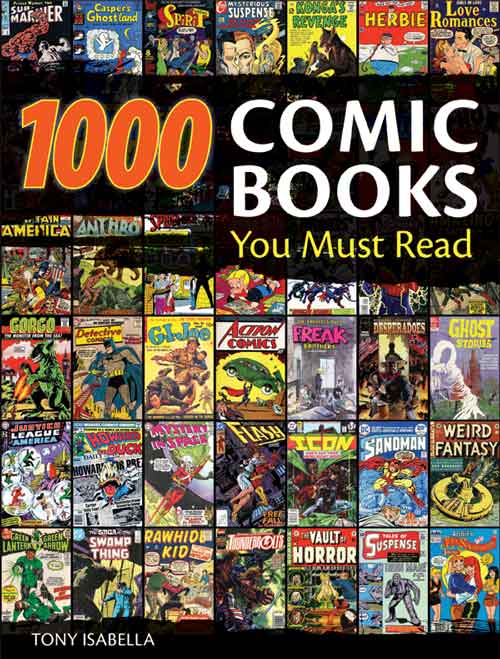
1000 COMIC BOOKS YOU MUST READ


1000 COMIC BOOKS YOU MUST READ. Tony Isabella. Krause; 2009. NOTE: Given the number of comics now being turned into movies -- as well as the link between comics and films -- Great Old Movies will occasionally review books on comics magazines.

Comics professional Tony Isabella has compiled this list of important comic books from the golden age to present day. The book is a thick hardcover packed with color reproductions of classic comics covers as well as many new ones. Which chapter interests you the most depends upon which era and genre most intrigues you -- some may find the later chapters less interesting because they focus on newer comics and not classic ones, but these chapters serve to introduce the reader to many new series, as well as to illustrate the huge variety and many genres of the comic book market. [Comic books are more than super-heroes, yet costumed characters seem to bring out the best in comics and vice versa.] You won't find much critical meat in the book, but it's not that kind of volume. Isabella introduces each chapter with some historical notes, but the book primarily consists of covers and captions with credits and an explanation of why that particular comic was included. The title, of course, must be taken with a grain of salt, as most super-hero fans won't be interested in the many angst-filled biographical and counter-culture comics that have cropped up in recent years and vice versa, and readers of Maus may not necessarily go for Donald Duck and Archie -- but who knows?

Verdict: Fun and informative for the serious comic book fan. ***.

Thursday, September 23, 2010

SUPERMAN VS. HOLLYWOOD


SUPERMAN VS. HOLLYWOOD: How Fiendish Producers, Devious Directors, and Warring Writers Grounded an American Icon. Jake Rossen. Chicago Review Press; 2008.

This is a very entertaining book that goes behind the scenes of the Superman comic book and all of the adaptations for films, television, serials, cartoons, and radio, as well as the struggles to gain rights, assorted lawsuits, and other internecine battles. The cast of characters includes everyone from George Reeves to Marlon Brando, Richard Donner and Richard Lester, Bud Collyer and Nicolas Cage [a big comic book fan who wanted to play the Man of Steel] to the Salkind Brothers, who produced the big-screen movies. You'll discover who really directed what on the Christopher Reeve Superman movies, and read about Superman projects that ultimately never materialized, such as Superman vs. Batman. Rossen also writes about Lois and Clark, Smallville, and Superboy TV programs, and the Broadway show It's a Bird, It's a Plane, It's Superman. Immensely readable, well-researched, and very informative.

Verdict: As much fun as a Superman comic book. ***1/2.

Thursday, September 16, 2010

SURROGATES


SURROGATES (2009). Director: Jonathan Mostow.

Fascinating science fiction film, based on a graphic novel, deals with a future world in which people stay home in bed and live out their lives with their minds inside more attractive -- and comparatively invulnerable -- robot bodies called surrogates. Tom Greer (Bruce Willis) investigates when surrogates begin to get murdered and their human hosts die along with them. Surrogates is a natural progression from such stories as "Marionettes Inc." and certain Twilight Zone episodes and other science fiction stories -- not to mention The Picture of Dorian Gray! The film is well-acted and very well-directed by Mostow, and has several well-crafted action sequences to go along with its nifty premise. Ironically, Bruce Willis looks better as his real self than he does as the blond-haired surrogate. Surrogates may be derivative, as some have charged, but it also introduces some interesting situations and sub-texts of its own.

Verdict: One of the better science fiction films of recent years. ***1/2.

Thursday, September 9, 2010

THE COMIC BOOK MAKERS


THE COMIC BOOK MAKERS. Joe Simon with Jim Simon. Crestwood; 1990.

NOTE: Due to the link between cinema and comics -- not to mention all the Hollywood adaptations of comic books -- Great Old Movies often reviews books about comics.

Comics writer and illustrator Joe Simon, who created Captain America, breezily and informatively recalls those early days of the golden age and silver age and afterward working in the comic book industry, and many of the other writers, artists, editors, publishers, and other assorted characters and personalities who inhabited the terrain. Some of the anecdotes may be familiar, but they're being told by someone who was actually there, and is of the era. There are a great many illustrations, including a full color insert, as well as a couple of complete stories, such as the disturbing "Beautiful Freak" from Black Magic 29 [1954]. Simon sets the record straight on a few things, but basically this is a good-natured book from a comics' giant. The cast of real characters includes Charles Biro, C. C. Beck, Stan Lee, and of course Jack Kirby. The book also relates how Simon and Kirby invented the romance comic [which became incredibly popular] and goes into their work on Archie Comics' Adventures of the Fly. Although the book is somewhat episodic and seems haphazardly organized, it is still a very interesting volume.

Verdict: Recommended for the serious comic book fan. ***.

Thursday, May 20, 2010

BATMAN SERIAL

BATMAN (15-chapter Columbia serial/1943). Director: Lambert Hillyer. 

"Don't be absurd! That simpering idiot could never be the Batman!" -- Dr. Daka. 
"Another Batman killed, eh? I hope that is the last of them." -- Ditto. 

Batman (Lewis Wilson) and Robin (Douglas Croft) tangle with the members of the League of the New Order, who are after supplies of radium for their special gun -- and worse -- an atom disintegrator. The League consists of American traitors being led by Japanese spy Dr. Tito Daka (J. Carrol Naish), who has a brain machine that turns men -- and women -- into slaves, as well as two pet gators [Nojo-nojo and Soko-soko] waiting hungrily beneath a trap door in his interesting headquarters (which is located inside a chamber of horrors). The league has a getaway car that cleverly changes color via the use of a special gas, and at one point Daka employs poisoned cigarettes to off some of his enemies. An amusing scene has a Japanese man in suspended animation arrive in a case to deliver a brief message and then die. Bruce Wayne's friend Linda Page (Shirley Patterson) gets involved when her wrongly accused Uncle Marty (Gus Glassmire) gets out of jail and becomes one of Daka's first mind-slaves. The Batman -- the article is always used in classic fashion -- works out of a "Bat's Cave" and leaves a bat insignia on the foreheads of thugs in the manner of pulp [and serial hero] the Spider. Wilson and Croft are fine as Bruce/Batman and Dick/Robin, and William Austin is excellent and amusing as their plucky butler Alfred. Charles Middleton -- Ming the Merciless himself -- shows up in a sympathetic role of the old miner, Ken Colton, illustrating Middleton's versatility. Shirley Patterson is swell; under the name Shawn Smith she appeared in such nifty items as It, The Terror from Beyond Space, World Without End and The Land Unknown. While it may not be considered his best performance and he is hardly Japanese, J. Carrol Naish is terrific as Daka and seems to be having a lot of fun as well. The fisticuffs in the film don't compare to the well-choreographed fight scenes in Republic's cliffhangers, but they get better as the serial proceeds. There are some nifty cliffhangers, including a descending freight elevator in chapter 7, and closing walls with spikes -- even as Linda faces a mind-blowout -- in chapter 13. Lee Zahler's dramatic theme music is also memorable. The "Bat's Cave" of this serial was later carried over and put in the comics, as was the secret entrance to it inside a grandfather's clock. Alfred in the comics was made thinner to look more like William Austin. 

Verdict: Fast-paced and atmospheric for the most part, this captures some of the flavor of the comics of the period. ***.

HUMAN TARGET


HUMAN TARGET (2010 Fox television series).

The Human Target, Christopher Chance, was originally a 1970's comic book series that appeared in Action and Detective comics. He never had his own comic book, just a back-up series.

In the comic book original, Chance was a master of disguise who took the place of people whose lives were in danger and ferreted out the bad guys -- or gals. The latter part of this premise was preserved for this TV series, but the former was dropped -- we never really see Chance in any clever disguise. [This is just as well for star Mark Valley, who would have been off-screen most of the time with other actors taking his place when Chance is in disguise.]

In this reboot, Chance was actually a gun for hire -- okay, a hit man -- who fell for one of his female targets and decided to get out of the game at great personal cost. Still, the idea that he was a hired killer is a bit ... disturbing.

Valley is excellent in the role, and he gets good support from Chi McBride and Jackie Earle Haley as his associates. Valley with his square jaw looks like he stepped right out of a comic book.

In the season finale -- the show will be back in the fall on Friday nights -- we met Chance's father figure [played by Armand Assante], who is not exactly happy with his "son." We also learned that there have been other "Christopher Chances" and that it is only an assumed name.

The last "Christopher Chance" was played -- and played well -- by Lee Majors. Assante was also good and intense, as usual. Majors' character tells the new, younger Chance "I won't be much good to you" but Majors still looks like he can handle himself.

This season's episodes included an assignment and attempted assassination on a bullet train; a search for gold bullion in the jungle; and Chance becoming a boxer to get a real boxer out of debt to a hood; etc. Then there's an old associate named Baptiste (an effective Lennie James) who has turned up more than once and is out to get Chance, but so far has not succeeded. [No surprise there.]

Human Target is no Alias, but it's not bad on its own terms, and it has a lot of potential.

Verdict: Definitely worth a look for action fans. ***.

Thursday, May 13, 2010

TALES TO ASTONISH


TALES TO ASTONISH: Jack Kirby, Stan Lee, and the American Comic Book Revolution. Ronin Ro. Bloomsbury; 2004.

NOTE: As previously noted, Great Old Movies will occasionally run reviews of comics and comics-related projects due to the similarity of the mediums of comics and film -- and the fact that more movies are inspired by comic books than is ever admitted!

While most people expect there to be all sorts of internecine quarrels behind the scenes of, say, an opera company or sitcom set, they may be surprised at all the squabbling that goes on behind the scenes of a comic book company. This highly entertaining and readable book, ostensibly a biography of Jack Kirby, documents the heady early days and troubled later years of Kirby, his frequent collaborator Stan Lee, Marvel Comics, and the other firms, including DC Comics, that they, especially Kirby, were also involved with as time went by. With Joe Simon, Kirby created Captain America back in the Golden Age of Comics during the forties. In the sixties, he and Lee collaborated on such characters as the Fantastic Four, the Hulk, the Avengers, the X-Men, and many others. Kirby became disillusioned, then enraged by the perception that Lee – which he felt Lee fostered -- was the sole creator and writer on these various strips, when Kirby did much of the plotting and creating himself. Eventually Kirby left Marvel for rival DC Comics where he created his own “Fourth World” of comics characters such as The Forever People, Mister Miracle, and The New Gods – but DC Comics was dissatisfied with the books and canceled them prematurely. (Ironically, The Fourth World proved a major influence on the Star Wars movies and most of Kirby's characters, particularly the villainous Darkseid, are now a big part of the DC Comics Mythos.) It was also noted that Kirby's books suffered without the deft scripting of Lee, whose contribution to the Kirby-Lee comics could not, in truth, be underestimated. Still, Lee got too much of the credit as far as Kirby, and many others in the comics industry, felt. Ro's book is full of fascinating details such as how Kirby and Lee disagreed vehemently on the direction taken by the character the Silver Surfer, who had a brief popularity, and the way that DC Editors had another penciller replace Kirby's drawings of Superman's face so that the image would conform to the accepted version of the Man of Steel. While it is utterly ludicrous to compare Kirby to the likes of Michelangelo(!), as one person does, this book makes clear that he was an extremely talented and very influential artist whose imagery and style has resonated throughout the comics industry for generations and will undoubtedly continue to do so for many years to come

Verdict: Darn good read for comics and pop culture fans. ***1/2.

Thursday, May 6, 2010

WATCHMEN -- THE MOVIE


WATCHMEN (2009). Director: Zack Snyder.

This is based on an influential comic book mini-series by Alan Moore that examines what would happen should super-heroes appear in the "real" world and they turned out to be as screwed up as everyone else. According to this there was a super-group called the Minutemen that first appeared in the 1940's. But now super-characters have basically been banned from operating, and someone is going around killing them off one by one. A psychotic character named Rorschach (Jackie Earle Haley) is on to the plot, which comes to embroil Nite Owl (Patrick Wilson) and Silk Spectre (Carla Gugino), and seems to point in the direction of one of their own. This has some effective scenes, but basically it's long and somewhat tedious, with the same dumb ending of the mini-series. The acting is okay; Matthew Goode has some flair as the wealthy hero Ozymandias. Even comic book fans, however, may find this a big disappointment.

Verdict: You can miss it and still have a full life. **.

Thursday, April 29, 2010

COMIC BOOK CULTURE


COMIC BOOK CULTURE: AN ILLUSTRATED HISTORY. Ron Goulart. Collectors Press; 2000. NOTE: As comics are also a visual medium like film, Great Old Movies will occasionally review comics and books about comics.

This is a huge, heavily illustrated coffee table book giving a fascinating history of the American comic book industry from the very early days up into the end of the golden age. Unlike Steranko’s History of Comics, which covered roughly the same period, you won’t find much criticism in this book but it is a well-written and entertaining overview, with chapters on early comic books that recycled newspaper funnies, Old Masters such as Bill Everett and Lou Fine, the Invasion of the Super-Heroes, “laff” comics, super-patriots such as the Shield, and a Brief History of “Good Girl Art.” Many, many comic book covers have been beautifully reproduced and this is packed with solid information about the early days of the comic book industry.

Verdict: Lavish tribute to this peculiarly American art form. ***