Lively, entertaining reviews of, and essays on, old and newer films and everything relating to them, written by professional author William Schoell.
Showing posts with label Bernard Cribbins. Show all posts

Thursday, December 22, 2022

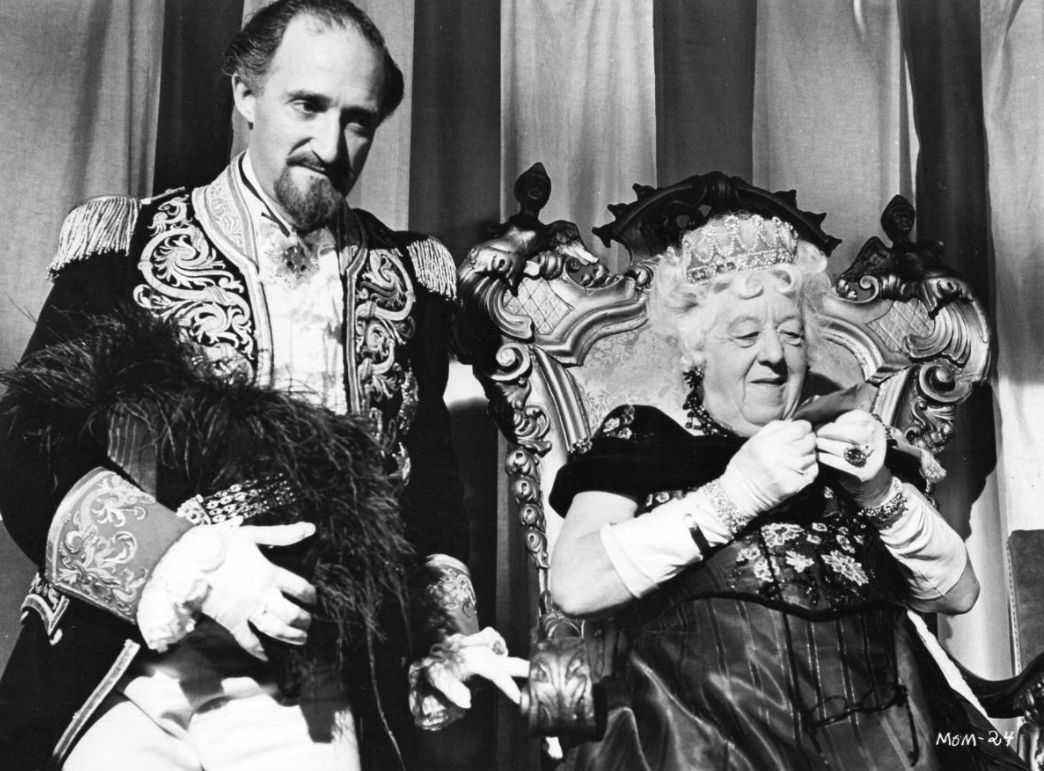
THE MOUSE ON THE MOON

Ron Moody and Margaret Rutherford
THE MOUSE ON THE MOON (1963). Director: Richard Lester.

A crisis develops in the little duchy of Grand Fenwick, the smallest nation in the world, when their chief and only export, wine, inexplicably develops explosive properties. The Prime Minister, Count Mountjoy (Ron Moody) hopes to borrow half a million from the United States to install modern-day plumbing throughout the duchy, but tells the government that they need the money for their space program so as not to sound silly. The U.S. gives Grand Fenwick a million dollars -- a ploy by the Secretary of State. Not to be outdone, the Russians send a rocket to the country, which Mountjoy hopes to transform into indoor plumbing. However, scientist Kokintz (David Kossoff) decides to use the wine as fuel so as to send the rocket on a trip to the moon. Delegates from the US and USSR arrive to see if the professor can actually pull it off. Going with him on the trip is Mountjoy's son, Vincent (Bernard Cribbins of Frenzy).

The Mouse on the Moon
, a sequel to The Mouse That Roared, has a cute idea, and there are quite a few laughs, especially in the first half, but it still comes off as second-rate. Margaret Rutherford as the dotty Grand Duchess is as fun and appealing as ever, but she isn't given nearly enough to do. Ron Moody gets the lion's share of the action, and he's fine, but not quite as amusing as you might hope. Once the rocket heads for the moon, the picture turns into a poor imitation of First Men in the Moon with its equally unscientific voyage into space. Terry-Thomas is cast as a spy, and June Ritchie is Mountjoy's niece, who gets involved with Vincent. Twenty years later Richard Lester directed Superman III. In The Mouse That Roared Peter Sellers played both the Grand Duchess and Count Mountjoy! 

Verdict: Very pleasant -- and pleasantly satirical -- in spots, but overall a disappointment. **1/2. 

Thursday, May 14, 2015

SHE (1965)

SHE (1965). Director: Robert Day.

In 1918, Leo Vincey (John Richardson), upon discovering that he looks exactly like an ancestor named Killikrates, journeys with his friend Major Holly (Peter Cushing) and pretty Ustane (Rosenda Monteros), to the lost desert city of Kuma in the "Mountains of the Moon." There they encounter the cruel, immortal Ayesha or "She" (Ursula Andress), who wishes Leo to join her in the flame that will give them both life everlasting. Holly and Ustane, however, recognize that Leo has fallen under She's spell, and is not acting the way he should. Who will win the battle for Leo's love, Ayesha or Ustane? Despite the widescreen and color, She is inferior to the 1935 original, although it, too, has some colorful and interesting settings, such as the striking entrance to the city. Andress [Dr. No] gives the weakest performance, but her looks and manner get her by. Cushing, Christopher Lee as a High Priest, and Andre Morell as the leader of a tribe of slaves, are excellent as usual. Like Andress, Richardson [Torso] certainly looks good -- he's like a cross between Troy Donahue and Guy Madison with a little Kerwin Mathews thrown in -- and his acting isn't bad, although Leo is a rather weak hero in this. Rosenda Monteros [The White Orchid] is lovely and very effective as Ustane, as is Bernard Cribbins as Job. The biggest problem with this Hammer remake is its slow pace. In the original film the lost city was in icy terrain but here it's in the desert. The best scene may be the slaves thrown into the fire pit.

Verdict: Not as much fun as The Mole People. **.

Thursday, October 25, 2012

FRENZY

The rape scene in Frenzy puts paid to the dumb theory that women enjoy being raped. 
FRENZY (1972 )  Director: Alfred Hitchcock. Screenplay by Anthony Shaffer.

Early in this movie of a rape-murderer on the loose in London, and an innocent man accused of the crimes, there is a scene in a bar when a middle-aged bar maid, somewhat anxiously and hopefully, asks a policeman if the killer rapes his victims before he strangles them.  "Every cloud has its silver lining, eh, Maisie," responds the police officer. Intentional or not, this ugly bit of business is contrasted later on with a very graphic and disturbing rape-strangulation scene in which it is quite clear that the terrified victim is in no way, shape or form enjoying the experience, and there is also absolutely nothing even remotely erotic about it -- it is pure sadistic woman-hatred and nothing more. [The sequence always makes me burst into tears, frankly.] That the victim, Brenda Blaney (Barbara Leigh-Hunt), is basically a kind and lovely person [not that this would be okay if she weren't] and that Leigh-Hunt's performance is so intense and skillful, makes it all the more horrible. Some feminists and others were outraged by the sequence, yet I think the scene is necessary to get past the tasteless jokes and show, for once, how awful a crime rape really is. Barry Foster also does a marvelously loathsome job as the murderer.

That being said, Frenzy is an excellent thriller with darkly comic moments. The protagonist, Richard Blaney (Jon Finch), ex-husband of the ill-fated Brenda, is not very sympathetic --  deliberately so, I believe --  and always seems much more concerned about himself than the women he supposedly cares for and who are dying all around him. Of course, as in most Hitchcock movies, the murderer has a lot more charm. Finch is perfectly okay in the part, but the best impressions are made by Foster, Leigh-Hunt, Anna Massey as a bar maid and girlfriend of Blaney's, and Bernard Cribbins as her dyspeptic boss. Also notable are Alec McCowen as the inspector assigned to the case, Vivian Merchant as his wife, who foists dreadful "gourmet" meals on him, and Elsie Randolph as a smirking hotel clerk. Billie Whitelaw and Clive Swift (of Keeping Up Appearances) play a couple who have differing opinions as to the guilt or innocence of Blaney, and Jean Marsh is a bottled-up receptionist [a rather tiresome stereotype].

Henry Mancini wrote an evocative theme for this, but Hitchcock wanted something different, which he got from Ron Goodwin, who delivered a stately opening theme redolent of England, and attractively sinister music for key sequences.Foster and Whitelaw were both in Twisted Nerve four years before.

Verdict: Flawed but compelling shocker from The Master. ***1/2.