Lively, entertaining reviews of, and essays on, old and newer films and everything relating to them, written by professional author William Schoell.
Showing posts with label June Allyson. Show all posts

Thursday, July 21, 2022

THEY ONLY KILL THEIR MASTERS

THEY ONLY KILL THEIR MASTERS
(1972). Director: James Goldstone. 

Chief of Police Marsh (James Garner) investigates when a woman is found dead and it is at first assumed that she was the victim of a Doberman Pinscher. But it turns out that she was murdered by a much more human adversary. Her husband (Peter Lawford) says she told him she was going to leave him for another woman. Interestingly enough, she was also pregnant at the time of her death. Suspects include a vet (Hal Holbrook), his assistant (Katherine Ross), who becomes involved with Marsh, and the vet's wife (June Allyson, who is quite good in a brief sequence). Edmond O'Brien plays the owner of a liquor store, and Tom Ewell and Ann Rutherford have supporting roles as well; Harry Guardino is another cop. This is typical of slick TV-like movies released theatrically in the seventies that try to be "hip" by adding homoerotic elements, but Lane Slate's script is pretty dated when it comes to the subject of homo and bisexuality and swinging. Garner is Garner; Ross is pretty. The best scene has the Doberman going a little nutty when Garner and Ross are in bed. 

Verdict: If you're a swinger you gotta die. **.

Thursday, February 21, 2019

GOOD NEWS

Peter Lawford and June Allyson
GOOD NEWS (1947). Director: Charles Walters.

Love is in the air at Tait University. Beef (Loren Tindall) is crazy about Babe (Joan McCracken), but she only has eyes for skinny Bobby (Ray McDonald). Connie (June Allyson) is smitten with football hero, Tommy (Peter Lawford), but he pangs for a new student, the pretentious, money-hungry, French (mis)quoting Pat (Patricia Marshall). Pat resists Tommy because she thinks the stuffy Peter Van Dyne III (Robert E. Strickland) has much more money. Considering who the stars of the picture are, it's no secret who will wind up with whom.

Patricia Marshall and Peter Lawford
Good News is a remake of a 1930's musical that was based on a Broadway show from the twenties. The plot -- such as it is -- was silly and insubstantial for 1930 let alone 1947, so the movie has to get by on its charm, its cast and its music. Neither Peter Lawford nor June Allyson can really sing -- Lawford is especially horrible to listen to; even his speaking voice is overly nasal -- and the other cast members don't have such dulcet tones, either, although Marshall is okay and McCracken (who was on Broadway in Rodger and Hammerstein's Me and Juliet) at least has personality and a voice best described as flavorful. Then there are the songs [De Sylva/Henderson/Brown].

Varsity Drag
Some of the songs are instantly forgettable, but there are a few that stay in the memory. "The Best Things in Life are Free" is, of course, a well-known standard, but there's also "Lucky in Love," as well as "Pass That Peace Pipe", "Just Imagine" and "Varsity Drag," which is the movie's liveliest production number. The performances across the board are all good, even though hardly anyone looks like a college kid with maybe the exception of 27-year- old McDonald. Allyson is certainly much more appealing in this than the rather freakish Penny Singleton in the 1930 version. Lawford has enough charm to get by even though he is hardly perfect casting. Others in the cast include Mel Torme as a student, Connie Gilchrist as a house mother, Donald MacBride as a rapacious coach, and Clinton Sundberg as a French teacher. Patricia Marshall did not appear in another movie for 28 years; she appeared primarily on the stage. McDonald only lived until 37 and McCracken died at 43.

Verdict: Mindless kitsch but fun if you're in the mood. **3/4. 

Sunday, April 1, 2018

PUKEY REPEATS

PUKEY REPEATS (1946). Director: Federico Fellini.

Although the studio deemed the June Allyson comedy Pukey to be unreleasable, famed Italian director Federico Fellini caught a special screening of it during a trip to Hollywood and was -- bizarrely enough -- totally enchanted. He contacted Allyson and arranged to make another Pukey film which can be considered a sequel or a remake or both. In this the cookie-tossing singer Pukey (Allyson) decides to take up opera, with completely unamusing results. Although she can't even sing normally, she somehow manages to acquire a contract with La scala in Milan, where much of this was filmed. Keefe Braselle, who appeared in the first film, absolutely refused to be associated with the second, so he was replaced by Broderick Crawford, who makes a highly unlikely love interest for Allyson. You have to hear Allyson attempting to croak out "Nessum Dorma" from Puccini's Turandot to believe it! Fellini filled the film with his usual interesting and exotic faces, but the script -- based, believe it or not, on a play by Italian artist and WW 1 hero Gabrielle D'Annunzio -- is just abysmal.

Verdict: Dreadful! *.

Thursday, May 22, 2014

THE SECRET HEART

Claudette Colbert
THE SECRET HEART (1946). Director: Robert Z. Leonard.

On shipboard, Lee (Claudette Colbert) is romanced by Chris (Walter Pidgeon), who urges her to marry him instead of his "friend," Larry Addams (Richard Derr), to whom she is engaged. But Lee does marry Larry and finds herself trapped in a relationship with a neurotic, paranoid composer -- basically an asshole -- who takes a long time to finally dispose of himself. Chris comes back into Lee's life, but she resists him out of guilt. Another complication is that her step-daughter, Penny (June Allyson), thinks she's fallen in love with the much older Chris -- when she learns the truth of whom he really loves will she go the way of her father? The Secret Heart is an absorbing enough romantic melodrama, bolstered by some very good performances, especially from Colbert, Derr [Terror is a Man], Robert Sterling [Bunco Squad] as Lee's stepson and Patricia Medina as his fiancee. Lionel Barrymore is in Wise Old Owl mode as Penny's shrink, and Marshall Thompson is charming as a young man who is attracted to a dismissive Penny. June Allyson is not bad as Penny, although, as usual, she's a trifle cloying, and Pidgeon manages to hold his own with Colbert without being on her level. Elizabeth Patterson and Dwayne Hickman are also in the cast. Leonard also directed the far superior In the Good Old Summertime.

Verdict: Some people you can live without. **1/2.

Thursday, August 8, 2013

A STRANGER IN MY ARMS

Allyson and Chandler at the sideshow


A STRANGER IN MY ARMS (1959). Director: Helmut Kautner.

Korean war widow Christina Beasley (June Allyson) and her mother-in-law Virgilnie (Mary Astor) are both mourning the death of son and husband, Donald (Peter Graves). The women, especially Virgilnie, are hoping that Major Pike Yarnell (Jeff Chander) will use his influence to get Donald a posthumous Medal of Honor, even though it's given in only the most extreme of circumstances. At first Pike doesn't even want to come to a ceremony for the man who was his navigator, but his attraction to widow Christina gets the better of him. As Pike and Chris find themselves increasingly drawn to one another, Chris must face the reality of her marriage, and Virgilnie must confront the even more difficult reality of her relationship with her son, as well as what happened on the life raft that Pike and Donald shared in the days before Donald's death (shown in flashback). A Stranger in My Arms certainly sets up an intriguing situation, but it's still rather dull, and as a romance it misfires because the leads have no chemistry. Not only is the sexless Allyson a mismatch for the virile Chandler, but she's so short next to him that there are times you get the strange sensation that Pike is pitching woo to a circus midget [not that there's anything wrong with that]! Allyson and Chandler offer competent performances, but nothing more than that, leaving the acting honors to Mary Astor, who has an especially good scene reacting to a note left for her by her son. As Donald's bimbo sister, Sandra Dee seems like a moron. Charles Coburn plays Donald's wealthy grandfather, who thinks he can buy anything, even a medal; he's fine but appears too briefly. Conrad Nagel is suitably low-key as Astor's put-upon husband and Graves is adequate but unimpressive in the flashbacks on the life raft. Kautner did a few American films and then went back to Germany.

Verdict: Intriguing situations of which the most is not made. **1/2.

Thursday, July 4, 2013

CURSE OF THE BLACK WIDOW

CURSE OF THE BLACK WIDOW (1977 telefilm). Director: Dan Curtis. Originally presented as an ABC Friday Night Movie.

A woman comes into a bar and asks for help with her car. A guy named Frank obliges, and is later found dead and drained of blood. His fiancee, Leigh (Donna Mills), asks one of the men who was in the bar that night, private investigator Mark Higbie (Tony Franciosa of Wild is the Wind) to find out what happened, as she's under suspicion because her first husband died at sea under mysterious circumstances. Higbie learns that there were several previous victims found in the same condition and one witness saw what appeared to be a giant spider leaving the scene. Could Leigh's family be under some kind of mystical curse?  ... This is an utterly absurd but entertaining horror film with good performances from Franciosa, Mills, Patty Duke Astin as Leigh's fraternal twin sister, Max Gail as a cop, and even June Allyson [The Shrike] as Leigh's aunt [you have to see her caught in a spider web]! The cast even includes Sid Caesar as a landlord, Vic Morrow [Great White] as a detective, Jeff Corey [Seconds] as a caretaker, and June Lockhart as a mysterious old lady locked in an attic. Roz Kelly nearly steals the show as Mark's spirited and funny secretary. The effects are not exactly high-tech but serviceable.The best thing about the movie is the ad [see photo]. Dan Curtis directed many made-for-TV horror films such as The Night Strangler, as well as such theatrical films as Burnt Offerings.

Verdict: Tarantula is way better but this has its moments. **1/2.

Thursday, June 30, 2011

THE SHRIKE


THE SHRIKE (1955). Director: Jose Ferrer.

Joseph Kramm's Pulitzer Prize-winning play The Shrike debuted on Broadway in 1952, where Jose Ferrer not only directed but played the lead part of Jim Downs. Three years later Ferrer did double duty again on the film version. Jim Downs is placed in the mental wing of a hospital after trying to commit suicide. He is estranged from his wife Ann (June Allyson), and in love with a woman named Charlotte (Joy Page). After initial success as a theater director, Downs fell on hard times and was down to his last few dollars. While he had very good reasons for feeling despair,  the doctors have to see him as someone who may be dangerous to himself and others. Not only is this sensitive, intelligent man virtually held captive by the mediocrities on the staff, but it becomes clear that his wife -- who wants him back under any circumstances -- holds all the cards. If he wants to go free, he has to renounce the woman he really loves.

In the play Charlotte did not appear at all, but the film was opened up to include flashbacks both of Jim and Charlotte and of his courtship of, and marriage to, Ann. Ann isn't given much chance to express her point of view in either the play or picture, but it's really Jim's story. The movie tacks on a somewhat hopeful ending that is entirely unrealistic. It also has a dumb scene -- not in the play -- in which a psychiatrist, sensing the vindictive nature of Ann under her surface concern and sweetness, essentially compares her to a bird called a shrike, which is not only awkward but even more unrealistic than the phony ending. [And for several reasons goes against the grain of the play as well. The playwright felt no need to elaborate for the theater audience.]

All three leads -- Ferrer, Allyson and Page -- give fine performances, although it's hard to imagine that Allyson was as good as Judith Evelyn in the play. Still, Allyson is not at all a bad choice for the role, as she manages to fool almost everyone into thinking she's as sweet and uncomplicated as she seems. There are good supporting performances from Will Kuluva, Mary Hayley Bell, Martin Newman and others as hospital staff and patients. Ed Platt plays Downs' brother, worried about what having a mental patient in the family will do to his career.

Yet for all the good stuff, there's something unsatisfying about both the play and the film. One suspects the play was forgotten because its characters were [as compared to, say. O'Neill and Williams] rather ordinary and under-developed, and because of its depressing wind-up. And by making compromises, the film doesn't deliver the wallop it should, and wound up being forgotten as well. Too bad, because both projects are certainly worthwhile if flawed, and the film is certainly worth seeing. The Shrike is chilling in its depiction of how a person has to prove his sanity in a mental ward even as he's nearly being driven crazy by the very situation he's in. Jim discovers that he's been offered a life-saving job which might end his career and financial woes, but the good doctors won't let him keep the appointment! 

Isobel Bonner, who played Dr. Barrow both on Broadway and in the film, was married to the playwright, Joseph Kramm. [In the movie, Ann is an actress who gave up her career when she got married.] She was performing the same part in Los Angeles the same year the film was released, when she suffered a cerebral hemorrhage and died right in a middle of a scene on the stage.

Verdict: I always thought Allyson was a shrike at heart! ***.

Thursday, April 1, 2010

PUKEY


PUKEY (1946). Director: Rouben Mamoulian.

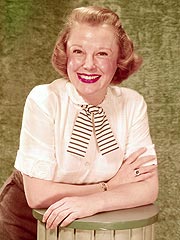
It's no wonder that this June Allyson (pictured) "comedy" was never released! Allyson plays an aspiring singer whose nickname is -- believe it or not -- Pukey. Therefore it shouldn't come as a surprise that every time she has to audition for someone, she gets so nervous that she has to run off and -- well, you know. Yes, Allyson spends most of the movie tossing her cookies [mostly off-screen, mercifully]. Keefe Braselle plays the love interest, an assistant producer who unaccountably thinks that Allyson has talent. The movie doesn't have a single laugh, and when the overly perky Allyson finally gets to sing, you'll wish you were anywhere else. A total dog. The movie, that is! Avoid this DVD at all costs!

Verdict: Could engender mass projectile vomiting amongst audiences! 1/2*.

Thursday, June 18, 2009

EXECUTIVE SUITE


EXECUTIVE SUITE (1954). Director: Robert Wise.

Avery Bullard, the head of Tredway Furniture Corporation, drops dead on a city street and a war begins over which of the executive directors will take charge of the company. The most interesting aspect of this picture is the opening, in which we see everything from Bullard's point of view (we never actually see Bullard). Then the picture just about talks itself to death, coming to life only sporadically whenever Barbara Stanwyck comes on as Julia Tredwell, wringing her hands, and yelling at one or two of the other characters. What this picture needs is a lot more of Stanwyck and a lot less of June Allyson, who is at her most perfectly cloying as William Holden's drippy wife. Fredric March, Nina Foch, Shelley Winters, Paul Douglas, and especially Louis Calhern all give good performances, however, with Stanwyck being the zippiest. Holden is adequate, and Walter Pidgeon is a bit better than usual in more of a character part. The funniest sections of the film -- which hasn't many laughs, just talk -- have to do with Calhern and his pretty, ever-hungry mistress. Allyson was a lot better in Woman's World, which came out the same year, had a similar premise, and was a much more entertaining movie.

Verdict: Given how little the women have to do in this film, it's a man's world after all. *1/2.

Thursday, June 4, 2009

WOMAN'S WORLD


WOMAN'S WORLD (1954). Director: Jean Negulesco.

"New York is the most fabulous, exciting, thrilling city in the world!"

This is a very entertaining, handsomely produced comedy-drama with a simple premise. Ernest Gifford (Clifton Webb), the President of Gifford Motors, needs a new general manager after the man in that position dies. He calls three district managers and their wives to New York so he and his sister can look them over. Gifford knows that the man who gets the job will need to have a wife who can also do her part on the social end, and who will understand that the job might have to come first. Katie and Bill Baxter (June Allyson; Cornel Wilde) are small-towners and the wife wants to keep it that way. Liz and Sid Burns (Lauren Bacall; Fred MacMurray) are actually in the midst of a marriage crisis, with the wife already thinking that the business has taken her husband away from her and given him an ulcer. When it comes to third couple Carol and Jerry Talbot (Arlene Dahl; Van Heflin), the wife has fallen in love with the city and all it offers while the husband fears he's too frank to be given the job. The picture works up some nice suspense as to who will be offered the position while offering serio-comic vignettes about each marriage and how each wife sees her position in it. Director Negulesco has gotten fine performances from the entire cast, with Webb his usual superb self, and especially nice work from MacMurray. Dahl is sexy and zesty as the slightly amoral Carol; one of her better performances. Allyson and Wilde make the Baxters a very appealing couple. [No mean feat, as this writer generally can't stomach June Allyson.]

Verdict: It ain't Shakespeare, but it's fun! ***.