Lively, entertaining reviews of, and essays on, old and newer films and everything relating to them, written by professional author William Schoell.
Showing posts with label George Coulouris. Show all posts

Thursday, April 2, 2020

A SONG TO REMEMBER

Cornel Wilde and Merle Oberon
A SONG TO REMEMBER (1945). Director: Charles Vidor.

Child piano prodigy Frederic Chopin (Cornel Wilde of The Big Combo) is urged to go to Paris by his teacher, Professor Elsner (Paul Muni). Chopin's parents won't allow the boy to go so it isn't until Chopin is grown, and forced to flee Poland after insulting the Czar, that he finally arrives in Paris. There he and Elsner have trouble convincing others of his greatness. Chopin's patriotic fervor is dampened by the presence in his life of the writer George Sand (Merle Oberon of The Price of Fear), who insists that a true artist must forget about the petty struggles of the "rabble." But Professor Elsner isn't about to let Chopin forget about where he came from nor about the Polish people.

Cornel Wilde as Chopin
A Song to Remember is a very heavily fictionalized version of the life of the great composer, with some incidents simply being made up to propel the story along and add some drama. The funny thing is that the lives of Chopin and Sand were already quite dramatic and full of incident, so the fabrications weren't even necessary. Still, there are basic factoids about the composer in the film, and one could argue that it portrays his essence if not his reality. Cornel Wilde is quite good as the Hollywood version of Chopin and was nominated for a Best Actor Oscar. If there is any problem with his portrayal it is within the script, as it makes Chopin out to be an ungrateful snob who literally snubs the man who has done so much for him. He redeems himself at the end, but still ...

Paul Muni and Maurice Tauzin
George Sand doesn't fare much better, coming off as monstrously self-absorbed. In this case, Oberon doesn't help with her one-dimensional emoting. Oberon is unable to get across the possibility that it is her need for Chopin that turns her into a selfish creature who makes outrageous statements. However, Paul Muni gives an excellent performance as the professor. He can be forgiven some "cutesy" moments because his role borders at times on the comic, but he is otherwise superb. Little Maurice Tauzin [Tarzan and the Huntress] also makes an impression as the great composer at age ten. There is also very good work from Stephen Bekassy as Franz Liszt, George Coulouris as impresario Louis Pleyel, Nina Foch as Chopin's concerned sister, and Howard Freeman as the critic Kalkbrenner. Even if you're unconvinced by the dramatics, the score consists of some of Chopin's most beautiful and memorable pieces -- you might be surprised by how many works you will be familiar with.

Verdict: Fine performances, a beautiful score, and lushly romantic. ***1/4.  

Thursday, May 4, 2017

TARZAN AND THE LOST SAFARI

Betta St. John and Gordon Scott
TARZAN AND THE LOST SAFARI (1957). Director: H. Bruce Humberstone.

Pilot Dick Penrod (Peter Arne of Battle Beneath the Earth), his dissatisfied wife, Diana (Betta St. John of The Robe), and friends are flying over Africa when their plane hits a flock of flamingos and down they go. They find themselves in the territory of the deadly Opar tribe, who love to make human sacrifices. Pretending to help this party -- along with Tarzan (Gordon Scott) -- is an untrustworthy fellow named Hawkins (Robert Beatty), who has an uneasy alliance with the bloodthirsty Oparians. Tarzan tries to take the downed party out of the jungle without them being attacked and killed by the hostile natives. Tarzan and the Lost Safari is in wide-screen and Eastman color -- this is the first Tarzan film in color, in fact -- but matte paintings of the jungle, some second unit location shooting, and a decent swamp set on a sound stage can't quite disguise the cheapness of the production. Tarzan is no Lord Greystoke in this, but a man of few syllables, and there's no mention of Jane. George Coulouris, Wilfred Hyde-White, and Yolande Donlan are the other members of the party. The acting is efficient enough, "Cheta" is adorable, and there's some good action at the climax, but otherwise this is not especially memorable. Humberstone also directed a number of Charlie Chan films such as Charlie Chan at the Opera.

Verdict: Mediocre Tarzan. **.

Thursday, January 5, 2017

JOAN OF ARC

A captive Joan prays: Ingrid Bergman
JOAN OF ARC (1948). Director: Victor Fleming.

"We can win only if we become God's army."

Joan (Ingrid Bergman), a young farm girl in France, claims to hear voices from God, telling her to speak to the Dauphin (Jose Ferrer) -- who would become King of France -- and to rally the French troops to force the British interlopers out of the country. She is on a mission from God to save France. Initially people are skeptical --  she is eventually seen as a witch by some, and a saint by others, and she marches into battle as a kind of unarmed mascot. But Joan's admirers are growing in number, and the French powers-that-be are disturbed ... Joan of Arc was excoriated when it was first released, primarily because it cost more than Gone with the Wind but was a financial bust. It's hard to understand why contemporary critics found the film boring and almost worthless. I am not at all religious, but I was impressed by the film's performances --virtually every well-known character actor working in pictures at the time -- the score (Hugo Friedhofer), and the beautiful color cinematography (Joseph Valentine) which often makes each shot look like a painting. The movie moves quite quickly as well. Bergman gives an Oscar-winning performance, and is wonderful. The only quibble I might have is that in scenes when she is supposed to be utterly exhausted due to no sleep she merely seems mildly fatigued -- even make up would have helped, but one supposes no one wanted to mar her features. Bergman was 33 at the time of filming (Joan was put to the stake at 19) and always wanted to play the role; a younger actress might have lacked the ability and strength the part required. Jose Ferrer, who was introduced in this picture,  also won a Best Actor Oscar, and while he's not on Bergman's level, he is quite good as the rather foppish Dauphin. Of the huge supporting cast there is notable work from Richard Derr as a knight and Joan's first follower; John Emery [Kronos] as the sympathetic Duke d'Alencon; and Jeff Corey [Seconds] as a jailer intent on Joan's rape. There are also appearances by Jimmy Lydon (!) as Joan's brother; Alan Napier (Batman's butler) as the Earl of Warwick; Hurd Hatfield as Father Pasquerel; and brief bits with Henry Brandon, Thomas Brown Henry, George Coulouris, and many others. The worst performance is by Francis L. Sullivan [Hell's Island], who plays Pierre Cauchon, Joan's chief accuser, almost as if he were a villain in a cliffhanger serial. The movie employs a lot of dramatic license, as a great deal is not known about Joan, and the picture simply takes her at face value, with no indication (from the movie's point of view) that she may be either demented, opportunistic or both. Her horrible death is depicted but rather glossed over -- she doesn't even break out into a sweat as the flames supposedly consume her.

Verdict: At times the movie seems to exist in a vacuum, but it is beautiful to look at, well-paced, and features some marvelous performances. ***.

Thursday, November 6, 2014

NO BLADE OF GRASS

Mediocre duo: Nigel Davenport and Jean Wallace
NO BLADE OF GRASS (1970). Produced and directed by Cornel Wilde.

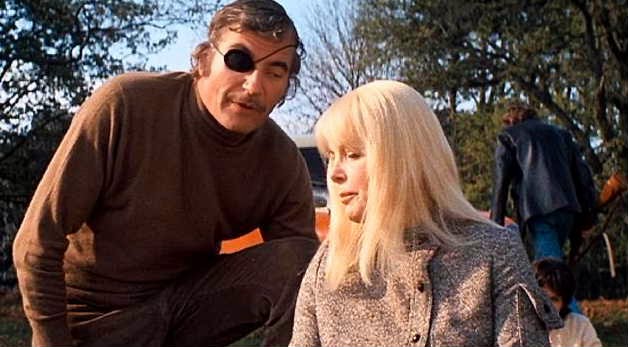
Extreme pollution and a grain-destroying virus have combined to cause hunger and even cannibalism in parts of the world, and citizens of the UK are afraid it isn't long before the same thing happens to them. John Custance (Nigel Davenport), his wife, Ann (Jean Wallace), their children, and friend Roger (John Hamill) take off for a farm in the countryside but have a hell of a time getting there. Along the way they hook up with Pirrie (Anthony May), a casual murderer, but they descend into savagery just as much as everyone else. Eventually Custance is pitted against his own brother ... No Blade of Grass is well-directed by Cornel Wilde [The Naked Prey] -- who does not appear in the film but offers some narration -- but can't overcome its weak script and the miscasting of its two mediocre leads, Davenport [A Man for All Seasons] and Wallace [Jigsaw], although there are good performances from members of the supporting cast. There are some arresting sequences, such as the harrowing business when the family tries to get out of a mob-ruled city by car, and a tense stand-off between Custance and Pirrie over the daughter, Mary (Lynne Frederick). George Coulouris [Citizen Kane] has a small role as a gun shop owner. Despite all of the very grim goings-on, No Blade of Grass manages to become quite tedious after awhile. There is hardly a sympathetic character in sight.

Verdict: Unremittingly depressing, and not good enough to compensate for it. **.

Thursday, November 14, 2013

DOCTOR AT SEA

Bardot and Bogarde
DOCTOR AT SEA (1955). Director: Ralph Thomas.

Dr. Simon Sparrow (Dirk Bogarde) becomes a ship's doctor chiefly to get away from an encumbrance with the plain daughter of his medical partner. Instead of a grumpy chief surgeon played by James Robertson Justice, he gets a grumpy Captain Hogg, also played by James Robertson Justice, and who's not much different from the surgeon. Hogg hates the idea of women on board ship, but he gets two female passengers, French chanteuse Helene Colbert (Brigitte Bardot), and Muriel Mallet (Brenda de Banzie), who is fascinated by the captain's beard and happens to be the daughter of the head of the line. There's some funny stuff in here, but more often the picture strains for hardy laughs. The cast is quite good, however, with an always-solid Bogarde, although a more demure, brunette Bardot, while attractive and capable, doesn't resemble the blonde sex bomb she was most frequently seen as. Justice played Sir Lancelot Spratt in one previous Doctor film, and in three later ones, including Doctor in Love, in which Michael Craig briefly took over from Dirk Bogarde in the lead, although not in the same role. Brenda de Banzie also had an important role in Hitchcock's 1956 The Man Who Knew Too Much, and is somewhat wasted in this piffle. George Coulouris plays a drunken sailor and plays it well.

Verdict: Fans of Bardot and/or Bogarde will enjoy this more than others. **.

Thursday, May 23, 2013

LADY ON A TRAIN

David Bruce and Deanna Durbin
LADY ON A TRAIN (1945). Director: Charles David.

Nikki Collins (Deanna Durbin) is on a train a few minutes from Grand Central Station when she sees a man being murdered from the window. [Agatha Christie used a similar premise -- on an English train, of course -- 12 years later, and did a lot more with it.] Unable to explain the situation with any intelligence to the police due to her "cute" ditsyness, she decides to take her problem to a well-known mystery writer, Wayne Morgan (David Bruce), but his girlfriend (Patricia Morison) objects to her presence. Learning the identity of the murdered man, she attends the reading of his will, and is mistaken for his paramour as in Something in the Wind. [And this takes place at Christmas time as in Durbin's Christmas Holiday.] The actual paramour is Margo Martin (Maria Palmer), a singer at the Circus nightclub, where some of the action  takes place. And so on. This is a fairly dull comedy-mystery, but at least the identity of the murderer may come as a slight surprise. Edward Everett Horton nearly walks off with the picture as an apoplectic employee of Nikki's father; Elizabeth Patterson gives Durbin a good whack in the face at one point when she thinks she's gotten all of the dead man's money; and William Frawley [Fred Mertz] is funny as a desk sergeant who thinks Nikki is nuts. Otherwise, there are only a couple of chuckles in this. Dan Duryea, Ralph Bellamy and Allan Jenkins are also in the cast, and dour George Coulouris seems to be in another movie entirely. Durbin warbles "Silent Night," "Give Me a Little Kiss" [in the nightclub], and "Night and Day" and does a fine job with all of them. Her acting is only so-so, however. Durbin later married the director.

Verdict: Some nice things but it isn't very good all told. **.

Thursday, April 25, 2013

SLEEP, MY LOVE

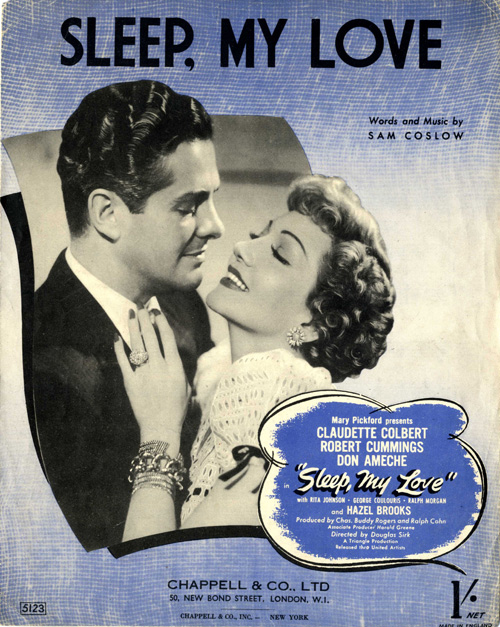
SLEEP,  MY LOVE (1948). Director: Douglas Sirk.

Sutton Place heiress Alison Courtland (Claudette Colbert) wakes up on a train to Boston with no idea how she got there. Turns out this is not the first time that this has happened. She also has weird nightmares and swears she keeps seeing a strange man in horn-rimmed glasses who claims to be a Dr. Rhinehart (Ralph Morgan) but looks nothing like the real one. We can also see this man, whose name is Charles (George Coulouris) and are let in early on that he's involved in some scheme with Alison's faithless husband Richard (Don Ameche), who has fallen for the slinky Daphne (Hazel Brooks) and has unpleasant plans for Alison. Bruce Elcott (Bob Cummings) is a man Alison met on the train and has become friends with; he's the only one who really believes she keeps seeing creepy Charles. The Gaslight -like plot of Sleep, My Love may not hold a lot of surprises, but the film is very entertaining in spite of it, thanks to Sirk's smooth direction and fine performances from the entire cast who make the most of the material. Raymond Burr appears briefly as a cop; Rita Johnson is Alison's muddle-headed friend Barby; and Keye Luke is Bruce's honorary brother, whose honeymoon is interrupted by sinister events. Hazel Brooks is as sexy and compelling in this as she was in Body and Soul with Garfield.

Verdict: Fun if minor suspense item with a creditable cast. ***.


Thursday, January 24, 2013

NOBODY LIVES FOREVER

NOBODY LIVES FOREVER (1946). Director: Jean Negulesco.

Nick Blake (John Garfield) is fresh out of the army, and discovers his girl, Toni (Faye Emerson) hasn't exactly been idle during his absence. He leaves for Los Angeles with his buddy Al (George Tobias), and is offered a lead role in a new scheme by fellow low-life, Doc (George Coulouris): he is to romance a recently widowed and wealthy woman named Gladys (Geraldine Fitzgerald) with the aim of parting her from her newly-acquired dough, a percentage of which he'll turn over to Doc and his racketeer cronies. But what happens if Nick genuinely falls in love with Gladys? Nobody Lives Forever is a surprisingly dull suspense drama with a shoot 'em out climax that seems to last an hour. Garfield is fine, but his character is unreal and uninteresting, and while Fitzgerald gives a good performance as the very naive and lady-like Gladys, it has no spark or fire, and neither does her character. The whole story is contrived and unbelievable in many respects to start with. George Coulouris (Womaneater; Citizen Kane) is excellent but George Tobias is irritating and adds absolutely nothing to the picture. Emerson [Lady Gangster], Walter Brennan [A Stolen Life] and Robert Shayne [The Neanderthal Man] are all fine in smaller roles. Again Brennan plays a character who is much older than he was at the time of filming.

Verdict: Phony and lifeless. **.

Thursday, January 26, 2012

THE MAN WITHOUT A BODY

Robert Hutton and Julia Arnall with the head of Nostradamus
THE MAN WITHOUT A BODY (1957). Directors: W. Lee Wilder; Charles Saunders.

When wealthy businessman Karl Brussard (George Coulouris) discovers he has a brain tumor he somehow gets the idea that if he can have the brain of Nostradamus transplanted into his head, he will take over the famous man's mind with sheer will power -- or something like that. Robert Hutton is the doctor, Merrick, who gets involved in this ridiculous experiment, Michael Golden is Nostradamus, Nadja Regin is Brussard's sexy girlfriend Odette, and Sheldon Lawrence [Bluebeard's Ten Honeymoons] is the equally sexy Dr. Lew Waldenhouse, who has a fling with Odette. Julia Arnall plays Jean, Merrick's assistant. Kim Parker from Fiend Without a Face has a small role as a maid. This is watchable but absurd, and not nearly as much fun as it sounds. Coulouris appeared in everything from Citizen Kane to Womeneater, not to mention the aforementioned Bluebeard's Ten Honeymoons, The Verdict (1946), and many others. This movie is not to be confused with other living head films such as The Thing that Couldn't Die or The Brain that Wouldn't Die.Wilder also directed Phantom from Space, Killers from Space and Manfish with Lon Chaney Jr. Far and away his best film was Bluebeard's Ten Honeymoons.

Verdict: Anyone with half a brain will probably not want to see this. **.

Thursday, June 11, 2009

WOMANEATER

WOMANEATER (1958). Director: Charles Saunders. NOTE: U.S. title was The Woman Eater

"What are these worthless lives compared to what I'm giving to the world?" 

Dr. Moran (George Coulouris, light years from Citizen Kane) travels to the amazon in search of a formula that can revive the dead, and somehow manages to come back with a full-grown native man, Tanga (Jimmy Vaughn), and a big limbed plant that likes to snack on full-grown females. Moran is of the opinion that after the creature snacks on a woman, he can use the sap for his formula to bring back the dead. Sally Norton (Vera Day) is a pretty ex-carnival worker who finds new employment at the doctor's, much to his housekeeper, Margaret's (Joyce Gregg), displeasure. Moran, who considers himself a genius, supposedly falls in love with Sally, who seems to have the brains of a mouse. Tanga practically writhes in orgasm each time the plant-monster feeds. The tree is covered with hair or fur and has many wriggling arms or trunks. This movie should be fun, and it's watchable, but somehow it lacks that certain sensationalistic aura that might have made it memorable, and the "feeding" scenes aren't very well done. The performances are good for the most part and there's an undeniable amusement value to the film. Jimmy Vaughn is quite vivid as Tanga but he never made another movie. 

Verdict: A good double-bill with the equally mediocre From Hell It Came. **.

Thursday, May 7, 2009

THE VERDICT (1946)

THE VERDICT (1946). Director: Don Siegel. 

Scotland Yard superintendent George Grodman (Sydney Greenstreet) loses his job to a rival, Buckley (George Coulouris), when it is discovered that a man he sent to the gallows for a murder was actually innocent. Then another murder occurs in the same family as before, and Buckley sets out to find the killer as Grodman does what he can to help him. Peter Lorre is cast as Victor Emmric, an artist friend of Grodman's, and Paul Cavanagh is Russell, who becomes a major suspect in the second murder. Rosalind Ivan is the hysterical landlady, and Joan Lorring is Lottie, a nightclub singer who was involved with the dead man. The picture at first seems to go in many different directions, but it eventually builds up quite a bit of suspense as to the identity of the murderer. The acting all around is excellent, although at times it may seem as if that wonderful team of Greenstreet and Lorre are just going through the motions (although it may just be some consummate underplaying). Terrific ending, and the film is fascinating on many different levels. Very well-directed for maximum tension by Donald Siegel, who also directed the science fiction classic Invasion of the Body Snatchers. This was his third directorial assignment. Lorring also appeared with Lorre and Greenstreet in Three Strangers

Verdict: Greenstreet and Lorre are always fun! ***1/2.

Thursday, March 5, 2009

NONE BUT THE LONELY HEART


NONE BUT THE LONELY HEART (1944). Director: Clifford Odets.

"Love's not for the poor, son. No time for it."

This is one of only two films directed by playwright/screenwriter Clifford Odets, and frankly you expect more from a man with his talent. The first problem is that Odets was adapting someone else's novel, and the second is that Odets the director wasn't a little tougher on Odets the screenwriter. To be blunt, despite a good idea and some nice moments, None But the Lonely Heart is a talky bore.

Ernie Mott (Cary Grant) wants to live free and independent, but when he learns that his Ma (Ethel Barrymore) is dying of cancer, he decides to stick around and help her run her shop. Although there's a nice, uncomplicated girl, Aggie (Jane Wyatt), who loves him unconditionally ("I wouldn't trade it for a box at the opera, the thing I feel for you," she tells him), Ernie gets involved with the much more complicated Ada (June Duprez). Ada is still very much connected to her brutal mobster ex-husband Jim (George Coulouris).

The problem with the plot is that the whole business of a basically nice guy getting involved
with a slick operator (in this case, Jim) to make money was pretty much old hat by 1944. In an earlier decade Mott would have been played by James Cagney and in a later decade Jim would have been enacted by Steve Cochran. In all the directions that the film could have gone, it chooses the most trite one.

The film is never convincing and is sentimental in the wrong way. Grant gives a very good performance, but he isn't exactly believable as a cockney or as someone from the lower classes; he's too old and too sophisticated by far. Barrymore is wonderful as Ma Mott, but even she is a touch too lady-like. Wyatt gives another lovely -- if brief -- performance as Aggie, and June Duprez does okay as Ada. Coulouris is on the money as Jim. An uncredited Queenie Vassar offers a vivid portrait of the larcenous Mrs. Snowden, and Konstantin Shayne and Barry Fitzgerald enact important supporting roles with aplomb.

Verdict: Disjointed disappointment, but with a great theme borrowed from Tchaikovsky. **.

Monday, June 23, 2008

BLOOD FROM THE MUMMY'S TOMB

BLOOD FROM THE MUMMY'S TOMB (1971). Director: Seth Holt.

An maltreated Egyptian Princess named Tera (Valerie Leon) takes over the mind of a young woman, Margaret Fuchs (also Leon), who was born at the exact moment her tomb was discovered twenty or so years before. Her corpse is remarkably well preserved, and drips blood from the wound where her hand was cut off centuries before. Various people who were on the expedition to her tomb are killed, their throats torn out. The bloodletting doesn't help a bit in making this slow, dull and somewhat inept film more entertaining. The tomb doesn't look as if it's older than the few days it took to put up the set, and the story is confusing. Holt's uninspired direction is absolutely no help at all. Andrew Kier plays Margaret's father, but his part is under-written. Mark Edwards is Margaret's boyfriend, named "Tod Browning." There's a lot of rushing around to little effect. Many people consider this one of the better Hammer horror films, but it's really quite forgettable. Based on Bram Stoker's novel The Jewel of the 7 Stars. Rosalie Crutchley, who plays another victim of the curse, was memorable as creepy old Mrs. Dudley, the caretaker's wife, in The Haunting. George Coulouris from Citizen Kane plays an aged professor, and James Villiers adds some zest as Corbeck. This film was remade as The Awakening in 1980.

Verdict: Nothing to shout about. *1/2.