Lively, entertaining reviews of, and essays on, old and newer films and everything relating to them, written by professional author William Schoell.
Showing posts with label 1977. Show all posts

Thursday, July 31, 2025

THE FILMS OF DORIS DAY

THE FILMS OF DORIS DAY. Christopher Young. Citadel Press; 1977. 

This was one of the picture-packed oversized volumes of Citadel Press' "Films of" series. Young has a biographical section up front, then a section on each of Day's movies, with excerpts from contemporary reviews and notes by the author on select films. There are also several photo galleries, and each movie has a crop of photos as well. Young makes the point that Day was often under-rated, both as a light musical comedy star and then later as a dramatic actress. Day gave notable performances in Julie, Midnight Lace, Love Me or Leave Me, The Man Who Knew Too Much, and others, and she was extremely adept in comedies, such as the ones she did with Rock Hudson. Still, poor Doris had her haters, including Mad magazine, which made merciless fun of her at every opportunity back in the day. 

Verdict: Enjoyable, heavily illustrated romp through Doris-Land. ***. 

Thursday, April 27, 2023

NASTY HABITS

Glenda Jackson and Sandy Dennis
NASTY HABITS (1977). Director: Michael Lindsay-Hogg. 

When the elderly abbess Hildegarde (Edith Evans) passes away, a battle ensues between two factions of nuns in Philadelphia. On one side is Sister Alexandra (Glenda Jackson), who wants to remain aloof as the Prioress Sister Walburga (Geraldine Page) and Mistress of Novices Sister Mildred (Anne Jackson) conspire with the somewhat addle-pated Sister Winifred (Sandy Dennis) to spy upon the other faction and trip them up at every turn. On the other side is the younger Sister Felicity (Susan Penhaligon) who sneaks out into the woods outside the convent for romantic rendezvous and hot sex on a regular basis. She wants all of her nuns to have a steady beau. Both groups are not above using hidden mikes and cameras to find out what the others are up to. When Felicity is excommunicated, she goes public, telling all on The Mike Douglas Show. Is this the end of this oddball Philly faction of possibly Catholic nuns? 

Jackson, Jackson and Page
Frankly, the notion of setting the whole Watergate story in a nunnery is brilliant, and while the execution may be flawed, Nasty Habits emerges as a memorable motion picture. The actors are all wonderful, but Glenda Jackson is simply superb as the quietly ferocious manipulator behind the scenes. One of her best sequences has her addressing the other nuns as to the difference between ladies and the bourgeoisie, but she is wonderful throughout. Nasty Habits may not be a laugh riot a la Night at the Opera, but it is consistently amusing. Keeping it in the family, a few of the cast members' husbands are also in the film: Rip Torn; Eli Wallach, and Jerry Stiller -- all play priests (Stiller's wife Anne Meara is a gum-chewing nun from Joisey.) Vatican scenes with Stiller and Wallach examine whether or not the Philly nuns are a true order or not, a sop to the Catholic Church, of course. Melina Mercouri is also fun as a nun who travels the world as a missionary and advises Sister Alexandra by telephone. 

Verdict: This very funny movie should have been a TV series! ***. 

Thursday, February 17, 2022

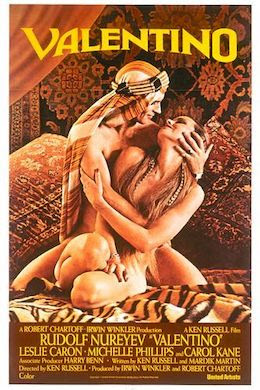
VALENTINO (1977)

VALENTINO
 (1978). Director: Ken Russell. 

Ken Russell takes the life of Rudolph Valentino (Rudolf Nureyev) and gives it the usual camp-grotesque treatment that he favors. Leslie Caron overacts (or was directed to overact) as Nazimova; Michelle Phillips (of The Mamas and the Papas) is barely adequate as Natasha Rambova. Other familiar faces in the cast are Anton Diffring as a cabaret owner; Linda Thorson ("Tara King" of TV's The Avengers) as a dance hall hostess; Huntz Hall of the Bowery Boys as Jesse Lasky; Carol Kane as an actress-friend of Fatty Arbuckle's; Seymour Cassel as an agent; John Ratzenberger of Cheers as a reporter. Russell himself plays Rex Ingram. Hall and Kane are simply mediocre. Some of the bad acting probably has to be attributed to Russell's lack of flair with actors. Nureyev, however, has charm and charisma and sometimes even hits the mark with his acting, but a different director might have brought out an even better performance. The picture really only comes alive when Rudy dances; especially good is Valentino's tango with Nijinski (Anthony Dowell) early in the picture. This is even worse than the 1951 Valentino; there is no attempt at characterization to speak of. Worse, the movie is actually quite boring. Russell wants so bad to be hip, but the dumb, homophobic humor works against it, as does just about everything else. By the way, the climactic boxing match never actually happened, which is true of most of the picture. 

Verdict: Turn it off after the tango. Another freak show from one of the worst film directors ever. *.

Thursday, April 16, 2020

BLACK SUNDAY (1977)

Bruce Dern and Marthe Keller
BLACK SUNDAY (1977). Director: John Frankenheimer.

German-Arab Dahlia (Marthe Keller) is a member of the terrorist group Black September. She has been able to manipulate her lover, a bitter Viet Nam vet named Lander (Bruce Dern), into helping her in a plot to kill thousands of Americans. She hopes to send a message to the U.S. to stop aiding Israel. A taped message that she had planned to release to the media after the event has been recovered following a raid so that now the government knows something deadly is planned but doesn't know what. (The fact that Lander is one of the pilots of the Goodyear blimp for the Superbowl should give you a clue.) Israeli agent Kabakov (Robert Shaw) and FBI man Sam Corley (Fritz Weaver) join forces with others to find this woman -- whom Kabakov should have killed during the raid but didn't -- and stop her plan before she can kill over 83,000 people -- and the President -- at the Superbowl in Miami.

Robert Shaw
Black Sunday is a thinking man's thriller, the kind they generally don't make anymore, in that it has some great action set pieces and lots of suspense, but it also has interesting characters and heroes who are not quite superhuman. The film is over two hours long but never boring as it follows the deadly exploits of the daring terrorist duo and their equally daring pursuers, with speed boat chases, telephone bombs, hotel shoot-outs and a climax involving a blimp, a helicopter, a sub-machine gun wielded all too well by Dahlia, and a bomb that will fire thousands of metal pellets into a crowd of cheering and clueless fans if something isn't done to prevent it.

Marthe Keller 
The acting in the film could not be bettered. Marthe Keller of Fedora gives another excellent and passionate performance as the terrorist, and Bruce Dern [Coming Home] is simply superb as the tormented and vengeful vet who spent months in a POW camp and whose wife left him for another man when he finally returned home. Robert Shaw is similarly on target, as are supporting performances from Weaver, Steven Keats [The Last Dinosaur] as another ill-fated Israeli agent, and others. There's a horrifying scene in a warehouse when the evil duo test their weapon on an innocent caretaker who only thinks they're going to take his picture, and many other memorable moments. John Williams' score is also quite effective.

This is based on a novel by Thomas Harris. I always thought it was far superior to his over-rated Silence of the Lambs and that this earlier film is far superior to the film version of Lambs. Back in 1977, terrorist plots like this were strictly the stuff of movies and books, not to mention James Bond, but 9/11 certainly changed that notion, as we soon realized, sadly, that now anything was possible ...

Verdict: Terrific thriller with a great plot and excellent performances. ***1/2. 

Thursday, November 28, 2019

HAYWIRE

HAYWIRE. Brooke Hayward. Originally published in 1977; updated 2011. Random House.

Brooke Hayward is the daughter of actress Margaret Sullavan and agent-turned-producer Leland Hayward. This memoir looks not so much at those two individuals, but at how their interactions affected Ms. Hayward and her brother and sister. Sullavan and the narcissistic Hayward divorced after the latter had an affair while she was out of town working oversea for months, and it left lasting scars, especially on Sullavan, who felt abandoned by her children when they went to live with their father. Both of the parents remarried.

Instead of a probing look at the parents, two interesting individuals, whatever their flaws, with seriously important careers, we mostly get the ruminations of their daughter, which at times become quite tedious in this lengthy if occasionally absorbing memoir, although, to be fair, she does a fair job of analyzing them at times. Although the author tries very hard to portray her family as some kind of dynasty, and their story as an epic tragedy, this doesn't quite work, and she seems oblivious to the fact that marital problems, suicides, mental health issues etc. also afflict people in tenements. In fact, entitlement screams at you from every page. Oddly, Ms. Hayward barely goes into her marriages to Dennis Hopper or Peter Duchin (son of Eddy Duchin), although that might have been of some interest to the reader. Despite the rave reviews (Ms. Hayward had connections, after all), I imagine many readers got tired of slogging through the book in search of juicy material. Another problem is that the book is poorly organized, jumping around in time when a linear narrative would have worked much better.

Ms. Hayward also ignores her career, although there wasn't much to it. Although she was rather amateurish appearing opposite Jerry Orbach in the film Mad Dog Coll, she displayed real ability in the Twilight Zone episode "The Masks." She only amassed 12 credits, however. She also had a brief modeling career although her looks were average.

If you actually want to read a biography of the great Margaret Sullavan, I recommend Margaret Sullavan, Child by Fate by Lawrence J. Quirk.

Verdict: Well-written but seriously flawed memoir. **1/2. 

Thursday, July 25, 2019

LIFE IS A BANQUET: ROSALIND RUSSELL

LIFE IS A BANQUET: ROSALIND RUSSELL. Rosalind Russell with Chris Chase. Random House; 1977.

Published posthumously, Rosalind Russell's autobiography, very well-written by Chris Chase, has an affecting introduction by her widower, the producer Frederick Brisson. Russell writes of her comparatively privileged upbringing, her two sisters (one of whom was to remind her of Auntie Mame), her first stabs at acting, her long-lived marriage to Brisson, and her many famous roles, especially Mame, which she played both on Broadway and in the film adaptation. Her other notable film roles included Sister Kenny, Gypsy, Craig's Wife,  along with a few stinkers, such as What a Woman, which she declines to even mention. She does not relate that many backstage or behind-the-scenes stories, and is generally kind to her co-stars, although she does excoriate some unnamed film directors who have no idea of what they're doing and can not work with actors at all. Russell reveals that Hayley Mills was extremely unpleasant to work with when she appeared in The Trouble with Angels, as well as the fact that Russell and her husband were close, lifelong friends with Frank Sinatra, who took over and completely handled what sounds like an incredible 25th anniversary party for the couple. Russell indulges in some perfectly understandable name-dropping along the way, including people who were not in the film business. In later years, she worked hard to help people who suffered from arthritis, as she did. Russell always felt that she was not quite "of" Hollywood, that she wasn't one of those stars who was so devoted to her career and so obsessed with becoming a top-ranked star that she neglected everything else in her life, and it sounds like she was all the better for it. Russell insists that she was not dubbed at all for her singing in Gypsy, but it's very clear in the movie that she begins to sing a number until Lisa Kirk takes over; Russell never mentions her and seems to have a delusion about her true vocal contribution. Russell gives an excellent performance in the movie, however.

Verdict: Excellent film memoir is engaging and well-written, although not very "dishy." ***1/2. 

Thursday, October 11, 2018

THE LAST DINOSAUR

Steven Keats and Richard Boone
THE LAST DINOSAUR (1977). Directors: Alexander Grasshoff and Tsugunobu Kotani.

"A creature forty feet tall and weighing eight tons with the mind of a pea has just destroyed one of the greatest minds of the century."

 Masten Thrust Jr. (Richard Boone of I Bury the Living) is not only a famous hunter but one of the world's wealthiest men. He has developed a vehicle called the Polar Borer, that uses lasers to drill through the Polar Ice Cap, discovering a hidden world in a prehistoric valley below that is warmed by a volcano. Four men have already died at the teeth of a T-Rex, that appears to be the only one of its kind, although there are other dinosaurs in the valley. Returning to this land with the only survivor of the first expedition, Chuck (Steven Keats), Thrust also brings along Professor Kawamoto (Tetsu Nakamura of The Manster); an expert and silent seven foot tall tracker named Bunta (Luther Rackley); and a perky photographer named Francesca (Joan Van Ark). Although the original plan is only to study the tyrannosaurus, when it proves aggressive and even squashes the poor professor underfoot, Thrust determines to destroy the creature. But then the big beast snatches up the Polar Borer in its teeth and the whole group is stranded in the valley with time running out ...

The rubber T-Rex
The Last Dinosaur has a workable plot line, but it borrows very heavily from the film The Land Unknown, and the Polar Borer (which hardly looks large enough to hold so many people) reminds one of a similar machine in At the Earth's Core. Of course it's just another imitation of The Lost World minus diamonds and "fire gods." A bigger problem is the FX work, which features some crude but effective process shots and a rubber monster brought to life with "suitmation" -- a man in an dinosaur suit. The creature also lets out metallic wails that are borrowed from Godzilla. The shame is that the film does manage to work up some suspense -- as in Land Unknown there's a small window of opportunity to get out of the valley if they can survive the beast's attacks -- and this could have made a very exciting picture had Ray Harryhausen brought the creatures to life. A battle between the T-Rex and a triceratops does not compare favorably to a similar battle in Harryhausen's The Valley of Gwangi.

Bantu takes after T-Rex with a spear -- good luck with that!
The acting in the movie is professional, if uneven, with Richard Boone creating a colorful if contradictory character, and William Overgard's screenplay does do its best to bring some of the people in it to life. There's some decent art direction in the movie, but the score is pretty terrible. This was meant to be a theatrical film, but it was released to television in a somewhat edited version. The film makes much of the fact that the title refers to Boone as much as it does to the tyrannosaurus.

Verdict: Hardly the "last" dinosaur we've ever seen in film. **1/4. 

Thursday, August 23, 2018

THE SPELL

Lee Grant
THE SPELL (1977 telefilm). Director: Lee Philips.

Rita Matchett (Susan Myers) is a slightly overweight 15-year-old girl who is cruelly taunted by the mean girls in her class. One of the meanest is in gym class when she falls off a rope doing a trick and breaks her neck. Rita has a younger sister, Kristina (Helen Hunt), a father, Glenn (James Olson of Crescendo), who's rather cold to her, and a mother, Marilyn (Lee Grant), with whom she seems to share a special bond. As more strange things begin to occur, Glenn wants to pack Rita off to a special school in London and Marilyn resists suggestions that Rita is not only different but dangerous ... The Spell is one of a long line of films made in the wake of Carrie, although this picture drops the strange-girl-vs-mean-girls storyline pretty early and turns into a domestic drama of sorts with two comparatively ineffectual parents trying to deal with their strange and rebellious daughter. Nothing much supernatural or especially weird happens until a friend and neighbor of the Mattchetts literally burns up from the inside out and becomes a ghastly corpse halfway through the movie, a literal cooked sausage. For the finale, the picture winds up back in Carrie territory. The Spell presents some intriguing situations, an interesting young heroine, and has a couple of twists, but it's also a little disjointed and confusing (one suspects scenes were left on the cutting room floor to make way for the commercial breaks), and there's no particular flair to the direction. If the film works at all it's because of the acting, with Lee Grant splendid as the mother, emoting with complete conviction as if she were in a serious drama and not a semi-schlocky made-for-TV suspense film. James Olsen and Susan Myers are also excellent, and a very young Helen Hunt already shows signs of the abilities that would eventually net her an Oscar. Brian Taggert, who also scripted the Lee Grant starrer Visiting Hours as well as a TV remake of What Ever Happened to Baby Jane? with the Redgrave sisters, seems to have grafted a not completely convincing horror story onto a tale of teenage angst in which the heroine discovers that she not only doesn't mind being "different" but actually prefers it. Director Lee Philips, who also helmed the interesting telefilm The Girl Most Likely To ..., was originally an actor in such films as Peyton Place and others. Years later Grant and Helen Hunt would both appear in Dr. T and The Women.

Verdict: Grant makes the most of a script that doesn't quite call for her talents. **1/2.

NOTE: This review is part of the "Lovely Lee Grant" blogathon co-hosted by Chris of Angelman's Place and Gill of Realweegiemidget Reviews. 

Thursday, October 26, 2017

SHOCK WAVES

Brooke Adams and Luke Halpin
SHOCK WAVES (1977). Director: Ken Wiederhorn.

A group of people out on a short chartered boat tour might not wind up on Gilligan's Island, but they probably wish they had. Instead they wind up on an island that is home to an elderly Nazi scientist (Peter Cushing) who tells them how they created unkillable super-soldiers who were meant to be the ultimate weapons. Dead already, these soldiers can stay underwater for hours and stalk the enemy with ultra-extreme stealth. The tourists, including Rose (Brooke Adams), Norman (Jack Davidson) and Beverly (D. J. Sidney),  team up with crew members Keith (Luke Halpin) and Dobbs (Don Stout) and try to get off the island before the zombie Nazis can slay them. Shock Waves has a damned good premise but its execution is below mediocre, with too many slack stretches, no real suspense or surprises, and not nearly enough exciting sequences. Of the major younger cast members, Adams makes the best impression and was the only one to have a fairly big career. Of the veterans, Peter Cushing has one of his least interesting roles, and John Carradine, as the captain of the tour boat, is killed off early on. Halpin [Island of the Lost] was most famous for the TV show Flipper.

Verdict: Pretty much a waste of a good idea. **.

Thursday, August 3, 2017

ANNIE HALL

Diane Keaton and Woody Allen
ANNIE HALL (1977). Director: Woody Allen. Screenplay by Allen and Marshall Brickman.

:There's too much emphasis on orgasms to make up for the emptiness in life.: -- Alvy.

"Who said that?" -- Annie.

"Leopold and Loeb." -- Alvy.

Comedian Alvy Singer (Woody Allen) tells us of his relationship with, and ultimate bittersweet breakup from, girlfriend Annie Hall (Diane Keaton) in a tale that looks at how people can love one another but may not be right as lifelong partners. Annie Hall is one of Allen's most likable and entertaining movies, a frequently inventive comedy-drama (with emphasis on comedy) in which Allen/Singer talks directly to the audience, and he and other characters observe and comment as they look back at their younger selves with earlier lovers, and so on. Allen [Shadows and Fog] and Keaton [Shoot the Moon] both offer winning performances and there are small roles/cameos from Colleen Dewhurst [You Can't Take It With You], Christopher Walken, Carol Kane, Shelley Duvall, Janet Margolin, and larger roles for Tony Roberts (whose character of a sitcom actor never seems remotely real) and Paul Simon as a wealthy record producer (he's fine). An odd scene has Annie talking about a tragic, shell-shocked uncle without having any real understanding of what the poor man must have gone through and laughing at it until she realizes "I guess it's not funny." Duh! The film has a sub-text of the differences between a New York and Hollywood lifestyle, not to mention the differences between Manhattan and L.A. You can't say that either Alvy or Annie are people you might actually want to hang out with, but they make an engaging sort of couple for the movie if nothing else. Allen won Oscars for writing (along with Marshall Brickman) and directing and was nominated for his performance; Keaton won the Best Actress Oscar, and the movie won Best Picture.

Verdict: Not really a masterpiece as such, but lots of airy charm and creative fun in this. ***.

Thursday, November 17, 2016

SHOCK (1977)

SHOCK (aka Beyond the Door 2/1977). Director: Mario Bava.

Dora Baldini (Daria Nicolodi of Opera), her second husband Bruno (John Steiner of The Devil Within Her) and her little boy Marco (David Colin Jr.) move into the home she previously occupied with her late first husband, a drug addict who presumably committed suicide. Being in the house -- a rather bad idea -- has an effect on Dora, as it seems to have on her son, an adorable seven-year-old child who begins doing upsetting things that he later tearfully denies. Bruno thinks it is all in Dora's head, reminding her of her stay in a mental institution after her husband's suicide. But do Dora and Bruno have other secrets as well ... Shock is Bava's last film, and it's not one of his best, although the story does lead up to some interesting twists and the performances are good. Little Colin is a wonderful scene-stealing child actor who easily walks off with the movie. There are some genuinely creepy moments in this, but the movie is still tedious and silly for much of its length. Steiner was a British actor who did much work in Italy, including Tenebrae, which starred Nicolodi. Shock was released in the U.S. as Beyond the Door 2 after the success of the original, which is related only in that Colin Jr. also had a role at the ripe old age of 3. Shock has been vastly over-rated by Bava fanatics.

Verdict: What this needs is a little more shock. **1/2.

Thursday, March 17, 2016

PLANET OF DINOSAURS

PLANET OF DINOSAURS (1977). Director: James K. Shea.

A spaceship has to make an emergency landing on a planet that is still in the prehistoric era, complete with lots of dinosaurs. (As usual in movies like this, the characters spend virtually no time talking about their loved ones back home that they might never see again.) A conflict breaks out because Captain Norsythe (Louie Lawless) is cautious and concerned with protecting his crews' lives when it comes to dinosaurs, while his chief opponent, Jim (James Whitworth) feels any risk is acceptable to become master of the monsters. (His attitude is actually more negative than the captain's, because he's assuming they will never be rescued.) As they bicker, they run into a brontosaurus, a big spider, and a battle between a stegosaurus and T Rex, then finally work together to kill an allosaurus (pictured) who keeps attacking their camp. The visual effects artists include Jim Danforth and Doug Beswick, and some of the stop-motion work isn't badly done. There is some attempt at characterization in the film, and some more-than-adequate actors, such as Lawless and Pamela Bottaro as Nyla. Harvey Baylor (Harvey Shain) is the obnoxious businessman who hired the space shuttle and is finally killed off in one of the movie's better moments. One crewman, Chuck, (Chuck Pennington) walks around shirtless throughout the entire movie as if he needed to show off his muscles. None of the people who are killed off ever seem to be mourned by anyone. Of the actors, Whitworth and handsome Max (Michael) Thayer as another crewman amassed the most credits.

Verdict: Not terrible space saga with some decent effects work. **1/2.

Thursday, June 25, 2015

ALEXANDER: THE OTHER SIDE OF DAWN

Leigh McCloskey
ALEXANDER: THE OTHER SIDE OF DAWN (1977 telefilm). Director: John Erman.

Dawn: Portrait of a Teenage Runaway, a telefilm aired in 1976, was a ratings success, so it was decided to come out with a sequel. Alexander Duncan (Leigh McCloskey), who was introduced in the first film as young prostitute Dawn's (Eve Plumb) boyfriend, is thrown out by his family (who can't afford to feed him) and winds up in L.A., where he, too, sells his body. Then he meets a closeted football player, Chuck Selby (Alan Feinstein), and begins to bond with him. But are they only just using one another? ... Alexander is a dishonest, superficial, ersatz "gay" movie where the lead character has sex with men but is supposedly straight. The scenes with him getting into cars with men, and his exact relationship with Chuck, are glossed over, and the "happy" ending doesn't seem to resolve Alexander's conflicts over his sexuality. Made for television in the seventies, it would have been a surprise that so much of the gay content made it to broadcast were it not for the fact that the far superior and much gayer That Certain Summer aired five years earlier. In this Alexander attends a rap session in a gay center, and goes to gay bars with Chuck (ever dreaming of sweet if drippy Dawn). Eric Holliman portrays a sympathetic gay counselor, and there are nice vignettes from Larry Rosenberg and Jonathan Banks [Wiseguy], among others, as young men at the center. Holliman's character says that he believes in people making their own choices, although nowadays it is not being gay that is considered a choice, but accepting oneself. McCloskey was actually twenty-two when he played this seventeen-year-old character, and while at times he seems a little too sophisticated, he gives a good performance. Holliman [The Power] is fine, as is Feinstein, although Chuck's dallying with a seventeen-year-old and getting him to go off and buy drugs for him, is problematic. Jean Hagen [No Questions Asked] scores as a landlady who's seen better days and has a picture of herself as "Miss Newcomer" of the Year on her wall, and Asher Brauner is also notable as a friend of Alexander's who gets him into hustling wealthy women, such as  Juliet Mills (these scenes have little veracity, frankly). Lonnie Chapman and Diana Douglas are effective as Alexander's parents. Miss Frances Faye plays herself and is apparently female, although in the film she comes off like a drag queen.

Verdict: The sequel, "Alexander Moves to New York and Comes Out," never materialized. **.

Thursday, May 29, 2014

SCARLET O'HARA'S YOUNGER SISTER Evelyn Keyes

SCARLET O HARA'S YOUNGER SISTER: My Lively Life In and Out of Hollywood. Evelyn Keyes. Lyle Stuart; 1977.

Evelyn Keyes was one of those innumerable Hollywood starlets who managed to have a few major roles in minor pictures, and small parts in big movies such as Gone With the Wind. When these "also-rans" write their memoirs they fill the pages with notes on the important people they knew and worked with, and do what they can to convince everyone that their life was fabulous even though Hollywood rejected them [or they rejected Hollywood, which sounds better]. Generally these books are about settling scores and perhaps there's a little of that in Scarlet O'Hara's Younger Sister, but what sets the book apart is that Keyes can write. This is not an "as told to" book where everything is interpreted by somebody else, but Keyes' story in her own generally well-chosen and witty words; it reads like a good novel where you're anxious to see what happens to our heroine next. The book is frank -- Keyes makes no bones that she slept with and married powerful men in the industry [directors Charles Vidor and John  Huston, among others] -- although she claims it was a daddy fixation. The book, full of amusing anecdotes, explores the sleazy underbelly of Hollywood and the crappy way that women, instantly disposable, were treated by most males in the industry. The most interesting passages deal with Keyes' several-years affair with Mike Todd, which almost led to the altar [except he met Liz Taylor], and her marriage to nutty chauvinist bandleader Artie Shaw, whose punctilious behavior would have driven anyone crazy. [Keyes was still technically married to Shaw when this book was published. When he died several years after their 1985 divorce, Keyes successfully sued for half of his estate, but she herself was gone only a couple of years later.] If you're looking for behind-the-scenes stories of the movies Keyes appeared in, look elsewhere; she doesn't even have that much to say about The Killer that Stalked New York, in which she gave an excellent performance. Keyes also gave notable performances in The Face Behind the Mask and Ladies in Retirement.

Verdict: Absorbing life of a Hollywood insider. ***1/2.

Thursday, August 15, 2013

SORCERER

Truck with nitro on rickety -- to say the least -- bridge
SORCERER (1977). Director: William Friedkin.

Jackie Scanlon (Roy Scheider) participates in the robbery of a parish during which a priest is shot, and the priest turns out to be the brother of a mafia bigwig. In France banker Victor Manzon (Bruno Cremer) learns that he is probably going to prison and the only man who can help him commits suicide. These two men and others wind up working in South America under fairly miserable conditions, and are desperate for money to go somewhere else. An opportunity arises when the oil concern needs volunteers to drive two trucks full of nitroglycerin for many miles over dangerous terrain to deliver to the oil well, with a big pay-off for those who survive. Sorcerer is a remake of Henri-Georges Clouzot's The Wages of Fear, and is generally well-done, if not exceptional. The movie pulls you in even though its characters are hardly sympathetic, and the gritty and atmospheric details help make the trip compelling. The film's main strength lies in excellent, harrowing [if somewhat improbable] sequences in which the trucks have to somehow maneuver their way over shaky bridges on the verge of falling apart and spanning rushing waters. [Oddly, one scene in which a deadly explosion occurs is sort of thrown away.] There is some forgettable music from Tangerine Dream when Sorcerer cries out for a rousing, dramatic score, which probably would have made it a much more successful picture on every level. [Even Hitchcock knew the value of a good musical score, and Friedkin is no Hitchcock.] The actors give it their all, and the photography is top-notch, although there are times the somewhat documentary-style approach results in some disjointed editing and an occasional slapdash look. Friedkin wrote about his travails making the picture in his book The Friedkin Connection.

Verdict: Not entirely satisfying, but often quite gripping. ***.

Thursday, July 4, 2013

CURSE OF THE BLACK WIDOW

CURSE OF THE BLACK WIDOW (1977 telefilm). Director: Dan Curtis. Originally presented as an ABC Friday Night Movie.

A woman comes into a bar and asks for help with her car. A guy named Frank obliges, and is later found dead and drained of blood. His fiancee, Leigh (Donna Mills), asks one of the men who was in the bar that night, private investigator Mark Higbie (Tony Franciosa of Wild is the Wind) to find out what happened, as she's under suspicion because her first husband died at sea under mysterious circumstances. Higbie learns that there were several previous victims found in the same condition and one witness saw what appeared to be a giant spider leaving the scene. Could Leigh's family be under some kind of mystical curse?  ... This is an utterly absurd but entertaining horror film with good performances from Franciosa, Mills, Patty Duke Astin as Leigh's fraternal twin sister, Max Gail as a cop, and even June Allyson [The Shrike] as Leigh's aunt [you have to see her caught in a spider web]! The cast even includes Sid Caesar as a landlord, Vic Morrow [Great White] as a detective, Jeff Corey [Seconds] as a caretaker, and June Lockhart as a mysterious old lady locked in an attic. Roz Kelly nearly steals the show as Mark's spirited and funny secretary. The effects are not exactly high-tech but serviceable.The best thing about the movie is the ad [see photo]. Dan Curtis directed many made-for-TV horror films such as The Night Strangler, as well as such theatrical films as Burnt Offerings.

Verdict: Tarantula is way better but this has its moments. **1/2.

Thursday, May 2, 2013

DEMON SEED

Julie Christie at mercy of malevolent computer
DEMON SEED (1977). Director: Donald Cammell.

"We look at the world differently. You find me boring. I find myself ... quite interesting."

Scientist Alex Harris (Fritz Weaver) has not only computerized his whole house, but is the inventor of a new super-computer named Proteus 4 [beautifully voiced by Robert Vaughn]. Proteus 4's artificial intelligence has curiosity about humans as well as itself, and to that end it links up with the computer system in Harris' house. Desiring to duplicate itself, it imprisons Harris' wife Susan (Julie Christie), using the system against her, and tells her that she is to help him in his reproductive efforts ... not good. Gerrit Graham plays Walter, Harris' assistant, who figures in a bizarre scene when Proteus 4 unleashes a metallic, unwinding cube against him as he tries to help Susan. Demon Seed made use of the notion of blending the biological with the mechanical two years before the much better-known Alien.  The actors are all good, the film holds the attention, but it becomes increasingly absurd to an almost comical degree. Based on a novel by Dean R. Koontz.

Verdict: Ridiculous but entertaining. **1/2.


Thursday, April 25, 2013

THE OTHER SIDE OF MIDNIGHT

John Beck and Marie-France Pisier
THE OTHER SIDE OF MIDNIGHT (1977). Director: Charles Jarrott.

Although it was not his first published novel, Sydney Sheldon had his first big bestseller with The Other Side of Midnight, a very entertaining "beach" read that was the first to employ his standard formula: Sheldon would take plots from old romantic movies and then add some intrigue and thriller elements to them. Generally it worked, although -- as one critic put it -- no matter how entertaining it was you forgot the book the minute you were finished with it. Oddly, the film version of Midnight was not a success, either financially or critically. Not so odd, maybe.

In 1939 Marseilles Noelle Page (Marie-France Pisier) discovers that her own father has basically sold her to her employer. Disgusted, Noelle sets off to Paris and heartbreak, where she meets a soldier, Larry Douglas (John Beck), who leaves her with child, and promises to return and marry her. Determined to get revenge on the man who never comes back to her, Noelle becomes a wealthy film star. In the meantime Larry meets and marries an American publicist, Catherine (Susan Sarandon of Twilight), even as Noelle moves from lover to lover to become the mistress of the world's wealthiest man, Greek shipping magnate Constantin Demeris (Raf Vallone of Therese Raquin). But she and Larry Douglas are fated to meet again, with dramatic consequences for all the parties already named ...

In the novel Noelle and Larry are described as gorgeous specimens of female and male pulchritude. Pisier is certainly a strikingly attractive woman, but every time you see lantern-jawed Beck making love to her you can't help but see chin-happy Jay Leno. Beck's performance is competent but not so great that you can understand his casting, but then the producers obviously wanted to save money by using relative unknowns. Sarandon and Pisier certainly earn their paychecks with well-crafted performances -- in addition Pisier is forced into bedroom scenes with one [comparatively speaking] ugly old man after another, making the flesh crawl, and even Larry isn't so great! These sex scenes go on for an excruciatingly long time. The producers wanted to provide long glimpses of Pisier's lovely body, obviously, but forgot that we had to look at her unlovely bed mates as well! 

If you approach the film without ever having read the book, you may find it reasonably entertaining if quite long. [In fact, it takes longer to watch the movie, which is nearly three hours long, than it does to read the book!] The trouble is that Jarrott directs with absolutely no panache, stripping the film of most of its suspense. Though the movie has pretty settings and attractive scenic design, the cinematography is flat and uninspired -- it all looks like a matter-of-fact hastily done TV movie. Jarrott had more success with Mary, Queen of Scots; with Midnight he seems utterly bored with the material.

Despite the film's length, some of the novel's most interesting sequences have been left out. Midnight may not have been a literary masterpiece, but a better film could have been made of it with a little more care and inspiration.

Verdict: Even Sheldon deserves better. **1/2.

DEAD OF NIGHT (1977)

DEAD OF NIGHT (1977 telefilm). Director: Dan Curtis.

Curtis followed up his ratings-successful telefilm Trilogy of Terror with this second anthology of horror stories, which was also the pilot for a projected series. In "Second Chance," scripted by Richard Matheson from a Jack Finney story, a man (Ed Begley Jr. of Eating Raoul) restores a car in which a couple was killed years ago, and discovers that it can drive him all the way to the past to prevent their deaths. Ann Doran from It, The Terror from Beyond Space has a supporting role.  "No Such Thing as a Vampire," which Matheson scripted from his own short story, features a fake vampire murder plot, and boasts some very good performances from Patrick Macnee and Horst Buchholz. "Bobby," written by Matheson, also has fine performances from Joan Hackett and Lee H. Montgomery in a story about a grieving mother who thinks she's called her drowned son back from the grave. The story has a good ending, but it is neither frightening nor moving, which you can pretty much say about the movie in general. Curtis remade "Bobby" even less effectively in Trilogy of Terror II. Robert Cobert's score is mediocre and does nothing to help the telefilm.

Verdict: Reasonably entertaining if very minor horror anthology. **1/2.

Thursday, March 21, 2013

THE SPY WHO LOVED ME

James Bond versus Jaws
THE SPY WHO LOVED ME (1977). Director: Lewis Gilbert.

James Bond/agent 007 (Roger Moore) is on assignment to stop megalomaniac Karl Stromberg (Curt Jurgens), who is stealing submarines and nuclear warheads, and operating from his impressive underwater headquarters. Since the Russians have also lost one of their nuclear subs, Bond joins forces with red agent Triple X/Major Amasova (Barbara Bach), unaware that he killed her lover during a mission and she plans to murder him when their dual assignment is over. [How Amasova's lover could be in two places at the same time is never explained, as she is seen in bed with a man even as he and Bond are fighting many miles away -- unless the good major was unfaithful.] The Spy Who Loved Me introduced Richard Kiel as Jaws, a metal-toothed adversary who seems modeled on the old comic book villain Iron Jaws. Bach is attractive and competent enough as Triple X, but when luscious Caroline Munro briefly appears as a hit woman for Stromberg, she pretty much blows Bach right out of the water. Moore plays this comic book stuff in the right mode, even if he's a far cry from Ian Fleming's original creation. Jurgens is excellent. The suggestive "Nobody Does It Better," composed by Marvin Hamlisch and sung by Carly Simon, is one of the better James Bond theme songs.

Verdict: Good to look at and lots of fun. ***.