Lively, entertaining reviews of, and essays on, old and newer films and everything relating to them, written by professional author William Schoell.
Showing posts with label Karin Dor. Show all posts

Thursday, February 13, 2025

DER TEPPICH DES GRAUENS

Joachim Fuchsberger and Karin Dor
DER TEPPICH DES GRAUENS (aka The Carpet of Horror/1962). Director: Harald Reinl.

John Millner (Roberto Rey) is the latest victim of a secret criminal group that use small balls full of poison gas to off their enemies. His niece, Ann Learner (Karin Dor of Alfred Hitchcock's Topaz), is appalled to learn that he was involved in shady activities and was planning to flee the country without even telling her. She is pursued romantically by handsome Harry Raffold (Joachin Fuchsberger), who is keeping secrets of his own. Other major characters include Dr. Shipley (Antonio Casas), who may have come up with an antidote to the poison; Mabel Hughes (Eleanora Rossi Drago), who owns the hotel where Harry is staying and makes a play for him; portly Vane (Jose Maria Carrafel), who wants to marry her; Crayton (Werner Peters), a member of the gang who discovers the identity of the mysterious boss and hopes to take over; and the imposing and formidable Colonel Gregory (Carl Lange) whose motives are unknown. Harry also has an assistant, a black man named Bob (Pierre Besari), who is on occasion referred to as, and treated like, a servant even though he is apparently an actual operative of some kind. Then there are Inspector Burns (Julio Infiesta) and his younger associate Inspector Webster (Marco Guglielmi), who at one point wants to arrest both Harry and Ann. 

Fuchsberger and Eleonora Rossi Drago
The English title of this West German film (co-produced with Spain), The Carpet of Horror, refers to the fact that the golf ball-size weapons that contain the poison gas are rolled onto carpeted floors in the victims' homes -- the carpet doesn't actually kill anyone. In any case, the movie -- based on a novel by Louise Weinert-Wilton (not Edgar Wallace) -- is exciting and suspenseful and a lot of fun, even if you may figure out the identity of the mastermind (who brought the sinister group over from India) behind the whole racket. The boss sends messages to the group via white letters on a screen, and their HQ is located inside a garage, with a trapdoor to a lower level inside a truck. Beneath the garage is a huge tunnel filled with debris, a striking locale indeed. There's a "catfight" in the underground at one point, which means that this very entertaining flick misses nothing! The cast is an interesting mix of both German and Spanish actors. Mercifully the film hasn't got too much comedy relief -- and no Eddi Arent -- although there is some humor attached to the Bob character. 

Verdict: For once a West German krimi that isn't based on a Edgar Wallace novel even if it seems to be! ***. 

Thursday, August 17, 2023

ALFRED HITCHCOCK'S TOPAZ

Ill-fated lovers: Karin Dor and Frederick Stafford
ALFRED HITCHCOCK'S TOPAZ (aka Topaz/1969). Director: Alfred Hitchcock. Based on the novel by Leon Uris. UNCUT version. 

On the eve of the Cuban Missile Crisis, a haughty defecting Russian Intelligence officer, Colonel Boris Kusenov (Per-Axle Arosenius), escapes from Denmark with the help of the Americans, including Michael Nordstrom (John Forsythe) of the state department. Nordstorm is good friends with a French agent living in Washington named Andre Devereaux (Frederick Stafford), and asks him for his help. First he has to get certain papers from a Cuban officer, Rico Parra (John Vernon of Point Blank), who absolutely loathes Americans. Then Devereaux travels to Cuba, as he does frequently, to see if he can find out exactly what the Russians are up to there. Finally he learns of an organization, code named "Topaz," which consists of highly-placed treasonous French officials who are secretly working with Moscow. Devereaux can't tell his bosses what he has learned about activities in Cuba until he finds and excises this traitorous element. 

Frederick Stafford as Devereaux
If Topaz had been directed by anyone besides Alfred Hitchcock, it would be an acclaimed film. But because the direction is not "showy" as in some Hitchcock films, and there are no outstanding cinematic sequences one can point to -- although there are several good scenes -- Topaz has been unfairly dismissed as a Hitch stinker. Actually it has a very interesting plot and good characters, although you might wish some of them were better-developed. One which is better developed is Andre Devereaux, who seems to have a happy marriage with one-time resistance fighter Nicole (Dany Robin of Follow the Boys) but also has a mistress, Juanita de Cordoba (Karin Dor), in Cuba. Widow of a revolutionary hero, her appeal to Devereaux is obvious -- she is still a "resistance fighter," secretly working against communist influences in Cuba at great risk to herself and her associates. 

Roscoe Lee Browne and John Vernon
Topaz
 has several acts. The first suspenseful section deals with the defector and his family getting away in Denmark and nearly paying the final price when Russian agents with guns pursue them. The second act takes place in New York, especially in a Harlem hotel, where Devereaux's associate Philippe (Roscoe Lee Browne) makes a deal with Rico Parra's secretary, Luis Uribe (Donald Randolph of The Mad Magician), for some papers that detail Russian missile activities in Cuba -- a lot of suspense is worked up over getting those papers out of a certain briefcase and the street chase that follows (which ultimately leads to problems for Devereaux and far worse problems for Juanita). The third act occurs in Cuba. The final section takes place in France, when Devereaux must somehow explains things to his superiors without indirectly giving important information away to the communists. Although Hitchcock filmed three endings, all of which can be seen on the DVD, he went with a quiet if satisfying conclusion at an airport. Perhaps he should have chosen the ending in which Devereaux and his friend, a man known as "Columbine" who runs Topaz, have a duel. (Apparently this was the original ending but preview audiences hated it.) 

Carlos Rivas and John Vernon
Topaz
 features some interesting casting. John Forsythe is solid as Nordstorm, although we never get to learn that much about him. Czech actor Frederick Stafford played a secret agent in a couple of French films previously and seemed perfect for Devereaux, which he is. German actress Karin Dor -- whose best-known film was You Only Live Twice as a Bond villainess who goes to the piranhas -- is given one of her best roles as Juanita, and you wish there was more of her. Phillipe Noirot manages to make his unsympathetic character of Henri Jarre strangely appealing and Per-Axle Arosenius is terrific as the rather obnoxious Russian defector who may be figuratively bloodied but is definitely unbowed. John Vernon had a long career, mostly on TV, but his performance as Rico Parra is only adequate. As his bodyguard Hernandez, Carlos Rivas [The Black Scorpion] makes a striking figure with a thatch of red hair and a beard to match. Ann Doran [It, the Terror from Beyond Space] appears briefly as a woman who ministers to the defector and his family when they first arrive at the safe house. There are also good turns from Michel Subor as Devereaux' son-in-law Francois, and John Roper, Lewis Charles and Anna Navarro as ill-fated associates of Juanita's, among others. Roscoe Lee Browne and Donald Randolph make the most of their scenes in the hotel and elsewhere. 

John Forsythe
Topaz
 is well-shot by Jack Hildyard [Summertime] but Maurice Jarre's score is problematic. I love the exciting opening theme, but just wish the rest of the score had been as dynamic. There are some good moments, but the music mostly lacks the dramatic intensity that might have turned Topaz into a whole new picture; I truly believe it's one of the reasons the film wasn't a critical success. Hitchcock's longest  film, it also could have used some trimming and tightening, especially in the final section. (Apparently this was done for the original theatrical version.) The screenplay is by Samuel Taylor, who wrote Vertigo

Verdict: The Master of Suspense tells the story more simply, perhaps, but still manages to do a better job than most contemporary directors. Some terrific scenes in this! ***. 

Thursday, October 27, 2022

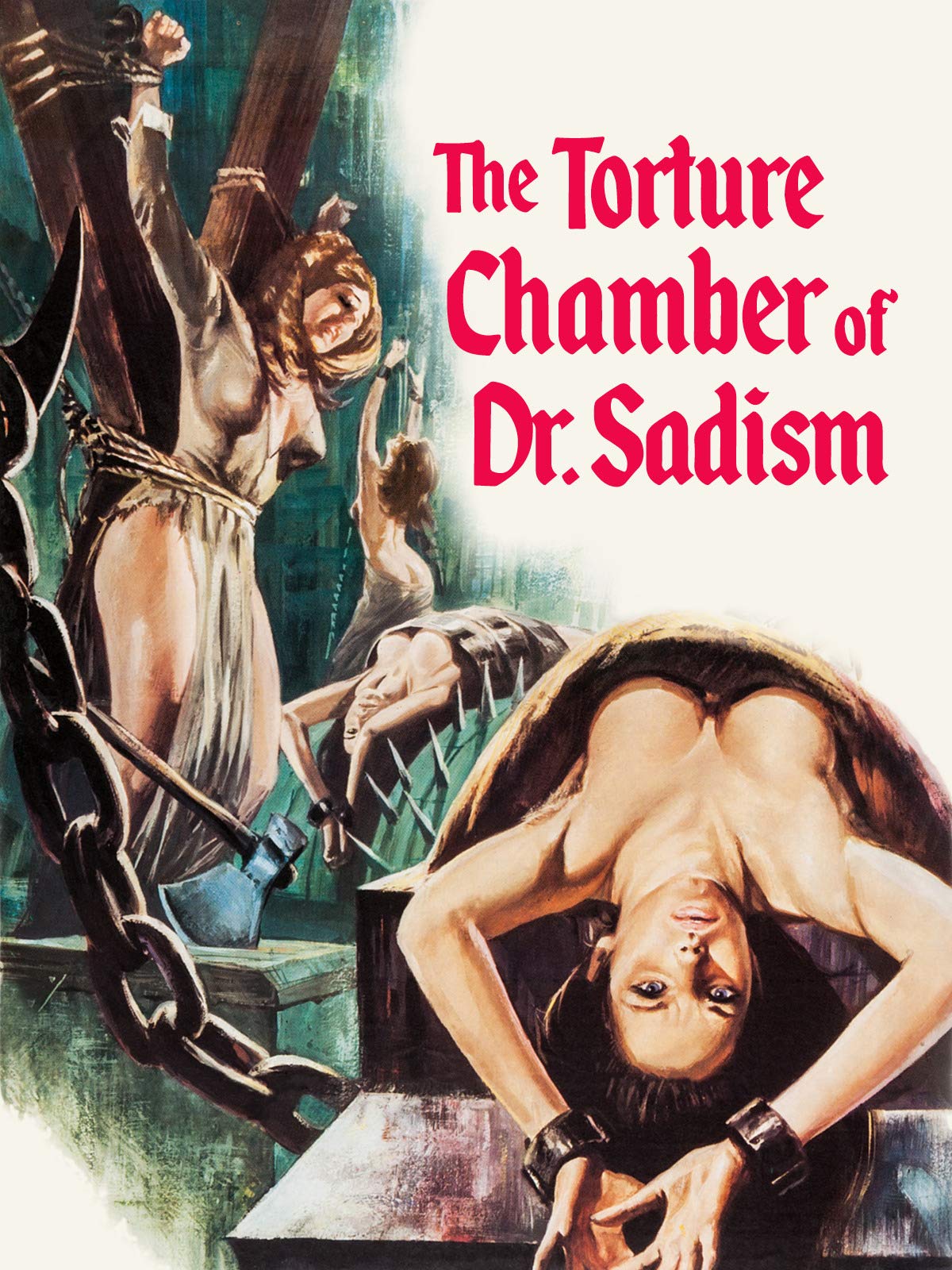
THE TORTURE CHAMBER OF DR. SADISM

THE TORTURE CHAMBER OF DR. SADISM (aka Die Schlagengruber und das Pendel/1967). Director: Harald Reinl. 

35 years ago Count Regula (Christopher Lee) murdered 12 virgins in an attempt to gain immortality. For his trouble, he was drawn and quartered as his two chief accusers stood watching. Now the descendants of these people, Roger Mont Elise (Lex Barker) and Baroness Lillian (Karin Dor), have received an invitation to the crumbling old Castle Regula, both unaware of what transpired in the past. Accompanying them by coach are Lillian's maid Babette (Christiane Rucker) and the rather shady Father Fabian (Vladimir Medar). 

The first half of the film is a protracted journey through a creepy forest in which trees have limbs growing out of them and skeletons are hanging from nooses. At the castle the group run into the long-dead Anatol (Carl Lange), the count's major domo, who plans to bring the count back to life. Wanting his revenge, the revived count places Roger under a slowly descending pendulum even as Lillian is nearly thrown into a pit full of writhing snakes. Yes, this is a very loose adaptation of Poe's classic The Pit and the Pendulum

Pitiful victim of "Dr. Sadism"
Although one could certainly quibble with some aspects of the screenplay, Torture Chamber not only holds the attention but has some classy and macabre art direction and is colorful in every sense of the word. Lex Barker appeared in several West German films and eurospy movies after he wrapped up his run as Tarzan. Karin Dor was a German actress who appeared with Barker more than once and was also in You Only Live Twice. Christopher Lee only appears in the prologue and at the very end and probably did all of his scenes in a couple of days  -- he appears to be the only actor who isn't dubbed. Carl Lange certainly makes an impression as Anatol.

Verdict: Fun horror film from West Germany that has some of the qualities of Italian horror features. ***. 

Thursday, June 8, 2017

THE FACE OF FU MANCHU

Christopher Lee as Fu Manchu: check out those nails!
THE FACE OF FU MANCHU (1965). Director: Don Sharp.

A number of bodies turn up dead in the Thames, and Sir Denis Nayland Smith (Nigel Green) of Scotland Yard figures his old adversary, Fu Manchu (Christopher Lee), is responsible.  Fu has developed a poison from the Black Hill poppy, a holy flower in Tibet, and uses it to kill off the entire population of a town. (This has an effective scene when two likable soldiers in the town suddenly drop dead.) This is just a demonstration of what he is capable of. In his HQ near the Thames Fu has a "drowning chamber" where he places people he wishes to kill or extract information from. His daughter, now called Lin Tang (she was Fah Lo Suee in the novels) and played by Tsai Chin, is arguably nastier than he is, and seems anxious to whip any employee who disobeys her or her father's orders. Other characters include Professor Muller (Walter Rilla of the Dr. Mabuse films) who works on the poppy formula; his daughter, Maria (Karin Dor of You Only Live Twice); her boyfriend Carl Janssen (Joachim Fuchsberger of Dead Eyes of London); Dr. Petrie (Howard Marion-Crawford); and a museum director (James Robertson Justice, less irritating than usual), who insists that his establishment is impregnable, even to Fu Manchu; of course he's wrong. As usual, Sax Rohmer's famous character is less dimensional than in the novels, and Christopher Lee, oddly, makes absolutely no attempt to play him as an actual Oriental. At the very beginning of the film, Fu Manchu escapes justice by substituting someone else to be beheaded, a notion carried over from Fantomas. Whatever its flaws, The Face of Fu Manchu is fast-paced and entertaining, and has the correct period setting. Lee is suitably creepy, and the versatile Nigel Green makes an excellent Nayland Smith. The movie doesn't quite capture that certain fiendish atmosphere of the books. This was the first of five Fu Manchu/Lee films produced by Harry Alan Towers. Followed by The Brides of Fu Manchu.

Verdict: Reasonably suspenseful fun. ***.

Thursday, February 9, 2017

THE INVISIBLE DR. MABUSE

Evil Clown (Werner Peters)
THE INVISIBLE DR. MABUSE (aka Die unsichtbaren Krallen des Dr. Mabuse/1962. Director: Harald Reinl.

Director Harald Reinl of The Return of Dr. Mabuse brings back Lex Barker [Tarzan's Magic Foutain] as FBI agent Joe Como, and replaces Gert Frobe's Inspector Lohmann with Inspector Brahm (Siegfried Lowitz). Como feels that Dr. Mabuse (again Wolfgang Preiss) is still alive and that his evil force has something to do with a theater presenting a bizarre ballet/operetta, while Brahm is just as sure that Mabuse is dead. An invisible man seems to be stalking the star, Liane Martin (Karin Dor of You Only Live Twice), but he may not be Dr. Mabuse. In the meantime, there is skulduggery afoot on a project known as "Operation X," which monitors satellites. The head of the project, Professor Erasmus (Rudolph Fernau), never comes out of his vault and has his own secrets. As usual, everyone who knows too much is conveniently knocked off by assorted henchman, including an evil clown (Werner Peters) who also appears in the theater's production. By this time the Mabuse movies were beginning to resemble Eurospy features, but then the villains in Ian Fleming's James Bond novels were always in the tradition of older characters like Mabuse (The first Bond movie, Dr. No, actually came out the same year). The Invisible Dr. Mabuse has atmosphere and interesting settings, and a few lively sequences, and the acting is generally good, with Preiss playing a dual role and actually killing "himself" at one point.

Verdict: Nothing stops that Mabuse. **1/2.

Thursday, February 17, 2011

STRANGLER OF BLACKMOOR CASTLE


THE STRANGLER OF BLACKMOOR CASTLE (1963). Director: Harald Reinl. West Germany.

A British nobleman, Lucius Clark (Rudolf Fernau), expecting to be knighted, lives with his niece, Claridge (Karin Dor), a reporter, on the rented estate of a weird Scottish Laird (Hans Nielsen), who is only one of many suspects in a series of murders around and about the estate. A very lively and sadistic maniac, who always wears a hood concealing his identity, strangles numerous victims, in some cases branding their foreheads and generally beheading them in various grisly and creative ways. He also has only nine fingers. Inspectors Mitchell (Harry Riebauer) and Watson (Gerhard Hartig) try to fit the murders in with some stolen diamonds and a nightspot called the Old Scavenger Inn, while Claridge's associate Mike Pierce (Hans Reiser) also tries to figure out what's what. Entertaining mystery-horror pic is no masterpiece but it moves along at a brisk pace and keeps you guessing.

Verdict: Heads will roll! **1/2.

Tuesday, May 20, 2008

YOU ONLY LIVE TWICE


YOU ONLY LIVE TWICE (1967). Director: Lewis Gilbert.

The film version of Fleming’s novel hasn’t got a whole lot to do with the book, although it does retain the Japanese setting and the master villain is still Blofeld. The character of "Tiger" Tanaka (head of the Japanese Secret Service) is also carried over from the book, as is the Ama diving girl called Kissy (the sexy Mie Hama). In this new storyline Blofeld is using his own spaceship to hijack manned rockets out of orbit, hoping to cause a war between the Russians and the Americans. Inexplicably Bond’s death is arranged and announced and he is even buried at sea amidst headlines, but this whole business seems contrived merely to fit in with the film’s title. You Only Live Twice is highly entertaining and has top-notch production values, including Freddie Young’s striking cinematography, Ken Adam’s stunning production design, and pretty sharp editing by second unit director Peter Hunt (who would helm a Bond feature himself in the future). This is a very well-made movie. Even the models and miniatures (copters, space ships, buildings, volcanoes) seem more like something out of the 80's than the 60's.

Highlights include the plane trap that horny Bond is suckered into by Helga Brandt (aka No. 11), played by lusciously sinister Karin Dor; the attack on the mini-copter "Little Nelly" by big copters that seem like malevolent dragonflies; and the poison-on-a-thread business that inadvertently kills Aki (Akiko Wakabayashi) when Bond himself was the target. There’s a scene with piranha in the novel – in the film Blofeld sends No. 11 into a pool full of them because she failed to kill Bond. Blofeld was behind the scenes in two previous Bond movies (From Russia with Love and Thunderball) and Bond finally meets him face to face in this entry, with Donald Pleasance properly weird and sinister (perhaps a little too weird) as Blofeld. Charles Gray, who plays the murdered Dikki Henderson in this film, would play Blofeld in Diamonds are Forever. Although the word S.P.E.C.T.R.E. is never mentioned, one imagines that Blofeld would need the services of that group to pull off this caper, and he is still referred to as "Number One." (Spectre was also mentioned in the film version of Dr. No, although not in the novel, as the group did not exist before Fleming wrote Thunderball.)

Roald Dahl’s screenplay is lively, and there are plenty of memorable action scenes and fisticuffs. The sexism involving the geisha girls and the Japanese opinion of women is so outrageous that it’s almost comical. This reaches its nadir when Tanaka tells Bond that as cover he must marry a woman with "a face like a pig." As he waits by the altar, two supposedly "homely" women approach, but the third, who is beautiful, of course, turns out to be the bride. Tanaka tells Bond that the geisha girls are fascinated by his hairy chest. "Japanese men have beautiful bare skin," he tells Bond. Bond replies, "Bird never make nest in bare tree." Sean Connery, giving his usual slick one-dimensional performance, is unconvincing as a Japanese – at his height (6 ft. 2), it’s a wonder they even bothered with the deception (even in the novel this aspect seems foolish). John Barry’s music is, as usual, excellent, with a compelling theme song sung competently by Nancy Sinatra. Lewis Gilbert directs with aplomb. [Question: Are the American astronauts still on Blofeld’s ship when Bond blows it up? This seems unclear.] The next Bond movie was On Her Majesty’s Secret Service; Majesty was actually published before You Only Live Twice, which served as a sequel to that book. The same cannot be said for the film versions, of course.

Verdict: Good show, 007! ***.