Lively, entertaining reviews of, and essays on, old and newer films and everything relating to them, written by professional author William Schoell.
Showing posts with label Alan Ladd. Show all posts

Thursday, March 12, 2026

HER FIRST ROMANCE (1940)

Edith Fellows and Wilbur Evans
HER FIRST ROMANCE (1940). Director: Edward Dmytryck.  Colorized.

Linda (Edith Fellows of Girls' Town) is a supposedly plain 17-year-old college freshman with an older half-sister and guardian, Eileen (Julie Bishop of Why Men Leave Home), who is cruel and selfish. Katy (Marian Kerby), the peppery housekeeper, can see right through bitchy Eileen, and makes up her mind to help Linda go to the prom -- and get the right dress -- despite her sister's edict that she cannot attend. Linda's being asked to the prom is just a fraternity joke, but when the boys see how transformed -- and downright beautiful -- she is, they all want to be her date. But that honor goes to handsome baritone Philip Niles (Wilbur Evans), who runs into Linda when both are busy singing in the woods!

Alan Ladd and Julie Bishop
Her First Romance is pure romantic fantasy, but it has a degree of charm and some very nice singing. Edith Fellows makes an appealing heroine, but once she becomes officially "beautiful," she's far less interesting. At the halfway point the movie becomes sillier and more incredible, with people falling in and out of love at the drop of a hat. Fellows had been acting since she was six, and amassed over eighty credits. Wilbur Evans appeared mostly on the stage, as he only had four appearances in movies, but with his looks and talent he should have become more famous. (Appearing in a Monogram picture probably didn't help him.) In a supporting role is Alan Ladd (of The Glass Key), as Eileen's fiance, whom she stole away from another sister, Marion (Judith Linden). Ladd, of course, went on to major stardom. The music includes the love duet in the forest; another duet from Don Giovanni; "My Love for You;" and Evans singing a version of Tchaikovsky's "Piano Concerto No. One." You watch the film to the end to see Eileen get her comeuppance, although she deserves worse than she gets.

Verdict: Just buy a new dress and the boys will all pant for you! **1/4. 

Thursday, May 11, 2023

DUFFY'S TAVERN

Ed Gardner
DUFFY'S TAVERN (1945). Director: Hal Walker.

Archie (Ed Gardner), the manager of the old-fashioned saloon Duffy's tavern, has hired 14 soldiers as waiters in the owner's absence because the record factory where they worked has closed down. O'Malley (Victor Moore) tries to raise money to reopen the factory but the bank won't extend him credit. His daughter, Peggy (Marjorie Reynolds of Up in Mabel's Room), meets and falls for one of the out of work soldiers, Danny (Barry Sullivan), not knowing that Archie is in love with her. Archie finally gets the idea of getting celebrities from a nearby hotel to put on a show and raise the needed capital. Archie acts as master of ceremonies, introducing sketches and song numbers with such guest artists as Betty Hutton, Brian Donlevy, Alan Ladd, Veronica Lake, and other performers from Paramount studios. 

Billy DeWolfe, Bing, and Betty Hutton
I can imagine how the public must have felt back in 1945 when they went to see a film allegedly starring Bing Crosby, and Der Bingle doesn't even show up until after 80 minutes into the running time! Instead we are treated to dull alleged comedy from Ed Gardner and Victor Moore, one of the unfunniest pairings in film history. Gardner had starred in the radio show Duffy's Tavern, and this picture was a film adaptation; ten years later Gardner starred in a TV sitcom of the same title. Based on his performance in this movie, I can see why Gardner has been completely forgotten -- he also contributed to the largely unfunny screenplay. He might be better known as Shirley Booth's first husband. 

Buck-toothed and brassy: Cass Daley
The last third of the film is somewhat of an improvement although much of it is also nearly unwatchable. Betty Hutton hollers her way through one number, and her less attractive clone Cass Daley (of Red Garters) also screams through a similar number -- both women lamenting the lack of interest they inspire in men. (The question is did Hutton rip off Daley or vice versa?) A terrific dance team temporarily lifts the audience's spirits and there's a quick, mildly amusing sketch with Paulette Goddard, Sonny Tufts, and Brian Donlevy.  The finale features Bing Crosby, first in a cute bio of his life with special guest-stars, and then his rendition of "Swingin' on a Star" with Dorothy Lamour and others joining in. The other generally forgettable songs are by Burke and van Heusen. This is one of the worst of the all-star studio films. Star Spangled Rhythm was a far superior Paramount compendium. 

Verdict: Put on any show but this one! **. 

Thursday, February 16, 2023

LADD: THE LIFE, THE LEGEND, THE LEGACY OF ALAN LADD

LADD: The Life, The Legend, The Legacy of Alan Ladd. Beverly Linet. Arbor House; 1979. 


Although it may seem hard to realize today, once upon a time Alan Ladd was a major star who for many years consistently topped popularity polls, appeared on magazine covers, and was considered one of the most bankable players in Hollywood. Although many of his co-workers would disagree, critics often thought he was less a fine actor than a personality who had "It," that indefinable something that added up to chemistry in spades. His fans were both men and women. Because of his short stature (although he was hardly the only short star in Hollywood), perhaps he was seen as attainable by women and non-threatening to men. 

In any case, Ladd toiled in many B movies and minor roles until achieving stardom with his first big picture, This Gun for Hire, teaming him for the first time with Veronica Lake. Following what seems like a dishonorable Hollywood tradition, Ladd dumped his first wife in favor of his second, an aggressive woman named Sue Carol who was also his agent. (Not the first or last time in Hollywood in which relationships have been career moves.) In spite of this Ladd essentially portrays the star as a "nice guy" who even started a campaign to get people to write letters to hospitalized WW2 vets who had no families. Ladd came off as cold or disinterested to many of his leading ladies -- Lake, Sophia Loren -- and it may have been because his wife was keeping a sharp lookout. Ironically, the one co-star he fell for -- although apparently it did not lead into an affair -- was the bland, utterly sexless June Allyson! June Allyson!  What was he thinking of?! (True his wife was no beauty.)

Ladd in Shane
Ladd finally achieved some critical acclaim with the western Shane, but that was virtually his last triumph, although he was quite good in his final picture The Carpetbaggers. Neurotic as hell, always lacking confidence, Ladd became more and more of a nervous wreck the older he got, and when he inevitably started slipping at the box office, it got worse. He also had that certain bloated appearance of the alcoholic and looked older than his years. Ladd had numerous minor "accidents" which may have indicated that he was drinking quite awhile before people began to notice, and there was a highly suspicious incident in which he "accidentally" shot himself in the chest. There is still uncertainty over whether his death at fifty was suicide or an accident. 

Ladd came to regret turning down the role played by James Dean in Giant because it was supposedly not the lead, but director George Stevens hated working with Dean and also regretted that Ladd didn't play the part; Ladd's wife may have had something to do with that. In the book the widow claims that Ladd was a very happy man with a very happy marriage, but the book is riddled with details that call all of that into question. Linet paints Ladd's life as a tragedy, but he had many good years, four loving children, reached the heights of stardom, and had plenty of money even when he began slipping. He is hardly the only movie star who takes to heart "you're only as good as your last picture," and despite his early death made out better than some. One suspects that his problems were often self-inflicted. Ladd is a very good and sympathetic biography but one flaw is that it rarely analyzes Ladd's films or his performances. 

Two of Ladd's children were in the business. The late Alan Ladd Jr. became head of 20th Century-Fox years after his father's death, and David Ladd was a child actor who appeared with his father in The Proud Rebel, among other films.  

Verdict: Page-turning bio with many interviews with friends and family members. ***1/2. 

HELL ON FRISCO BAY

Alan Ladd
HELL ON FRISCO BAY (1955). Director: Frank Tuttle. 

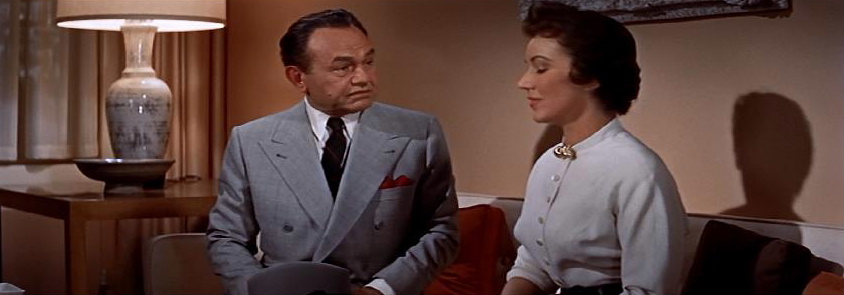
Ex-cop Steve Rollins (Alan Ladd) was framed for a murder he didn't commit and sent to prison for five years. When he gets out he is determined to find out who really murdered the victim and clear his name. He pretty much ignores his wife, Marcia (Joanne Dru), because he wants to protect her and also because she dared to dally with a gentleman out of loneliness when Steve wouldn't even let her come to see him. The San Francisco docks are controlled by a nasty man named Victor Amato (Edward G. Robinson), who has a good right hand, Joe (Paul Stewart), and a good-for-nothing nephew, Mario (Perry Lopez), who loves the ladies. Joe spends his nights with a former movie star named Kay (Fay Wray) while Victor is stuck with his pious wife, Anna (Renata Vanni), who treats Mario like a son and thinks he should be a priest. Steve talks to assorted individuals in the hopes they can give him information that might help him, but when Amato offers him a job, and Steve turns him down, he vows to make him pay -- painfully. 

Robinson and Fay Wray
Hell on Frisco Bay
 is a fast-paced and entertaining film noir thriller with many intriguing elements and a highly interesting cast. Ladd could probably play this kind of role in his sleep by now, but he manages to stay awake and acquits himself nicely. A deceptively cheery Robinson slowly unveils the layers of corruption and evil until he reveals the slimy lizard at his core, going so far as to order Joe to murder his own nephew. Stewart is excellent as the hired gun who's trying to get out from under Robinson's thumb. Fay Wray scores as Kay, and one of the best scenes is between Wray and Robinson as Amato makes a pass at her and gets angry when she turns him down, hitting her. "Get out, you filthy peasant!" she screams. Joanne Dru is acceptable as Marcia, giving solid line readings that don't always hit the emotional mark. 

William Demarest and Rod Taylor
The film is also full of flavorful performances by a wide variety of supporting players. William Demarest is a cop and friend of Steve's while Willis Bouchey is the police lieutenant who has to be convinced of Steve's innocence. Rod Taylor plays a hood who may have committed the murder Steve was sent away for with Tina Carver as his girlfriend. Peter Hansen [When Worlds Collide] is the corrupt cop, Connors, and Anthony Caruso [The Asphalt Jungle] is especially notable as a fisherman who is scared that if he talks to Steve his young son, George (Peter J. Votrian, who is also good) may come to harm. Renata Vanni probably made a career out of playing long-suffering wives or mothers. Nestor Paiva plays another dock worker who tries to work things out with Amato and only winds up dead. Perry Lopez [The Steel Jungle] plays the sexy but weak nephew to perfection. Jayne Mansfield plays his date.

Paul Stewart with Robinson
Ladd is manhandled by the chubby gunsel Hammy (Stanley Adams) in one scene and turns the tables on him, beating him up and telling Joe to "get your pig outa here!" The film has a boat chase at the end that is exciting although not quite on the level of similar scenes in those old cliffhangers. Although this might not be listed among Max Steiner's greatest scores, it is effective and thrilling when it needs to be. The screenplay is good, but one wishes the picture crackled with tension -- although it comes close at times -- but director Frank Tuttle doesn't make the film quite as explosive as it could have been. Still, it's quite well-played and snappy.

Verdict: Memorable crime drama with some outstanding performances. ***. 

Thursday, February 2, 2023

THE GLASS KEY

Alan Ladd
THE GLASS KEY (1942). Director: Stuart Heisler. 

Politician Paul Madvig (Brian Donlevy), essentially a crook, is trying to clean up his reputation for re-election by going after hood Nick Varna (Joseph Calleia). Paul has formed an alliance with wealthy Ralph Henry (Moroni Olsen), and also fallen in love with Henry's daughter, Janet (Veronica Lake). Meanwhile Paul's sister, Opal (Bonita Granville), is head over heels for Janet's brother, Taylor (Richard Denning), a gambling addict with serious debts. Paul's associate and best friend, Ed Beaumont (Alan Ladd), stumbles across Taylor's dead body, and wonders if Paul, who hated Taylor and his influence over his sister, could possibly be responsible. Apparently both Opal and Janet think that he is. The truth may be a little more complicated.

Ladd and Lake
Based on the novel by Dashiell Hammett, The Glass Key is a reasonably absorbing but rather unpleasant bit of film noir. For one thing, there isn't a single really likable major character; even the hero played by Ladd is a creep. Ladd is as swell at the hardboiled routine as anyone, but he never quite comes off as a real person. He's handsome, but almost as bland and artificial as a Ken doll. Brian Donlevy is as good and forceful as ever, but it's a typically brusque and bristling Donlevy performance like he gives in virtually every movie, including The Creeping Unknown. Similarly Joseph Calleia is excellent in his very familiar gangster role. Veronica Lake has been seen to better advantage in other movies (such as I Married a Witch). 

"Let's have a drink." William Bendix with Ladd
Part of the problem is that the characters in this are mostly one-dimensional and the actors can't do enough to flesh them out. One exception is William Bendix, who honestly steals the movie as the sadistic gunsel who nearly beats Ed to death. Bendix also has a splendid scene, again with Ladd, when they sort of share a drink together as a semi-drunken Bendix tells Ladd what horrible things he's going to do to him. It's not in the script, but Bendix makes this miserable character come alive and almost makes your flesh crawl. (Why Ed would want to be anywhere near the psychopath who put him in the hospital is another question.) Before he became the lovable hero of TV's Life of Riley, Bendix frequently played distinctly malevolent characters and played them superbly.

Tramp and Dickhead: Margaret Hayes and Ladd
A tip of the hat also must go to Margaret Hayes, who briefly plays Eloise Matthews, the trampy wife of a newspaper publisher who makes a play for Ladd right in front of the man after she learns her hubby is flat broke. A true gentleman -- not -- Ladd fervently responds to her sexual entreaties. Again, even with this character being played by the pleasant and inoffensive- looking Ladd it can't disguise what an utter dickhead Ed is! Others in the cast include Frances Gifford as a friendly nurse; Donald MacBride as the easily-influenced district attorney; and Billy Benedict as an office boy. Bonita Granville does a nice job as the grieving girlfriend of the dead Denning.

Verdict: If ever a "hero" didn't deserve a happy ending! **1/4. 

Thursday, July 7, 2016

THE MAN IN THE NET

Alan Ladd confronts Carolyn Jones
THE MAN IN THE NET (1959). Director: Michael Curtiz.

John Hamilton (Alan Ladd) is an aspiring painter who's brought his wife, Linda, to the country to work on his art -- and keep dipsomaniac Linda (Carolyn Jones) away from the liquor. Unfortunately, the bored and resentful Linda can't stay away from men, either. When John returns from a business trip to New York, he discovers that Linda is missing. Everything goes awry in the second half of this very poor mystery due to suspect developments and a bad screenplay. Half the town converges on Hamilton's home, denouncing him as a wife-murderer, when the townspeople barely know him and there's no reason for them to act like villagers out to get that evil Baron Frankenstein. Worse, John is befriended by a little girl, Emily (Barbara Beaird), who enlists a whole bunch of her little friends into helping John investigate the mystery. The entire second half of the film is taken up with these children, who are cute and not bad actors, but they make the picture resemble a distinctly forgettable Disney movie. Ladd [The Carpetbaggers], his face puffy and years older due to heavy drinking, barely gives a performance, while Jones [Eaten Alive] pretty much steals the show in her vivid portrayal of the screwed-up Linda. Charles McGraw [Roadblock] is typically vital as the town sheriff, and Diane Brewster and John Lupton are effective as family friend Vicki and her handsome husband, Brad (you might call Lupton a "prettier" version of Marshall Thompson). As Brad's father, John Alexander is so terrible you'd have to assume he was given the part as a favor to someone were it not for the fact that he amassed many theater and movie credits; this is not a highlight of his, or anyone else's, resume. Curtiz is defeated by the material.

Verdict: Even one of the lesser episodes of Perry Mason (not that there were many) is better-scripted and more entertaining than this. *1/2 out of 4.

Thursday, May 19, 2016

AND NOW TOMORROW

Susan Hayward and Loretta Young
AND NOW TOMORROW (1944). Director: Irving Pichel.

Socialite Emily Blair (Loretta Young) has become deaf due to meningitis, and pursues different doctors to find a cure. Family friend Dr. Weeks (Cecil Kellaway) gets Emily together with Merek Vance (Alan Ladd), who is working on a serum that may cure Emily, but who has a chip on his shoulder regarding her wealth and privilege. Adding to the complications is the fact that Emily's fiance, Jeff (Barry Sullivan), has fallen in love with her somewhat selfish sister, Janice (Susan Hayward), and vice versa. If she gets her hearing back, Emily may be in for a big surprise ... And Now Tomorrow is an entertaining soap opera that probably has little to do with the realities of hearing loss, and might even be considered a heartless fantasy for the deaf. On the other hand, it's very well-acted, with Young, Hayward, and Kellaway [Love Letters] taking the top honors, although Ladd [Boy on a Dolphin] and Sullivan [Jeopardy] also acquit themselves nicely. Beulah Bondi, Grant Mitchell and Helen Mack have smaller roles, and all are fine. The movie borders on the absurd at times but never quite goes overboard. and is well-paced and entertaining. Young is excellent, but Hayward comes close at times to stealing the movie from her.

Verdict: Having a handsome doctor is half of it. ***.

Thursday, April 5, 2012

THE BLACK CAT

Gale Sondergaard
THE BLACK CAT (1941). Director: Albert S. Rogell.

In this entertaining comedy-thriller, the relatives of elderly Henrietta Winslow (Cecelia Loftus) are gathered inside the obligatory spooky mansion waiting for her to die and wondering how much they'll each get. Naturally murders and weird goings-on ensue. The Black Cat certainly has an unusual collection of actors: everyone from Bela Lugosi (as a groundskeeper) to Broderick Crawford to Alan Ladd to Gale Sondergaard [who at least you expect to see in stuff like this] and even Gladys Cooper [whom you don't]. Sondergaard is very amusing as the sinister housekeeper, Abigail, and Gladys Cooper practically steals the picture in her turn as Myrna -- her husband is played by no less than Basil Rathbone, and he, too, is excellent. Anne Gwynne, Claire Dodd, and John Eldredge also have roles and Hugh Herbert is comic relief -- or something. Some may find this a little too humorous to sustain any kind of real atmosphere but it's fun and has an exciting climax.

Verdict: Any picture with this cast can't be all bad. ***.

Thursday, February 11, 2010

BOY ON A DOLPHIN


BOY ON A DOLPHIN (1957). Director: Jean Negulesco.

Let's see. This movie has spectacular scenery shot on location in Greece, the spectacular body of Sophia Loren (pictured) whose every outfit shows off her great figure, a story about sunken treasure and some skulduggery -- and it's still a deadly bore! Loren, who gives a saucy and credible performance, plays Phaedra, who tries to team up with more than one man -- Alan Ladd and Clifton Webb are the guys -- to bring up the title statue of gold whose location is known only to the "Greek" beauty. Webb and Laurence Naismith add some zest to the picture, but most of this is talk, talk, talk and little suspense or action. Loren and Ladd have absolutely no chemistry. Loren sings -- lip-syncs actually -- a sexy song in a tavern scene.

Verdict: Not even Sophia can save everything. *1/2.

Monday, May 5, 2008

GREAT GUNS


GREAT GUNS (1941). Director: Monty Banks.

Stan Laurel and Oliver Hardy began working for Twentieth Century Fox, but many of their fans feel Fox didn't really know what to do with them. Their early Fox films, such as Great Guns, were seen as imitations of successful Abbott and Costello features. Although the boys are as good as ever in this picture, at times they seem lost in busy surroundings and a not-very-compelling love triangle. When an over-protected young man Daniel (Dick Nelson) is inducted into the Army, Stan and Ollie -- who work for his family -- go with him to look out for him (along with Stan's pet crow). They come afoul of a bad-tempered Sergeant (Edmund MacDonald) who has a yen for a pretty photo shop clerk, Ginger (Sheila Ryan, who would also appear in A-Haunting We Will Go), but she prefers the shyer, less aggressive Daniel. It all ends with the boys getting involved in war games. Some funny moments, but not one of the better Laurel and hardy features. Kane Richmond (Spy Smasher) and Alan Ladd have very small speaking roles as soldiers. Ryan and Nelson make an appealing romantic couple and give nice performances as well.

Verdict: For L&H fanatics only. **.

Saturday, January 12, 2008

THE CARPETBAGGERS


THE CARPETBAGGERS (1964). Director: Edward Dmytryk. Screenplay by John Michael Hayes.

George Peppard gives a surprisingly dynamic performance – his best, ever – as Jonas Cord, a Howard Hughes-type rich boy's son who weds and beds many a wench, starts an international airline, and takes over a movie production company and creates a star out of his own, very sexy former stepmother (Carroll Baker). Based on Harold Robbins' novel, this could easily be dismissed as trash were it not for the fact that it's quite well-acted, well-scripted (for what it is), and moves at a pace that leaves little time to ponder events but much time to be extremely entertained – there isn't a boring moment and much of the film is even striking in its way. Peppard and Baker are both better than you'd expect them to be, although they may not capture whatever nuances other actors might have found in their characters. Alan Ladd scores as Peppard's old companion and surrogate father, who becomes a cowboy hero of the movies and marries Baker. Ladd's climactic fight scene with Peppard is a highlight of the picture. Elizabeth Ashley, who later married Peppard in real life, is excellent as the wife he terribly mistreats, and even Martha Hyer is sexy fun as another blond hooker Peppard decides to turn into a star. Ralph Teager is fine as Peppard's pilot buddy and Bob Cummings is right on the money as a rather slimy Hollywood agent positively dripping with charm. Lew Ayres has one of his best latter-day roles as Peppard's business advisor, who is eventually disgusted by his antics (their parting scene is very well played).
Verdict: Overall, this long, lusty, often amusing and exciting picture isn't bad at all. ***.