Lively, entertaining reviews of, and essays on, old and newer films and everything relating to them, written by professional author William Schoell.
Showing posts with label Jack Weston. Show all posts

Thursday, March 2, 2023

PALM SPRINGS WEEKEND

Owen Orr, Dorothy Green, Stephanie Powers, Troy Donahue
PALM SPRINGS WEEKEND  (1963). Director: Norman Taurog. 

The members of a college basketball team hightail it by bus to Palm Springs for Easter vacation, unaware that their dyspeptic Coach Campbell (Jack Weston) is along for the ride. A gaggle of gals are also on vacation and before you can say "Where the Boys Are" -- an earlier film that clearly was the inspiration for this one -- the sexes are intertwining in both comedic and light dramatic fashion. Naturally some of these young couples will think they're in love -- after a weekend!

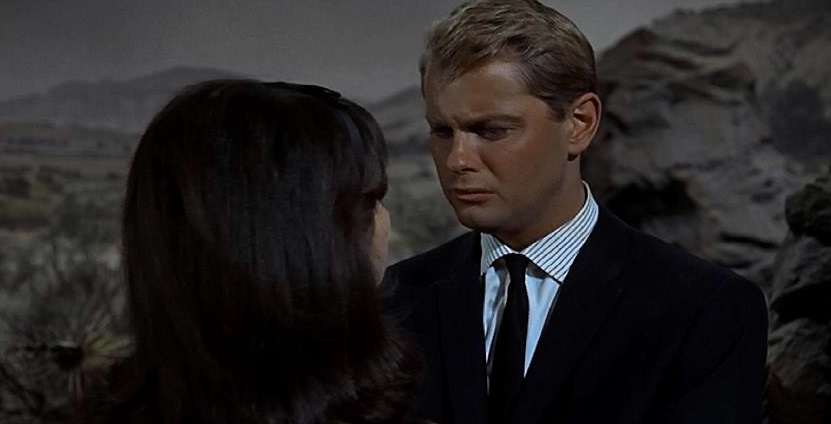
Eric (Conrad) and Jim (Donahue) speak frankly
Of the lead "youngsters" -- none of whom are that young -- Robert Conrad (of The Wild, Wild West) offers the best performance as spoiled rich kid Eric Dean, a Palm Springs resident whose neglectful unseen daddy is off on one of his frequent honeymoons. Eric sets his sights on perky Gayle Lewis (Connie Stevens) who claims to be from Hawaii even though she isn't. She gets caught between Eric and hunky Texan and Hollywood stuntman "Stretch" (Ty Hardin of Wall of Noise). Meanwhile nice boy Jim Munroe (Troy Donahue) is smitten with record shop clerk Bunny Dixon (Stephanie Powers), who is the daughter of the Chief of Police (Andrew Duggan). Biff Roberts, played by typical college student Jerry Van Dyke, is at first put off by the tomboyish Amanda (Zeme North), but once Gayle helps her with her make up ... ! 

Jerry Van Dyke, Zeme North, Troy Donahue
The comedy has to do with such things as the pool turning into a bubble bath due to the accidental introduction of detergent, as well as the antics of Boom Boom (Billy Mumy of Twilight Zone's "It's a Good Life"), the adorable little monster who belongs to the hotel's proprietor, Naomi Yates (a spirited Carole Cook). The dramatic scenes have to do with a fight sequence when some lowlifes invade a party, and Eric taking after Stretch in his car and causing an accident after the latter has prevented Eric from sexually assaulting Gayle. 

In love after two days: Stephanie Powers with Donahue
Troy Donahue had to make this picture whether he wanted to or not, and was so zonked on drugs and alcohol during filming that it's a wonder he gives any kind of performance, although he gets by. In some shots you can already see the effect this is having on his looks, a certain puffiness, although the attractive sensitivity of his features is unaffected. Zeme North had appeared on Broadway in Take Me Along but had limited film and TV credits, retiring in the late sixties, which is too bad as she's quite appealing in this picture. As usual, little Billy Mumy nearly steals the movie. A small role is played by Owen Orr, AKA Greg Benedict, who was Donahue's college roommate and best friend. 

Verdict: Amiable if forgettable teen movie with hardly any teenagers in sight! **1/2. 

Thursday, April 26, 2018

PLEASE DON'T EAT THE DAISIES

David Niven and Doris Day
PLEASE DON'T EAT THE DAISIES (1960). Director: Charles Walters.

Kate MacKay (Doris Day) and her husband, Larry (David Niven of Enchantment) are raising four adorable if rambunctious boys and planning a move to the country. Larry, a professor of drama, is made a theater critic for a top newspaper. In a contrived event, he is assigned to review his best friend, Alfred's (Richard Hadyn), new musical, and not only slams it, but prints that the leading lady, Deborah Vaughn (Janis Paige of This Side of the Law), has no talent. This leads into amusing encounters between Larry and Deborah as well as an opportunity for Alfred to get a kind of revenge on Larry. Meanwhile Kate is worried that her husband is turning into the kind of justifiably-abhorred critic who is more interested in making clever jokes at a playwright's expense than in writing serious and fair-minded theater reviews. If you take some of the improbable developments (they move into a house that resembles a castle) with a grain of salt, Please Don't Eat the Daisies is a delightful comedy, with the two leads in top form. Day and Niven work very well together and seem to be having as much fun as the audience. Some of the critical words that come out of the mouth of Doris' mother make her seem like a monster, but the casting of sweet Spring Byington makes her character more palatable.  Patsy Kelly plays the housekeeper but isn't given much of a chance to shine, although Hadyn scores as the angry Alfred, and Paige is just wonderful and very sexy as Deborah. Jack Weston is also fine as a taxi-driving wannabee playwright, and Kathryn Card of I Love Lucy appears briefly as a principal. The business with the baby being kept in a locked cage would raise eyebrows today and frankly makes little sense. (The rationale is that he can pick locks, but wouldn't that include the locks on his cage?) Please Don't Eat the Daises -- the title comes from a reference to one of the boys eating flowers -- is based on a novel by Jean Kerr, a playwright who was married to Walter Kerr, best-known as a theater critic for the N.Y. Times; the couple had six children. Doris does a reprise of "Que sera, sera" from The Man Who Knew Too Much and also nicely warbles the title tune and "Anyway the Wind Blows."

Verdict: Very amusing and well-acted comedy with an especially winning Day. ***.

Thursday, October 11, 2012

MIRAGE

MIRAGE (1965). Director:Edward Dmytryk.

"If we can lie, cheat, steal and kill in broad daylight, but have to wait until it's dark to make love ... what does that have to say about us as a society!"

"If you're not committed to anything, you're just taking up space."

In 1951 Howard Fast published the novel "Fallen Angel" (which was reissued years later in paperback under the title "Mirage") under the pen name Walter Ericson. The book was well-written, but typical of post-WW2 fiction, in that it was grim and fatalistic and occasionally pretentious. "Fallen Angel" was the basis of two films, Mirage and Jigsaw. Mirage is by far the better of the two.

Although there are some changes made, Mirage is pretty faithful to the novel. David Stillwell (Gregory Peck) discovers that he has amnesia on the same day that a man plummets to his death in the same office building in which Stillwell works. Or so he thinks. The office has disappeared; a pretty young woman  named Shela (Diane Baker) claims to know him although to him she's a complete stranger; and worse, people are trying to kill him and demanding he turn over something -- but he has no idea what it is or what they're talking about. Stillwell hires a first-time private eye named Ted Caselle (Walter Matthau) to help him, but the man uncovers more questions than answers.

Mirage is a first-rate suspense film (although it can be argued that it succeeds due to the acting and plot more than to Dmytryck's standard if more-than-competent direction). Peck gives a very good performance, and although Baker isn't quite the femme fatale type the attractive actress nevertheless acquits herself nicely. Matthau, in his pretty much comic turn as the private eye, doesn't really seem to fit into the movie. Of the supporting cast, Robert H. Harris makes the best impression as Dr. Broden, but there are also notable turns by Jack Weston, George Kennedy, Walter Abel, Leif Ericson, Kevin McCarthy, and Anne Seymour. There's an excellent use of New York City locations, and an exciting chase sequence in Central Park. Ann Doran has a bit part as the neighbor of a murdered man who wants to keep her nose clean. Peter Stone's screenplay intelligently adapts the novel, makes things a little clearer than they are in the sometimes murky book, and has some excellent dialogue as well (see above).

Verdict: Classy suspense film with a convoluted but fascinating storyline and very good performances. ***1/2.