Lively, entertaining reviews of, and essays on, old and newer films and everything relating to them, written by professional author William Schoell.
Showing posts with label Margot Grahame. Show all posts

Thursday, September 28, 2017

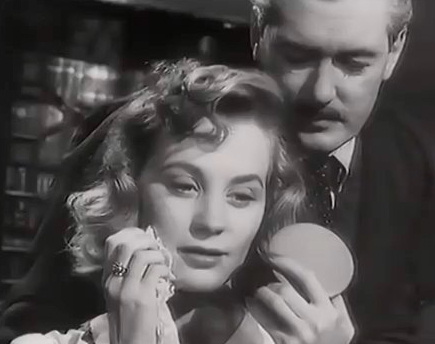
NAUGHTY ARLETTE

Mai Zeiterling and Hugh Williams 
NAUGHTY ARLETTE (aka The Romantic Age/1949). Director: Edmond T. Greville.

A girls school hires its first male instructor, a middle-aged English teacher named Arnold Dickson (Hugh Williams of The Fake). Dickson has a daughter, Julie (Petula Clark), who attends the school, and a wise, lovely wife named Helen (Margot Grahame of Orders Are Orders). But that doesn't stop Dickson from succumbing to the charms of one of his students, the sexy French girl Arlette (Swedish actress Mai Zetterling), who only makes a play for the sap to get even with him for his dismissive treatment of her. Naughty Arlette is not a particularly memorable movie, but it boasts excellent performances from the entire cast and some sensitive moments in its relatively superficial study of an aging, not very sexy man who somehow needs the attentions of a pretty young woman. (In movies like this, the wives are much too forgiving). Petula Clark [Goodbye, Mr. Chips] later became internationally famous with her rendition of "Downtown" in the sixties. The ending with Arlette's butler giving her her comeuppance is amusing if somewhat improbable.

Verdict: Perhaps Arlette just isn't quite naughty enough. **.

Thursday, September 7, 2017

ORDERS ARE ORDERS

Peter Sellers before diet
ORDERS ARE ORDERS (1955), Director: David Paltenghi.

Producer Ed Waggemyer (Sidney James) takes over an Army barracks so he can shoot what appears to be a perfectly dreadful sci fi epic on the grounds. To avoid his displeasure, actress Wanda Sinclair (Margot Grahame of Black Magic) flirts with Colonel Bellamy (Raymond Huntley) and has Ed give him a part in the film. The colonel's daughter, Veronica (June Thorburn of Escort for Hire) is an aspiring actress and for a time she seems to be the girlfriend of Captain Harper (Brian Reece), who is actually in love with professional actress Joanne Delamere (Maureen Swnnson of The Deadly Game). Despite all the busyness, absolutely nothing very amusing ever occurs throughout the 75 minute running time in this extremely dull service comedy.  Chief among the supporting cast is Peter Sellers, about forty pounds heavier than he was in his starring days, playing Private Goffin. Sellers and the rest of the cast offer good performances but it's a very minor service "comedy" that slips out of your mind even as you're watching it.

Verdict: When you can't even get a laugh out of Peter Sellers you know a movie is in trouble! *.

Wednesday, July 16, 2008

BLACK MAGIC (1949)

BLACK MAGIC (1949). Director: Gregory Ratoff.

Alexander Dumas Sr. is working on a book about Cagliostro and trying to get a handle on him when he relates the story that forms this film to his son. Black Magic is a mix of fiction and history, and can best be described as a somewhat entertaining potboiler. Young Joseph Balsamo is whipped and forced to watch his gypsy parents being hanged upon the orders of the cruel Viscount DeMontagne (Stephen Bekassy) -- fiction. When he grows up, Balsamo has turned into the famed mysticist Count Cagliostro (fact), and eventually marries a young woman named Lorenza (fact) who is the spitting image of Marie Antoinette (fiction). The two of them get mixed up in a plot to turn the French public against Antoinette involving a piece of jewelry (part fiction, part fact). Then, of course, Cagliostro must get his revenge against DeMontagne, although this aspect of the story doesn't get nearly enough dramatic attention. Orson Welles gives another wonderful performance as Cagliostro, although the movie is certainly no Citizen Kane. Nancy Guild makes the most of her dual role as the sweet and innocent Lorenza and a rather bitchy Marie Antoinette, and Margot Grahame scores as Mme. DuBarry. Akim Tamiroff is fine, as always, as a friend of Cagliostro's. After awhile the muddled proceedings begin to grow wearisome, however, although there's an eye-opening sword fight high above on the roofs of Paris at the end that is quite striking and cinematic. Another memorable sequence has a crowd of supposed cripples and sick people gathering in front of the King, who orders Cagliostro to cure them en masse -- with amusing results.

Verdict: Has its moments, but you can also see why it's been forgotten. **1/2.