Thursday, March 12, 2026
THE BAD AND THE BEAUTIFUL: HOLLYWOOD IN THE FIFTIES
This is a very entertaining and readable account of Hollywood trends, important movies, and notable performers, writers and directors during the very end of the film capitol's golden age. The Bad and the Beautiful has chapters on the scandals both in and surrounding the controversial publication Confidential; the troubled offspring of certain movie stars (such as Edward G. Robinson and his son Manny); James Dean and Rebel Without a Cause; Rock Hudson, Douglas Sirk and Ross Hunter; Charles Laughton's Night of the Hunter; Kim Novak and Sammy Davis Jr.; Sweet Smell of Success, Burt Lancaster and Walter Winchell; rival Hollywood "news hens" Hedda Hopper, Louella Parsons and Sheila Graham; the life and plays (Picnic; Come Back, Little Sheba) of William Inge and the film versions thereof; and Gloria Swanson and Sunset Boulevard. The book also details how Hollywood was completely changing in this decade, what with the inroads of television, the breakdown of the studio system, and the increasing use of location filming over shooting strictly on sound stages. Some of this material may be familiar to the film enthusiast, but there is much that is new and interesting as well, all told in compelling prose that keeps the pages turning.
Verdict: Excellent look at the foibles and triumphs of 1950's Hollywood. ***1/2.
Thursday, October 14, 2021
THE BRIEF, MADCAP LIFE OF KAY KENDALL
Since most if not all of the major stars have been covered ad nauseam, many publishers have come out with books on 2nd, 3rd and 4th tier celebrities. British actress and comedienne Kay Kendall [Les Girls; Wings of Danger), who did indeed have a brief life and career, fits into the lattermost of those categories. Kendall was talented and tragic, dying young of leukemia, which her husband and family tried very hard to keep her from knowing until nearly the end. Her husband was Rex Harrison, and Kendall would have probably been forgotten by all but her most obsessive fans, however many, if it had not been for that association with a much bigger star. Kendall's marriage to Harrison played out during a time when the latter was ascendant due to his triumphs in both the stage and screen versions of My Fair Lady. Eve Golden's entertaining and page-turning book won't necessarily have you admiring Kendall's character, although she was probably no worse than a lot of other husband-stealing, rather "trampy" and superficial starlets; Kendall also became full of herself. (Kendall stole Harrison from Lilli Palmer, who had herself broken up an earlier marriage to Harrison. Harrison claimed that he primarily married Kendall only because she was dying.) Kendall was great friends with Dirk Bogarde and his partner, Anthony Forwood. Biographer Golden does a very good job dissecting Kendall's films and performances while never neglecting her interesting personal life.
Verdict: Good read for those interested in this talented if minor British actress. ***.
Thursday, September 7, 2017
MR. STRANGELOVE: A BIOGRAPHY OF PETER SELLERS
"He was amoral, dangerous, vindictive, totally selfish, and yet had the charm of the devil." -- Sellers' first wife.
Mr. Strangelove adeptly traces the career and personal life of one of the cinema's funniest men, the brilliant Peter Sellers. There is his early association with Spike Milligan, with whom he did radio and TV programs; his relationship with his ever-loving if too controlling mother, Peg, as well as his several wives (including actress Britt Ekland) and children; and of course the many, many movies he appeared in. Sellers was like many powerful, successful film figures -- a man who could be monstrous one minute, even with his own children, and then turn around and be remarkably generous. Doted on by his mother, Sellers became self-absorbed at an early age, but many of his companions make clear that he could also be a very good friend. His career took precedence over everything else, as it does with so many driven film stars. Mr.. Strangelove also goes behind the scenes of Sellers' movies, both famous and obscure, such as The Pink Panther films, Dr. Strangelove, The Magic Christian, Being There, Murder By Death, The Wrong Box, and many, many more. Sikov perhaps spends too much time on Milligan and the Goons (a comedic group/program of which Sellers was a part early in his career); otherwise this is a solid bio.
Verdict: Interesting look at a comic genius. ***.
Thursday, March 16, 2017
ALICE FAYE: A LIFE BEYOND THE SILVER SCREEN
Alice Faye is one of the few movie stars who walked away from it all when she was still at the top of her game. Faye appeared in several musicals, became a queen of Hollywood, then longed for more of a private life and a successful marriage, and also itched for a chance to show off her acting chops in more serious pictures instead of the "technicolor twaddle" (as Bernstein's "Trouble in Tahiti" would put it) she was usually offered. Fay gave a very good performance in her last picture under the studio system, Fallen Angel, although author Elder writes that most of Faye's best scenes were left on the cutting room floor and Linda Darnell got most of the screen time. (I have a much higher opinion of Preminger's picture than others do.) Furious and disheartened, Faye left the studio and did a radio sitcom with comedian husband Phil Harris [The High and the Mighty] instead, making a brief "comeback" in the second musical version of State Fair (the conditions of the filming as described herein are reflected in Faye's face in the movie) and then a cameo in Won Ton Ton, as well as a stint on Broadway. Faye's first marriage was to handsome crooner Tony Martin [Music in My Heart], but the fact that they never had much time to spend together, the disparity in their success levels, and Martin's "causal romances" caused Faye to divorce him. Although Harris was also alleged to be a ladies man, he was rather homely compared to Martin; perhaps Faye felt he would be less likely to stray. In any case, their marriage lasted for decades. Still, Faye's career we not free from scandal, such as the early rumors of an affair with her mentor Rudy Vallee [The Palm Beach Story] that dogged her for quite some time. Faye appeared in such snappy musicals as King of Burlesque and On the Avenue. Alice Faye: A Life Beyond the Silver Screen is an excellent biography that sets the scene for each period in just enough detail, describes the supporting players in Faye's life without going on too much about them, and is very well-written and researched.
Verdict: A fine job. ***1/2.
Thursday, March 9, 2017
CRAWFORD!
![]() |
| Crawford, of course |
![]() |
| The "Essential" Biography: Quirk; Schoell |
This week on the FX network begins a new series on the supposed life-long "feud" between Bette Davis and Joan Crawford, which has been greatly exaggerated, to say the least. The two women were not good friends, did not especially like each other, but a "feud" is over-stating things. Crawford was not crazy about the fact that Davis got nominated for a Best Actress Oscar for What Ever Happened to Baby Jane? while she didn't; and Davis was not at all thrilled when she lost said Oscar to an absent Anne Bancroft, and as arranged, Crawford accepted the statuette for her. So there was Crawford getting the (second-hand) applause from the crowd while Davis could only watch in disappointment. Joan was always annoyed that Davis considered herself the better, more serious actress while Davis, who fancied herself more down-to-earth than Joan, disliked what she saw as Joan's diva-like ways. In truth, both women were major movie stars who were more alike than they were different. The two women were to be re-teamed on Hush ... Hush, Sweet Charlotte, but Joan discovered she had no great desire to work with a grumpy, unpleasant Davis anymore (it was she who had come to Davis with the book "Baby Jane?") and she feigned sickness to get out of the assignment; Olivia De Havilland replaced her.
Cut out of her will because Joan felt she had supported her daughter long enough, and angry that Joan couldn't help the modestly talented young lady get anywhere in her career, Christina Crawford decided to get even and make money by writing "Mommie, Dearest," which even her siblings found "fake and fictional." Ever since that time Crawford has been turned into a joke, with every single thing she's said or done being re-interpreted as proof that she was some kind of monster. She has been subjected to perpetual sniggering by those who believed every single word of Christina's tome .Much has been made of Crawford's "phoniness," such as her being "sick" on Oscar night when she was nominated (and won) for Mildred Pierce, In one interview, co-star Ann Blyth intelligently explained Joan's reasons for this, but the persistent interviewer kept trying to make something more out of it, Sheesh -- is anyone really that surprised that old-time movie stars (or even current ones) can be "phonies" at times?!
All movie stars are difficult to deal with, and Crawford may have had imperfections as both mother and woman, but both the one-sided book and the film adaptation make her out to be utterly grotesque. It's almost become impossible to look at her life or career in an objective manner. I and my co-author Lawrence J. Quirk, who knew Joan well for years, attempted to redress that wrong in our book, Joan Crawford: The Essential Biography. The book doesn't necessarily whitewash Joan, but it does expose a lot of the crap that has been written and said about her, and provides a more objective look at her life and career. The book was published by the University Press of Kentucky in 2002 and is available in various editions, including kindle, on amazon and elsewhere.
Here's a review of the book from Library Journal.
"She wasn't the greatest actress of the silver screen, but was there ever a bigger star than Joan Crawford? Who else had made ten films with Gable, danced with Fred Astaire, won an Academy Award for best actress (in 1945, for Mildred Pierce), outlasted her contemporary Greta Garbo by nearly three decades ... ? And just as she was fading from memory, she got a new lease on notoriety with the publication of adopted daughter Christina's Mommie Dearest. In a dual preface, Quirk (The Films of Joan Crawford), a personal friend of the actress, rejects much of that highly unflattering account, while Schoell (Martini Man: The Life of Dean Martin) debunks it entirely. Their study is a thoroughgoing, evenhanded review of Crawford's life and work, which in tone is neither academic nor gossipy but rather confessional, as if they are eager to set the record straight. It should go a long way toward restoring Crawford's reputation as a hardworking professional who lived for her fans and managed to slap almost every leading man who ever played opposite her. In Sunset Boulevard, Gloria Swanson's character famously observed, "I'm still big; it's the pictures that got small." Perhaps the same could be said of Crawford. Recommended for all film collections in public and academic libraries".Edward Cone, New York.
So, this week GREAT OLD MOVIES looks at the television work of Joan Crawford: telefilms, dramatic series, anthologies, and westerns. We also take another look at the film version of Mommie, Dearest. And to round it out, a critique of the television remake of Baby Jane with Lynn and Vanessa Redgrave!
*Ann Blyth was interviewed in 2006 at a San Francisco showing of Mildred Pierce and was asked questions by the happily gesticulating host, who kept referring to "this crowd" and indulged in some Joan-bashing (saying she was the last person he would want to have dinner with but that Ann and Eve Arden would top the list). Try as he might to get Blythe to say something bad about Joan, she wouldn't do it, probably because she had no nasty stories to tell.
Thursday, May 19, 2016
SUSAN HAYWARD: HER FILMS AND LIFE
This is essentially a well-done, illustrated career study of Susan Hayward, with biographical notes and an essay for each of her films, including Oscar-earning turns in I Want to Live!, and appearances in everything from "A" (Ada) to "Z" (Young and Willing) -- the filmography in the back of the book is alphabetical, which may at first confuse some readers. There are extensive notes, lots of black and white photographs, and synopses and critical reactions to each movie, with the author offering his own cogent opinions. The obvious affection for and appreciation of Hayward comes through on every page.
Verdict: Solid book on Susan Hayward and her career. ***.
Thursday, November 5, 2015
DIE ANOTHER DAY
| Rosamund Pike and Halle Berry |
James Bond (Pierce Brosnan) is captured during a mission and spends over a year in a prison in North Korea. General Moon (Kenneth Tsang) blames Bond for the death of his corrupt son, Colonel Moon (Will Yun Lee), but is the colonel really dead? After Bond affects his escape, "M" (Judi Dench) sees him as a useless non-agent, but 007 goes rogue (as he did in Licence to Kill) and takes off to capture the dangerous spy and terrorist, Zao (Rick Yune). Along the way he encounters American operative Jinx (Halle Berry), who also uncovers a clinic in Cuba where criminals can have their appearances altered via DNA manipulation. Bond learns that Gustave Graves (Toby Stephens), a man without a past and who has made a fortune in diamonds, may have made an alliance with Zao. Bond has both Jinx and undercover agent Miranda Frost (Rosamund Pike) helping -- or hindering -- him as he investigates Graves' operation in Iceland, and has a final encounter with Graves on a plane carrying a devastating weapon. I must say that I loved Die Another Day, which is one of the most exciting Bond movies in years. Brosnan is perfect as a more human Bond; Berry [Catwoman] and Pike [Gone Girl] are fine; Dench is on the money; and Stephens makes a sensational Bond adversary. Rick Yune, Yun Lee, and Tsang also offer superlative performances. There's a superbly-handled sword duel between Bond and Graves at the latter's club; a frenetic business with lasers running amok as Jinx tries to escape captivity; a laser beam pursuing Bond from on high as he races across the ice in his "invisible" car; and an outstanding climax with multiple battles on a plane that is breaking into pieces all around the participants. The only negatives are the over-abundance of high school-type double entendres that really make anyone over the age of eight groan. [For example: Miranda: "Has Mr. Bond been exploring his big bang theory for you? Jinx: "Oh, I think I get the thrust of it."]. Not to mention Madonna's dreadful title tune. Madonna [Shadows and Fog] herself, without her mole, shows up briefly as someone or other ("Verity"), and isn't bad. Die Another Day is full of entertaining absurdities. This is Brosnan's last appearance as Bond and his best 007 outing.
Verdict: Breathless, fast-paced fun. ***1/2.
Thursday, August 27, 2015
YOU'RE ONLY AS GOOD AS YOUR NEXT ONE Mike Medavoy
Once upon a time only major movie stars got to write books about themselves, but now anyone connected to the glamorous industry of Hollywood feels they have a book in them. One thing this book proves is that even comparatively dull behind-the-scenes types can be as self-absorbed as any movie star. Mike Medavoy started out as an agent, moved over to United Artists, became Executive VP in charge of production at Orion, then worked at Tristar, ultimately becoming a producer with -- and CEO of -- a smaller firm called Phoenix. Along the way he settles some scores and there are stories -- some good, some bad -- about Kevin Costner, Robert Redford, Rodney Dangerfield, Francis Ford Coppola and the making of such films as Apocalypse Now; Warren Beatty and Bugsy; Woody Allen and assorted movies. All the while Medavoy insists that he was less concerned with the bottom line than others in the business, and was chiefly concerned with making good pictures (many that he mentions really haven't held up all that well over the years). You're Only As Good still manages to make more interesting reading than you might imagine, mostly because "co-writer" Josh Young has done a smooth job of translating Medavoy's thoughts to paper. The most shocking thing about the book is that Medavoy includes a photo of his trophy wife but makes absolutely no mention of his son, Brian, who is also a producer.
Verdict: Okay for some behind-the-scenes details, but not essential reading. **1/2.
Thursday, June 25, 2015
FAR FROM HEAVEN
![]() |
| Dennis Quaid and Julianne Moore |
"I've fallen in love with someone who wants to be with me."
Todd Haynes, who has obviously seen the Douglas Sirk-directed All That Heaven Allows (produced by Ross Hunter) more than once, came up with this new take 43 years after the original. In Heaven Allows Jane Wyman causes a scandal in a small town because she starts seeing a younger man, Rock Hudson. In Far From Heaven, the scandal occurs when Cathy Whitaker (Julianne Moore) develops a romantic friendship with her black gardener, Raymond (Dennis Haysbert) in 1950s Connecticut. If that didn't create enough problems for her, she brings supper to her husband, Frank (Dennis Quaid) in the office one night and catches him kissing another man. Can husband and wife each find happiness -- with someone else? Far From Heaven deliberately has the style of prime Ross Hunter, as well as a lush romantic score by Elmer Bernstein, and it is quite well-acted by the leads. Haynes avoids the trap of making all of these people too nice -- Frank is initially tormented by his sexuality, but one senses he's not the most pleasant person in the world to begin with and certainly not much of a father. One can quibble with a lot of things about the movie -- there are times when it approaches parody, the characters aren't as dimensional as they might have been, and Cathy seems a little unreal at first -- but it eventually becomes quite compelling and moving. Among the supporting cast, Patricia Clarkson scores as Cathy's friend, as does the authoritative Viola Davis (of Doubt and later star of that absurd but entertaining show How to Get Away With Murder) as Cathy's maid Cynthia. Some viewers thought Raymond was just a token character, which sort of misses the point. Haynes recognizes that a movie set in the fifties can't be too politically correct as it might seem unrealistic. While Far From Heaven is like a Ross Hunter movie with added depth and dimension, the screenplay still seems like something from the fifties and the picture may be too glossy for its own good. Still, it's a lovely movie. Haynes also wrote and directed the 2011 cable remake of Mildred Pierce. Both Moore and Clarkson played batty mothers in two remakes of Carrie, Moore in 2013 and Clarkson in 2002.
Verdict: Viewers who go with the flow may find this quite rewarding. ***1/2.
Thursday, February 20, 2014
CARRIE (2002)
![]() |
| Angela Bettis as Carrie White |
CARRIE (2002 telefilm). Director: David Carson.
This unnecessary TV remake of Brian De Palma's excellent Carrie tells the same story of a tormented telekinetic teen who wreaks havoc after she's humiliated at the prom, but takes half an hour longer to do so. It could be argued that this is somewhat more faithful to the documentary-type approach of the novel, but the scenes with a cop (David Keith) interviewing different people about the prom disaster that are interspersed throughout the telefilm add nothing to the movie, and only pad the running time so this could air in a three hour time slot (with lots of commercials naturally). Angelis Bettis is quite good as Carrie White, looking a bit more neurotic and freakish than Sissy Spacek, but Patricia Clarkson is completely unimpressive as her mother. Perhaps trying not to imitate the flamboyant Piper Laurie in the original, Clarkson underplays too much and is simply dull; she's more natural than Laurie but much less interesting. Rena Sofer is fine as the gym teacher, and the other young people playing assorted high-schoolers are all okay. This includes some other sequences from the book, such as a meteor shower hitting Carrie's house, and a scene when bitchy Chris Hargensen's father threatens the school with a law suit. Otherwise, it pretty much follows Lawrence D. Cohen's screenplay for the original version, using much of the same dialogue, although, incredibly, only Bryan Fuller is credited. The ending was supposed to make room for a weekly television series about the exploits of Carrie White, but low ratings put paid to that lousy idea. The funniest line has someone remarking that mean girl Chris Hargensen has an IQ of 140 -- sure! The original film was actually moving at times, but this one is not.
Verdict: Some good things in this, including Bettis' performance, but far below the level of the De Palma classic. **1/2.
Thursday, October 24, 2013
BATTLE-AXE: THE MAKING OF "STRAIT-JACKET"
| An intense Joan Crawford |
"We have to remember that we can't expect everyone to be perfect." -- Diane Baker.
This is an entertaining, if brief, look behind the scenes of the William Castle production of Strait-Jacket, starring the inimitable Joan Crawford. The title refers to the weapon of choice in the movie -- which "realistically depicts axe murders" -- and not to Crawford, who is basically handled sympathetically and whose performance in the black and white B shocker is deservedly praised. Joan Blondell was supposed to play the lead but she was injured in an accident. The part of Joan's daughter, played by Diane Baker, was originally essayed by a more voluptuous but apparently less talented and unnamed actress whom Crawford wanted replaced. There are interesting observations from film historian David Del Valle, as well as comments from Baker, who tells -- not unkindly -- that Crawford drank a bit and had the ending changed so that it would focus on her and not Baker [well, she was the star, after all]. Baker says at one point that the makers of horror films, such as William Castle, are actually "lovable," but apparently she didn't feel that way about Alfred Psycho Hitchcock, whom she doesn't exactly depict as lovable in Donald Spoto's book Spellbound by Beauty [Baker appeared in Hitchcock's Marnie].
Verdict: Interesting featurette on a minor horror classic. ***.
Thursday, September 6, 2012
GOING TO PIECES: THE RISE AND FALL OF THE SLASHER FILM, 1978 - 1986
When such films as Halloween and Friday the 13th became big money makers, there was a rush to come out with cheap, gory films with psychos on the loose slashing and hacking at everyone in sight. Rockoff intelligently dissects the genre, which he loves, examining the styles of different directors, as well as going behind the scenes of many productions. The book is bolstered by comments from producers and others. A final chapter looks at the revival of the genre with the Scream movies. [It's too bad this came out too early to cover all the recent remakes of famed slasher films such as Friday the 13th, My Bloody Valentine, and others.] Being human, Rockoff does at times tend to be kinder to films made by people who consented to be interviewed as opposed to others, but when he thinks a film is a stinker he isn't shy about saying so. The book is quite well-written as well.
I appreciate that Rockoff mentions my 1985 tome Stay Out of the Shower: 25 Years of Shocker Films Beginning with "Psycho," and acknowledges it as one of the very first books to discuss slasher films (along with other horror films.) However, I can't say that I "loathe" such movies as he claims [I've certainly seen plenty of them, then and now.] I've always enjoyed the original Friday the 13th, among others in the genre, but I confess I do prefer films -- slashers, among them -- that have decent production values, a firm directorial hand, some three-dimensional characters, generous suspense, and a plot with some kind of mystery to it, and most slasher films -- maybe most movies -- don't fit that criteria, more's the pity. So I would say I don't so much loathe slasher films but am disappointed by them.
Verdict: Slasher movie fans will love this. ***.
Thursday, October 21, 2010
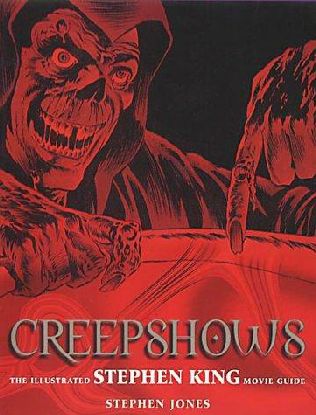
CREEPSHOWS: THE ILLUSTRATED STEPHEN KING MOVIE GUIDE

CREEPSHOWS: The Illustrated Stephen King Movie Guide. Stephen Jones. Billboard Books; 2002.
This volume offers an excellent look into the many film, television and cable adaptations of the many works of the prolific Stephen King, from Carrie -- which put the author on the map -- to Rose Red, with a look at [at the time of publication] upcoming projects. The book proceeds chronologically from one film to the next with essays on each film relating its literary origins, how it came to be made, and how successful it was [or not]. Jones on occasion reveals works by other writers that may have heavily influenced some of King's stories. The book concludes with Jones' interesting interview with King. Jones now and then offers up a negative comment on a particularly meretricious work, but by and large this is more of an entertaining overview with behind-the-scenes details than a critical study. The section that offers mini-biographies of actors who have appeared in King adaptations is unnecessary, but on the plus side, Creepshows is loaded with lots of photographs.
Verdict: A must for the King fanatic, and fun for the rest of us as well. ***.
Thursday, March 11, 2010
STAR TREK NEMESIS

STAR TREK NEMESIS (2002). Director: Stuart Baird.
This was another big-screen movie using the characters not from the original Star Trek, but from Star Trek: The Next Generation. Captain Jean-Luc Picard (Patrick Stewart) has his hands full when he encounters a megalomaniac, Shinzon (Tom Hardy), who is a clone of Picard and wants revenge on the Federation and everyone else for his horrible childhood. [Hardy, a fine actor, practically walks off with the picture, although his full lips -- as opposed to Stewart's thin ones -- would make him an unlikely clone, shaved head or no.] Shinzon is a member of the Remans race, who are treated like slaves and inferiors. There are some zesty battle scenes in this [the characters show no shock or remorse after extras are "killed" in front of their eyes], and an intriguing opener when the members of a council are killed by a gas that putrefies them, but all in all it's nothing especially memorable. It is fun to see Kate Mulgrew as Captain Janeway from Star Trek: Voyager, now promoted to Admiral Janeway, in a cameo. Apparently this did so poorly at the box office that it pretty much killed off the theatrical franchise.
Verdict: Holds the attention. **1/2.
Thursday, May 28, 2009
CRUSH

Andie MacDowell is a headmistress in a small town who is friends with two women (Imelda Staunton and Anna Chancellor) who are appalled when she takes up with a young hunk who plays the organ at her church. [This leads to many jokes about his “organs” and a lot of out-in-public sex scenes.] The two go to almost pathological attempts to break them up and then tragedy strikes. We're supposed to believe that a headmistress, sober, will have sex in a park with this guy with hardly any prelude, but this movie is hardly about romance. Even when MacDowell comes to the conclusion that she loves the guy, she flashes back not to a tender moment between the two but to one of their sexual encounters, making it clear exactly what it is that exists between the two. The movie feigns sophistication, but it remains on a sitcom level, never penetrating below the surface in its situations and characterizations, despite an occasional nice touch [MacDowell collapsing on the grass as a crowd gathers]. A potentially strong story is completely undermined by the limitations of John McKay as a writer. The movie tries to be hip by involving one of the women in an affair with another woman, but then shows its true colors when said woman insists that she's basically straight and – heavens, no! -- not a lesbian. A really hip movie would have made her gay – throughout the picture she seems obsessed with MacDowell, for instance -- and been done with it. In true sitcom style the film resolves conflicts in a pat style: the humiliated, jilted suitor of MacDowell's just happens to marry another woman we've never even seen before to give his part of the story a fake happy ending. There are good moments and some nice acting, but this is mostly a bad, unmemorable parody of the “women's pictures” of the forties.
Verdict: Watch I Love Lucy instead. **.
Thursday, May 21, 2009
TADPOLE

An intelligent fifteen-year-old who fancies himself more sophisticated than he really is develops an infatuation on his middle-aged stepmother (Sigourney Weaver, pictured) and has little interest in girls his own age. At one point he has sex with his stepmother's forty-ish friend, played by Bebe Neuwirth. When the parents, including father John Ritter, find out about this, they hardly react the way they would in real life, although at least Weaver seems a little bit appalled. She, too, winds up kissing her stepson, although this – fortunately – does not lead to another bedroom scene. In the way of the immature, the boy gets over his crush pretty fast, and the movie is left without a climax or any real resolution. The only point of Tadpole seems to be to present pedophilia – and make no mistake, that's what this is – as an acceptable option to women who can't find sensitive boyfriends their own age. Neuwirth's choice to molest the boy seems determined by the fact that her current beau is not attractive to her [then why is she bothering with the man at all?]. The scene where she rationalizes her actions to Weaver takes place in Central Park near the statues of Alice in Wonderland characters – a rather heavy-handed reference if ever there were one. One can only imagine the outcry this film would have gotten had the youngster been a girl instead of a boy, and if the molester were male. [Or if both adult and child were males!] Despite some good acting [by adult performers who should have known better] and an excellent performance by Aaron Stanford as the boy, this is pseudo-sophisticated pedophilic junk and not memorable at all.
Verdict: Forget it. 1/2*.
Friday, January 30, 2009
LORD OF THE RINGS; FELLOWSHIP OF THE RING

Wednesday, November 26, 2008
ROAD TO PERDITION

The graphic novel this film was based on was probably more effective, because Road to Perdition, despite some good elements, isn't a particularly memorable picture. Enforcer Michael Sullivan (a badly miscast Tom Hanks, pictured), goes on the run with his surviving son and namesake after his wife and other son are murdered. This all came about because young Michael witnessed a killing by Connor Rooney (a superb Daniel Craig), the son of Sullivan's mob mentor and father figure, John Rooney (a quietly effective if minor-league Paul Newman). Naturally this leads to an emotional division of loyalties, and eventually a hit man played by Jude Law is called in to hopefully dispense with the surviving Sullivans. While most mob movies are rather operatic, this tries a more understated approach -- which doesn't work. The film generally lacks suspense and tension, although it has a nice wind-up. The total absence of police figures is improbable, and the movie can best be described as a sort of lifeless exercise with only one exciting sequence.
Verdict: One road you needn't follow. **.
Wednesday, August 13, 2008
BELOW