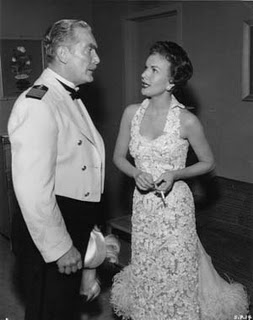
Lively, entertaining reviews of, and essays on, old and newer films and everything relating to them, written by professional author William Schoell.
Showing posts with label Roy Roberts. Show all posts

Thursday, February 18, 2016

THE BOSS

THE BOSS (1956). Director: Byron Haskin.

Matt Brady (John Payne) comes back from WW1, and has a love-hate relationship with his older brother, Tim (Roy Roberts of Oh, Susannah!). Driving away his girlfriend, Elsie (Doe Avedon) with his drunken behavior, Matt impulsively marries a sad barfly named Lorry (Gloria McGhee), while his best friend, Bob (William Bishop of Harriet Craig), marries Elsie. After Tim's death, Matt rises as a crooked political boss with the aid of Bob, who's become a lawyer. A reformer named Millard (Rhys Williams) represents a problem to Brady, even as his ill-advised marriage to Lorry proceeds on its dismal course. John Payne gives perhaps the best performance of his career as the bitter, unpleasant, unhappy if powerful Brady, and there are also fine performances from McGhee, Bishop, and Roberts, as well as from Robin Morse as gangster Johnny Mazia, and William Phipps [Five] as the killer, Stitch. Percy Helton and Joe Flynn have smaller roles. One of the best scenes is a massacre of hoods in Union Station. Albert Glassers' score is also effective. Neither Gloria McGhee (also spelled McGehee) or Doe Avedon amassed too many credits.

Verdict: Payne makes his mark in an absorbing crime drama. ***.

Thursday, January 30, 2014

THE SECOND FACE

Phyllis (Ella Raines) before her makeover.
THE SECOND FACE (1950). Director: Jack Bernhard.

Phyllis (Ella Raines) is a plain but lovely woman who works for a bitter man, Paul (Bruce Bennett), whose pretty wife ran out on him. He sends Phyllis to Los Angeles to stay with a friend, Claire (Rita Johnson of Sleep, My Love), who tries to get her a job with a fashion house as a designer, but since she's required to do some selling on the floor first, she isn't hired due to her appearance. She goes to work for Claire's fiance, Allan (Roy Roberts of The Gale Storm Show), who is fooling around with a client's pretty daughter, and is "romanced" by the slimy Jerry (John Sutton of The Invisible Man Returns), who only wants to use her designs for himself. Phyllis is racing to prevent a possible murder when her car smashes into a truck -- now there's a chance that surgery can make her as attractive as she's always dreamed ... Most of the male characters in The Second Face are pretty loathsome. One guy breaks off with his fiancee by sending a telegram to another person, expecting her to relay the bad news to the rejected woman. An aging businessman (Pierre Watkin) is unspeakably blunt and cruel to Phyllis just to make a point about advertising. Meanwhile no one makes the point that Phyllis' sweet demeanor and feminine, charming aura would certainly make her appealing to some men, and none of her lady friends suggest make up or a new hairdo. In any case, Raines' performance is excellent, and the supporting players are adept enough. Eugene Vale's screenplay is often psychologically astute. Raines also made a good impression in The Strange Affair of Uncle Harry but was less effective in Impact. Kathleen Freeman has a nice bit at the end as a homely-but-happy married lady whose husband likes her just the way she is.

Verdict: An appealing Raines helps put this over. ***.

Thursday, September 6, 2012

HE WALKED BY NIGHT

Richard Basehart
HE WALKED BY NIGHT (1948). Director: Alfred L. Werker.

A cop is murdered in L.A. and the hunt is on. There's no mystery as to the identity of the killer; it's a man variously known as Roy Martin or Roy Morgan, played well by Richard Basehart [Voyage to the Bottom of the Sea]. This police procedural follows Sgt. Brennan (Scott Brady) and his stern captain Breen (Roy Roberts of The Gale Storm Show) as they follow the trail to an electronics dealer named Paul Reeves (Whit Bissell, who also gives an excellent performance as a man innocently caught up in this murderous drama). Jack Webb, later of Dragnet fame, has a small role as a police technician who gives the cops some clues. The climax tales place in the same storm drains that figure in the finale of the giant ant thriller, Them, made six years later. This is well done and generally well-acted, with crisp cinematography, but the cinema verite approach strips the film of needed drama and intensity, and the characters are all one-dimensional. It holds the attention, but reminds one of a TV episode. Still, the film has its admirers.

Verdict: This could have used some giant ants. **1/2.

Thursday, October 27, 2011

THE GALE STORM SHOW / OH SUSANNA!

Roy Roberts and Gale Storm
THE GALE STORM SHOW [OH SUSANNA!] 1956 - 1960.

After My Little Margie wrapped up its run, star Gale Storm wasn't especially interested in doing another series, but she was talked into this one, probably because of its simplicity and unlimited potential for story ideas. In this Storm plays Susanna Pomeroy, the social director on a cruise ship. Susanna was basically Margie grown up. Storm had just started a recording career around this time, so she sang at least one number in most of the episodes. Her roommate and best friend was Elvira "Nugie" Nugent (Zazu Pitts), who ran the beauty parlor on board, but the main "relationship" in the show was the love/hate one she had with her boss, Captain Huxley (Roy Roberts). Adversaries from the first, they eventually developed a grudging fondness for each other. British actor James Fairfax was another regular for about half the episodes as the stewart, Cedric. Storm could overact, trying too hard for a laugh -- she was certainly no Lucille Ball or Joan Davis -- but she was still a funny, gifted performer and she had a nice singing voice. In her memoirs, Storm admitted that more people remembered her in Margie than in this show, and maybe the former was "funnier," but The Gale Storm Show had its moments and was in general a very pleasant series. [Apparently the exact title was "The Gale Storm Show: Oh Susanna" and only "Oh Susanna" was used in syndication, but who knows?] Roberts made a perfect foil for Storm, and Pitts was her usual adept and dithery self.

Even when the show wasn't a laugh riot, the stories often held the attention in spite of it. Still, most of the episodes I've seen [about 80 out of 125] never rise above a B+ level. The very few "A" episodes include: "For Money or Love," in which Susanna gets a rich guy on the rebound; "It's Murder, My Dear," which guest-stars a wonderful Boris Karloff [during his tenure on The Veil anthology series] in a dual role; "The Parisian Touch," with some funny tomfoolery over an allegedly valuable painting [with Elvia Allman and Vincent Padula]; and "Singapore Fling," in which a talking mynah bird who says bad things about the captain nearly gets Susanna into hot water; Keye Luke guest-stars. Other memorable episodes include "The Chimpanzee," which features a talented and adorable chimp; "Model Apartment" [Susanna sub-lets, to her regret]; "Love and Kisses" [love between a passenger and a stoker]; "It's Only Money" [Nugie thinks she's inherited a fortune]; "Super Snoop" [Susanna mistakes Nugie for a snitch]; "Heaven Sent" [the gals try to market a supposedly new perfume, with Jacques Bergerac]; "The Magician" [who is also a kleptomaniac]; "Sweepstakes Ticket," in which Dick Miller swipes a winning ticket from a deckhand; and "Card Sharp," which guest-stars William Frawley and could have been sub-titled "Margie Meets Fred Mertz." Other guest-stars on the show included Gene Nelson, Percy Helton, William Bishop, Irving Bacon, Margaret Hamilton, Jay Novello, Ken Clark [a Texas millionaire], Anthony Dexter [gypsy king], Steve Dunne, King Donovan, Edd Byrnes, Jim Backus, Joi Lansing, Pat Boone, and Jerome Cowan.

Although Susanna, Cedric and other crew members often reacted to the captain as if he were an ogre, he never seemed so worthy of their contempt, and frankly, his ire at "Miss Pomeroy" often seemed warranted, as she was a screw-up. While Susanna's schemes were generally for positive reasons, in one episode she seems almost manically determined to expose a phony medium even though most sensible people will agree that anyone who sees a medium as anything other than entertainment deserves to be taken. In the show's final episode, "Show Biz,"  Jack Albertson plays a washed up vaudevillian. Unfortunately, nothing he does when he gets to perform displays the talent the character was supposed to possess [although Albertson himself is a fine actor].

The show lasted for four seasons.

Verdict: A good cast puts this over. ***.