Lively, entertaining reviews of, and essays on, old and newer films and everything relating to them, written by professional author William Schoell.
Showing posts with label June Haver. Show all posts

Thursday, March 30, 2023

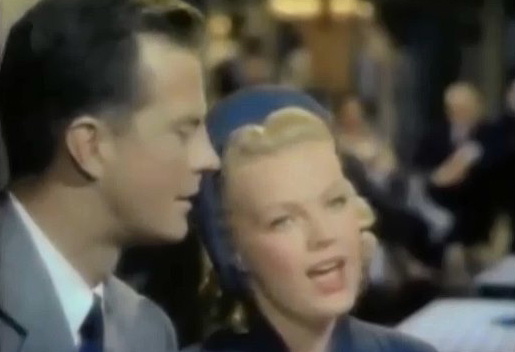
THREE LITTLE GIRLS IN BLUE

Blaine, Vera-Ellen and Haver
THREE LITTLE GIRLS IN BLUE (1946). Director: H. Bruce Humberstone.

Three farm sisters in 1902 -- Pam (June Haver), Liz (Vivian Blaine) and Myra (Vera-Ellen) -- learn that they haven't inherited as much from their late aunt as they were expecting. So they go to Atlantic City and book a suite while Pam pretends to be an heiress. with Liz playing her secretary and Myra playing her maid. The plan is to attract a wealthy husband whom she will also, naturally, fall in love with. Pam quickly gets two suitors: Van (George Montgomery of The Brasher Doubloon) and Steve (Frank Latimore of In the Meantime, Darling). Meanwhile Myra finds herself very attracted to hotel employee Mike (Charles Smith of Henry and Dizzy) and vice versa. Of her two gentlemen callers Pam prefers Van, but will the fellow propose before their money runs out? 

Frank Latimore and George Montgomery
If Three Little Girls in Blue sounds familiar it's because it was already filmed at least twice as Three Blind Mice and Moon Over Miami. The plot is creaky but it's been dressed up with enthusiastic players and technicolor. There are several song numbers, with the suspicion being that the forgettable ditties are new while the best songs -- "On the Boardwalk in Atlantic City" and especially "You Make Me Feel So Young" -- are classics. All of the performances are good, with Charles Smith particularly notable as the likable Mike. As usual Vera-Ellen impresses with her dancing skills. Celeste Holm, who made her film debut in this picture, shows up late in the movie as Steve's sister. At times she channels "Oklahoma's" Ado Annie (she was in the Broadway show) and other times is the bitchily genteel Southern belle.

Verdict: Amiable, pleasant and well-played poop. ***. 

HOME IN INDIANA

Lon McCallister and Jeanne Crain
HOME IN INDIANA (1944). Director: Henry Hathaway. 

"If you'd been a boy we'd have been the greatest pals!" 

Orphaned "Sparke" Thornton (Lon McCallister), who got into some unspecified trouble in the big city, comes to live on his aunt and uncle's farm in Indiana. His first impulse is to run out the back door but then he discovers there's a stables and track -- and two pretty girls -- next door. His Uncle "Thunder" Bolt (Walter Brennan) himself has only one old and blind filly left, but Sparke contrives to secretly mate this animal with the neighbor's prize stallion, resulting in a possibly champion racing horse. It isn't long before Sparke, with the help of Thunder, "Char" (Jeanne Crain) and the more glamorous "Cri-Cri" (June Haver) -- not to mention stable boy Mo' (Willie Best) and employee Tuppy (George Reed) -- is off to the races! 

Charlotte Greenwood with McCallister
The performances -- by those named as well as a wonderful Charlotte  Greenwood as Aunt Penny -- greatly help put over this somewhat entertaining but unriveting horse drama. It seems Lon McCallister was too often teamed up with horses (The Boy from Indiana) and mules (Scudda Hoo!, Scudda Hey!, which reteamed him with Haver and Brennan) as often as he was with the ladies. He's earnest and appealing in that "gosh oh golly" way of his. He, Haver and Crain, although all three had had bit parts in previous films, were "introduced" in this movie.  McCallister plays very well with both Crain and Haver, although his switching his affections from one to the other occurs rather abruptly and without any real explanation. The girls' fathers are played by Ward Bond and Charles Dingle. Remade as April Love with Pat Boone.

Verdict: Horse lovers will get more of a kick out of this. **1/2. 

Thursday, February 2, 2023

SCUDDA HOO! SCUDDA HAY!

Walter Brennan, June Haver, Lon McCallister
SCUDDA HOO! SCHUDDA HAY!  (1948). Written and directed by F. Hugh Herbert. 

"Snug" (Lon McCallister) lives with his father, Milt (Henry Hull), termagant stepmother (Anne Revere), and nasty stepbrother, "Stretch" (Robert Karnes) on a farm. Fed up with his horrible wife, Milt goes back to sea while Snug goes to work for the dyspeptic farmer McGill (Tom Tully). McGill has two daughters: the adorable little "Bean" (Natalie Wood), and the older, curvaceous "Rad" (June Haver). Snug makes a deal with McGill for two mules that the farmer doesn't want, and with the help of old Tony (Walter Brennan), turns the mules into a team that will bring in good money. But McGill and Stretch cook up a nasty scheme to get the mules back -- or will they? 

Is that June -- or Marilyn?
I had heard of this oddly-tilted movie -- the title is actually a kind of mule call -- for decades, but never had that much desire to see it until I discovered the "adorable one" -- Marilyn Monroe -- was in the cast. Alas, her part was cut down so drastically that I couldn't even spot her until I checked again and saw her say hello to June Haver while coming out of church. And that's it! The poster tries to make the flick look as sexy and exciting as possible, and wouldn't you know that June Haver actually looks a lot like Marilyn Monroe in the ad! As for the film itself, it does have some good moments (the two step brothers have a rip-roaring fight; Rad tells off her father) and even a bit of suspense at the end as our hero sort of "bets the farm" on whether or not his mules can pull a tractor out of the mud, but other than that it gets a little tedious. As ever June Haver is bland, pretty, and professional, while Lon McCallister is a combination of charm and petulance. At times Snug hardly seems much nicer than Stretch. Brennan and the rest of the supporting cast are all terrific, and Natalie Wood nearly steals the movie in her very cute turn as the precocious and intelligent Bean. Geraldine Wall subdues her usual feistiness as McGill's wife but is good. Lee MacGregor has a nice scene when he comes to tell Rad that Snug's father died at sea. 

Lon McCallister was an appealing actor who was often cast in these kind of roles. He was the boyfriend of actor William Eythe, who co-starred with Tallulah Bankhead in A Royal Scandal. In this film you will learn that mules are a combination of horses and donkeys but are actually more intelligent than either -- yes, it's true!

Verdict: Way too much about mules! **1/4. 

Thursday, August 18, 2022

WAKE UP AND DREAM

Jun Haver and John Payne
WAKE UP AND DREAM (1946). Director: Lloyd Bacon. 

Jeff Cairn (John Payne) lives with his little sister, Nella (Connie Marshall), on a farm during WW2. Although he could get a deferment, he enlists in the Navy and says good-bye to his sort of sweetheart, waitress Jenny (June Haver). Then a notice comes saying that Jeff is Missing in Action. Nella and Jenny, in convoluted fashion that never quite makes sense, wind up on a drydocked boat built by the old curmudgeon, Henry Pecket (Clem Bevans). With the aid of Howard Williams (John Ireland), Peckett is able to set sail (sans permit or any special plan) and Jenny, Nella and Howard go with him. Nella is hoping they will sail to some beautiful island where she will be reunited with her brother, but instead they wind up literally stuck in the mud. 

Haver with John Ireland 
Say one thing for Wake Up and Dream, one of the oddest musicals I've ever seen, it is unpredictable. Oh it's no great surprise that Jeff turns up alive after missing most of the movie (a pretty much wasted role for Payne),  but other events are not so certain. Payne introduces the song "Give Me the Simple Life" early in the picture, and Haver warbles the pretty "I Wish I Could Tell You" but then in a much later sequence a chorus starts singing "We're Off to See the Wizard" [!] as the group trek into the swamp after a hermit that Nella has discovered. One could argue that the movie offers a message of hope, but when you consider that most men listed as missing in action were actually dead, it's perhaps not in the best of taste. In any case, all of the performances are quite good, including Charlotte Greenwood as a widow who takes in boarders and Irving Bacon as a toll gate attendant. Lee Patrick is in the picture but I must have blinked and completely missed her. Based on a novel by Robert Nathan, this has all the earmarks of a screenplay that was cut and pasted together. Some good dialogue, however. 

Verdict: 20th Century-Fox was no MGM when it came to (semi) musicals. **1/2. 

Thursday, May 12, 2022

OH, YOU BEAUTIFUL DOLL

Mark Stevens and June Haver
OH, YOU BEAUTIFUL DOLL (1949). Director: John M. Stahl. 

Around the turn of the (last) century, song promoter Larry Kelly (Mark Stevens of Time Table) runs into classical composer Alfred Breitenbach ("Cuddles" Sakall) and uses the latter's arias from his unproduced opera to turn them into tin pan alley hits. This he does with the cooperation and encouragement of Breitenbach's daughter, Doris (June Haver), who has a big crush on Larry. While Alfred enjoys the money he makes as "Fred Fisher" -- the name he takes as composer of popular hits -- he is afraid he is bowdlerizing his art and will never be taken seriously as an operatic composer. So he just takes off to rework the opera while Larry, Doris, and his wife, Anna (Charlotte Greenwood) frantically search for him. But famous conductor Gottfried Steiner (Eduard Franz of The Four Skulls of Jonathan Drake) has an idea to get the man back ... 

Charlotte Greenwood and Cuddles Sakall
Mark Stevens had already teamed with June Haver two years earlier in I Wonder Who's Kissing Her Now in which he played composer Joe Howard, although in this his character is fictional. There really was a Fred Fisher, born Alfred Breitenbach, and he did have a daughter named Doris, but just about everything else is made up, including his being a classical composer. Cuddles Sakall gives his customary good and lively performance in this, and Mark Stevens gives a fine account of himself as well. Playing another good and proper gal as she generally did, the only thing June Haver lacks is a little frosting. Gale Robbins [Double Jeopardy] is a little spicier as actress Marie Carle, but she isn't given much to do. Charlotte Greenwood is swell as Cuddle's wife, but she not only doesn't deliver any of her famous high kicks, she doesn't sing and dance at all. 

The big finale
A strange thing about the picture is that both Haver and Stevens were singers, but both of them are dubbed in this movie. Bill Shirley, who has a splendid voice, did the singing for Stevens; he appeared as himself in a few movies as well. As for the songs, aside from the title tune (not composed by Fisher), and Fisher's best-known compositions "Peg O' My Heart" and "Chicago," and maybe one or two others, they are forgettable. The finale has Gottfried Steiner conducting a concert version of Fisher's hits, when it probably would have been more appropriate to play the original operatic versions (which never actually existed). In beautiful technicolor. 

Verdict: Pleasant, with a more interesting plot than usual, even if it's completely fabricated. ***.  

Thursday, May 14, 2020

I'LL GET BY

William Lundigan and June Haver
I'LL GET BY (1950), Director: Richard Sale.

Aspiring songwriter William Spencer (William Lundigan of Pinky) meets another composer named Freddy Lee (Dennis Day) and the completely fictional team of Spencer and Lee is born. The two men have romances with the singing team, the Martin Sisters: Liza (June Haver of The Dolly Sisters) and Terry (Gloria DeHaven of So This is Paris). Thelma Ritter cracks wise now and then as their secretary; Steve Allen appears as a radio DJ; and Harry James occasionally blows on his trumpet.

Gloria DeHaven and Dennis Day
I'll Get By apparently ran out of real-life songwriting teams when it came up with this concoction, but the soundtrack contains such memorable standards as the title tune, "You Make Me Feel So Young," and "Deep in the Heart of Texas," as well as a host of other songs written by a variety of composers and lyricists including Vernon Duke and Jules Styne. The story, alas, is not up to the music. It begins in 1939 and goes up to the end of WW2, which is almost literally tossed off with a gag. Dennis Day has a nice voice and likable manner, the two leading ladies are pleasing, Lundigan is smoothly handsome and professional, and Ritter probably makes the best impression with her deadpan delivery. Danny Davenport plays the initially naive songwriter Chester Dooley. When he asks Lundigan how much he will have to pay to have his song published, Ritter says "Who let you off the farm?" There are cameos by Jeanne Crain, Victor Mature, Dan Daily (doing a soft shoe routine) and Reginald Gardiner.  The film is fun at first, but the silly misunderstandings that keep the two couples apart eventually become irritating.

Verdict: Some good songs and talented performers can't quite save a tired screenplay. **1/4. 

Thursday, July 6, 2017

THE DOLLY SISTERS

June Haver, Betty Grable and John Payne
THE DOLLY SISTERS (1945). Director: Irving Cummings.

Latsie Dolly (S. Z. Sakall) brings his two nieces from Hungary to America where Jenny (Betty Grable) and Rosie (June Haver) become a popular singing and dancing sister act. Jenny falls for entertainer Harry Fox (John Payne) but their romance hits a couple of snags. Lest you think that the Dolly Sisters were a mere invention of 20th Century-Fox, these gals actually existed, and a true story of their lives would have shocked the hell out of staid 1940's movie house patrons. In this sanitized version of their backstage history, the focus is on the love affair and marriage of Jenny and Harry -- Harry Fox was also a real person -- but the latter was only one of Jenny's husbands -- and lovers. This movie completely ignores the fact that the two gals became more famous for gambling and bed-hopping with wealthy men than they did for their singing and dancing! A car crash which necessitated plastic surgery for Dolly is presented in the movie, and would seem like a lame attempt to add "drama" were it not for the fact that it actually happened. Reginald Gardiner [Black Widow] plays a duke who dallies with Jenny after she and Harry part ways, and Frank Latimore [Shock] is a real-life store owner, Irving Netcher, who marries Rosie. Trudy Marshall [Mark of the Gorilla] has a nice bit as Lenora, a woman who has the misfortune of falling for Harry even though he's still in love with Jenny. While the screenplay is mediocre, The Dolly Sisters is bolstered by sumptuous Technicolor, high-class cinematography from Ernest Palmer, professional performances (from Sig Ruman and others), and some pleasant songs (Gordon and Monaco), although the best numbers are standards such as "I'm Always Chasing Rainbows." Two ladies who make an impression are Collette Lyons as (fictional?) entertainer Flo Daly and an uncredited chorus cutie who plays "Rosie Rouge" in a production number devoted to make up. (This song, in particular, has a weird off-kilter melody, if you can even call it that.) I have no idea what they were like in real life, but as embodied by Haver and Grable, the Dolly Sisters come off as a decorative but not terribly mesmerizing or especially talented vaudeville act.

Verdict: Smooth and entertaining and good to look at it nothing else. ***.

Thursday, March 26, 2009

IRISH EYES ARE SMILING


IRISH EYES ARE SMILING (1944). Director: Gregory Ratoff.

This purports to tell the life story of composer Ernest R. Ball (Dick Haymes) who wrote such popular songs as When Irish Eyes Are Smiling and Mother Macree. However it comes off as just the usual fictionalized schlock in most of these Hollywood musical biopics about subjects who are too dead to protest and whose life story is not well known enough for the audience to care. June Haver is the quick-with-her-fist gal that Ball falls in love with. Veda Ann Borg shows up briefly in a vivid bit as a bitchy performer who fires Haver. Monty Woolley, the real star of the film, gives an excellent performance, but he's completely wasted in this tripe. Haymes makes a pleasant and attractive leading man, and has a nice voice. Haver is as competent as ever; she's just not very distinctive. Famous baritone Leonard Warren sings one of the ballads and steals the show. Clarence Kolb and Anthony Quinn are along for the ride. Nice music. The Bonnie with a Bustle number is high camp. A completely contrived script.

Verdict: Can't beat that bustle! **.

Thursday, March 5, 2009

I WONDER WHO'S KISSING HER NOW


I WONDER WHO'S KISSING HER NOW (1947). Director: Lloyd Bacon.

Surely the life of performer and songwriter Joseph E. Howard was more interesting than this? Mark Stevens enacts the role capably and with charm, although he might seem a tad bland to some. June Haver plays his "kid sister," who was raised with him but is actually unrelated, and has an unrequited passion for him. Martha Stewart and Lenore Aubert are two women with whom he gets involved both professionally and romantically.

The movie is pleasant and easy to take, but there is no real drama in it, and no particular comedy, either, despite the presence of William Frawley (Fred Mertz). Gene Nelson is a featured dancer, but has few if any lines. Florence O'Brien makes an impression as the saucy, non-deferential maid, Marie, as does Lewis L. Russell as Milford. Reginald Gardiner is okay as a playwright. Sexy Martha Stewart didn't amass too many credits and Aubert's most famous role was as Sandra in Abbott and Costello Meet Frankenstein.

Besides the title tune, Howard's most famous composition is arguably the snappy "Good-bye, My Lady Love." This was one of the period tunes that Jerome Kern used in Show Boat which was not composed by Kern. A highlight of the film is the "Glowworm" number which, via rich orchestration, turns the simple melody into a veritable symphony.

Verdict: Minor-league musical. **1/2.