Lively, entertaining reviews of, and essays on, old and newer films and everything relating to them, written by professional author William Schoell.
Showing posts with label Martita Hunt. Show all posts

Thursday, April 27, 2023

IT STARTED IN PARADISE

Martita Hunt and Jane Hylton
IT STARTED IN PARADISE (1952). Director: Compton Bennett. 

In the years leading up to WW2, Martha Watkins (Jane Hylton of The Manster) is frustrated that her employer, fashion designer Mme. Alice (Martita Hunt), thinks her designs are far too modern. Martha takes advantage of the situation after she importunes Alice to go off for a rest cure, and makes major changes to the line and even the studio itself. With the backing of her boyfriend, Arthur (Ian Hunter), Martha rises in the world of fashion, but makes the mistake of falling for a supposedly French bounder named Edouard (Terence Morgan). Meanwhile a younger designer, Alison (Muriel Pavlow of Murder She Said) and her boyfriend, Michael (Brian Worth), may prove formidable competition to Martha. Will ruthless Martha come undone?

Paging RuPaul!
If this film had been made in the United States ten years later it might have starred Susan Hayward at her bitchiest and been a lot of fun, but this comparatively dull British flick never really catches fire. Jane Hylton is a more than competent actress but she lacks that intense and fiery presence that might have made her performance more compelling. The others in the cast are all good enough, and Kay Kendall sparkles a bit as a superficial creature who makes an arrangement with Martha to bring in customers in exchange for clothing. The movie has an absolutely hilarious climax in which Alison shows up Martha with her own showing, featuring designs based on Elizabethan clothing. While these outfits might work for a costume party -- or for some drag queens -- the ordinary 20th century female would hardly be caught dead in most of them! Compton Bennett directed much better pictures, such as Daybreak. Malcolm Arnold's score helps just a bit. 

Verdict: Dig those crazy gowns! **. 

Thursday, January 12, 2017

ANASTASIA

Helen Hayes, Yul Brynner, Ingrid Bergman
ANASTASIA (1956). Director: Anatole Litvak. Screenplay by Arthur Laurents.

In Europe in the 1920's rumors are circulating that Anastasia (Ingrid Bergman), the youngest daughter of the Tsar Nicholas, may have survived the purge that killed the rest of her family. General Bounine (Yul Brynner) finds a woman, fresh out of mental hospitals and contemplating suicide, whom he thinks resembles Anastasia, and guides her -- like Henry Higgins -- to act more like royalty. But as she is about to meet the Dowager Empress (Helen Hayes) and seal her fate, she wonders if she could really be who everyone says she is. Anastasia is a wonderful, absorbing film that is not true to historical facts but to their spirit, and works beautifully as a kind of fairy tale. Bergman deservedly won a Best Actress Oscar for this, and she is matched in excellence by a powerful Hayes, and a rather sexy and dynamic Brynner. There is also fine work from Martita Hunt [Becket] as the Empress' peppery lady-in-waiting [to whom the Empress says "to a woman of your age, sex should mean nothing but gender"]; Ivan Desny as her nephew, Paul; Akim Tamiroff [The Vulture] as Boris Chernov, one of the co-conspirators in this matter of the "phony" Anastasia; and Natalie Schafer [The Other Love] as one of the group of Russian exiles who embraces Anastasia as their own; among others. The ending is contrived but effective, and the movie still manages to maintain an air of ambiguity. In real life, the Empress completely rejected "Anastasia's" claim, and the woman lived her life as Ana Anderson, protesting all along that she was the real daughter of the Tsar. Decades later, DNA proved conclusively that Anderson was lying. Filmed in stunning DeLuxe color and with a nice score by Alfred Newman.

Verdict: A true classic with superb performances. ****.

Thursday, April 7, 2016

BECKET

Richard Burton and Peter O'Toole
BECKET (1964). Director: Peter Glenville.

In the 12th century the Saxon Thomas Becket (Richard Burton) becomes friend, companion -- and some feel, collaborator -- with King Henry II (Peter O'Toole) -- and the two go "drinking and wenching" together. First Henry makes Beckett the Royal Chancellor, and then hits upon the idea of making him Archbishop of Canterbury. This is done because of the friction between the king and the Catholic Church, but Henry gets a surprise when Becket takes his role seriously and becomes seriously pious. When an arrested priest escapes jail and is killed by a Nobleman, Becket wants the man excommunicated, which Henry sees as a blow against England. If Becket goes ahead with his plans, there will be terrible consequences ... Becket is a handsome, well-produced, and well-acted film with a fine score by Laurence Rosenthal, striking production design by John Bryan, and excellent wide-screen photography by Geoffrey Unsworth, but Becket must not be taken as literal history. Edward Anhalt's script was based on a poorly-researched play by Jean Anouilh which ignores the fact that Becket was not a Saxon, but a Norman as Henry was. While this may add more motive and conflict to the story, it simply isn't true. Then there's the blatant homoerotic element. The relationship between the two men first seems like a warm if cautious friendship, but turns strange (by 1964 standards) when Henry's wife and mother both object to the presence of Becket in the king's life. Henry's mother accuses her son of having an "unhealthy" and "unnatural" obsession with him; O'Toole plays certain scenes like a discarded lover; Henry clearly loves Becket much more than his wife and children; and at one point cries out in anguish in front of his men at how much he still loves Thomas Becket. If King Henry II had romantic or sexual longings for Becket, or if the two had a relationship early in life, there has never been any historical proof of it . In a sense the portrayal of Henry is the cliche of the tormented homosexual or bisexual man who acts as much out of "twisted" passion and rejection as anything else, like Rod Steiger's character in The Sergeant.

Richard Burton is excellent as Becket, while O'Toole is superb as the king. There is also fine work from John  Gielgud as the King of France; Donald Wolfit [Room at the Top] as Bishop Folliot, who'd hoped to be made Archbishop himself; David Weston as Brother John, a would-be assassin (of Becket) turned monk; and Sian Phillips as Gwendolyne, who loves Becket and comes to a sad fate. As the movie's representations of Henry's mother and wife, respectively, Martita Hunt [The Brides of Dracula] and Pamela Brown seem merely to be striking poses and busily "acting" compared to the others. Besides the distortion of history, there are other problems with the movie, such as the "cutesy" element of some scenes, with the king acting like a girl-crazy adolescent and the Pope almost turned into a figure out of a sitcom. There is absolutely no sense of the passage of time.

Verdict: Entertaining, dramatic "history" served up on a now dated psycho-sexual platter. ***.
Thursday, August 30, 2012

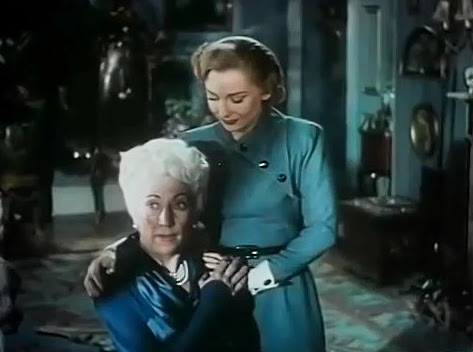
THE BRIDES OF DRACULA

THE BRIDES OF DRACULA (1960). Director: Terence Fisher.

A young French woman, Marianne (Yvonne Monlaur), on her way to a girls school to join the teaching staff, spends the night in the castle of a lonely old woman, Baroness Meinster (Martita Hunt), who tells her that her son, the baron (David Peel), lives by himself in another part of the castle. Marianne finds him and is shocked to see that he is in leg irons. Freeing him, she unleashes a wave of vampirism that engulfs the girl's school and brings in that legendary vampire hunter, Professor Van Helsing (Peter Cushing). This sequel to Horror of Dracula  has its moments but suffers from the fact that there is no actual Dracula -- or Christopher Lee, who played the count in the first film -- in the story. Nonetheless Peel makes an impression as this substitute bloodsucker, and Freda Jackson scores as the housekeeper, Greta, who looked to the baron's needs for years and goes literally mad when he finally escapes; Hunt is also good as his mother. Cushing, of course, is excellent. Nothing terribly provocative happens at the girls school, but director Fisher still handles it with his usual dramatic flair.

Verdict: Entertaining if minor Hammer horror flick. **1/2.